Recovery or Renewal? Time for an economic rethink
Published in Social Sciences



The International Monetary Fund (IMF) expects the global economy to contract by 5% this year alone, making it the largest downturn since the Great Depression in the 1930s. However, even before the current crisis the global economy was showing signs of slowing down. Rates of economic growth across the OECD have been in decline since the 1970s,.
In a recent study, published in Nature Scientific Reports, we’ve been exploring an even longer story about the ups and downs of economic growth and recession. Critical Slowing Down (CSD) theory is most commonly used to understand the oscillations (waves) in physical systems. In our study, we used the same techniques to analyse long-term trends in the gross domestic product (GDP) in datasets from as far back as the 1820s.
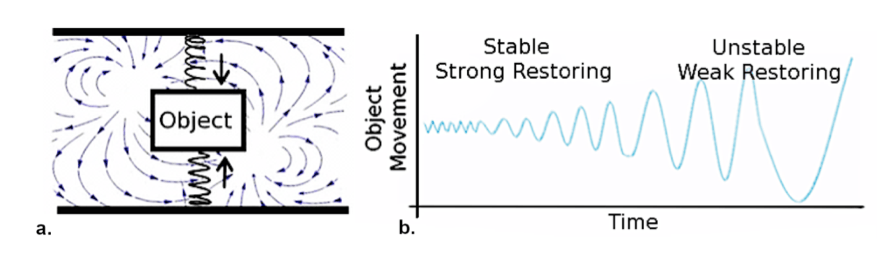
Figure 1: An illustration of the theory of critical slowing down over time
Our analysis suggests that the ‘restoring forces’ in economic cycles have changed over time. It shows that there are periods in history where the ‘restoring forces’ of the economy are strong and recessions are frequent but small (Figure 2). Similarly, there are periods where the ‘restoring forces’ are weak and recessions are large and with slow recoveries.
This is the backdrop against which the Covid-19 pandemic is playing out. The impact of a large deep shock to the economic system will be profound. The word ‘critical’ in CSD theory suggests that at a certain point the system will become unstable. When a constrained, dynamic system is close to breaking point, its ability to recover decreases. Fluctuations around the system equilibrium become deeper and more pronounced because its internal stabilisation forces have weakened.
There is no easy way back to equilibrium growth because the restoring forces in the economy were already weakened, for reasons that we don’t entirely understand. Shifts in economic structure, unstable financial markets, unsustainable debt: all these things have been suggested as possible reasons for the ‘secular stagnation’ of advanced economies. The one-off burst of high labour productivity growth experienced last century may only have been possible at all because of the unsustainable use of fossil fuels.
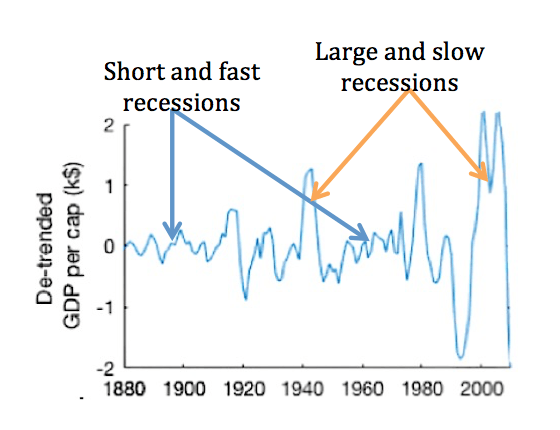
Figure 2: UK de-trended GDP data highlighting periods with short fast recessions and large slow recessions.
Placing the economy on hold to prevent unfathomable human tragedy from the Covid-19 pandemic was the right decision. However, our analysis suggests that a short sharp return to high economic growth is very unlikely. A post-growth world is now even more likely to be the ‘new normal’. At least for the advanced economies.
On the other hand, there is a curious corollary to this lesson from physics. A system with weak restoring forces is more easily guided into a new equilibrium. With appropriate policy, we have a unique opportunity to refashion and reshape the economic models that have been failing us for decades. The challenge is enormous. But so is the prize. Our analysis suggests that we are better placed than ever to make the transition to a resilient, sustainable economic system which protects the health of people and planet.
Follow the Topic
-
Scientific Reports
An open access journal publishing original research from across all areas of the natural sciences, psychology, medicine and engineering.

Related Collections
With Collections, you can get published faster and increase your visibility.
Cancer Prevention and Control
Publishing Model: Hybrid
Deadline: Feb 19, 2027
Healthy Aging
Publishing Model: Open Access
Deadline: Dec 31, 2026