Reform Singapore's Education System to Counter Fertility and Demographic Decline - A Policy Assessment White Paper
Published in Social Sciences, Education, and Law, Politics & International Studies
Please read the following news media articles:
Why Singapore's fertility crisis is partly an education crisis - and how to fix it
‘Confugenics’ and East Asia’s demographic crisis
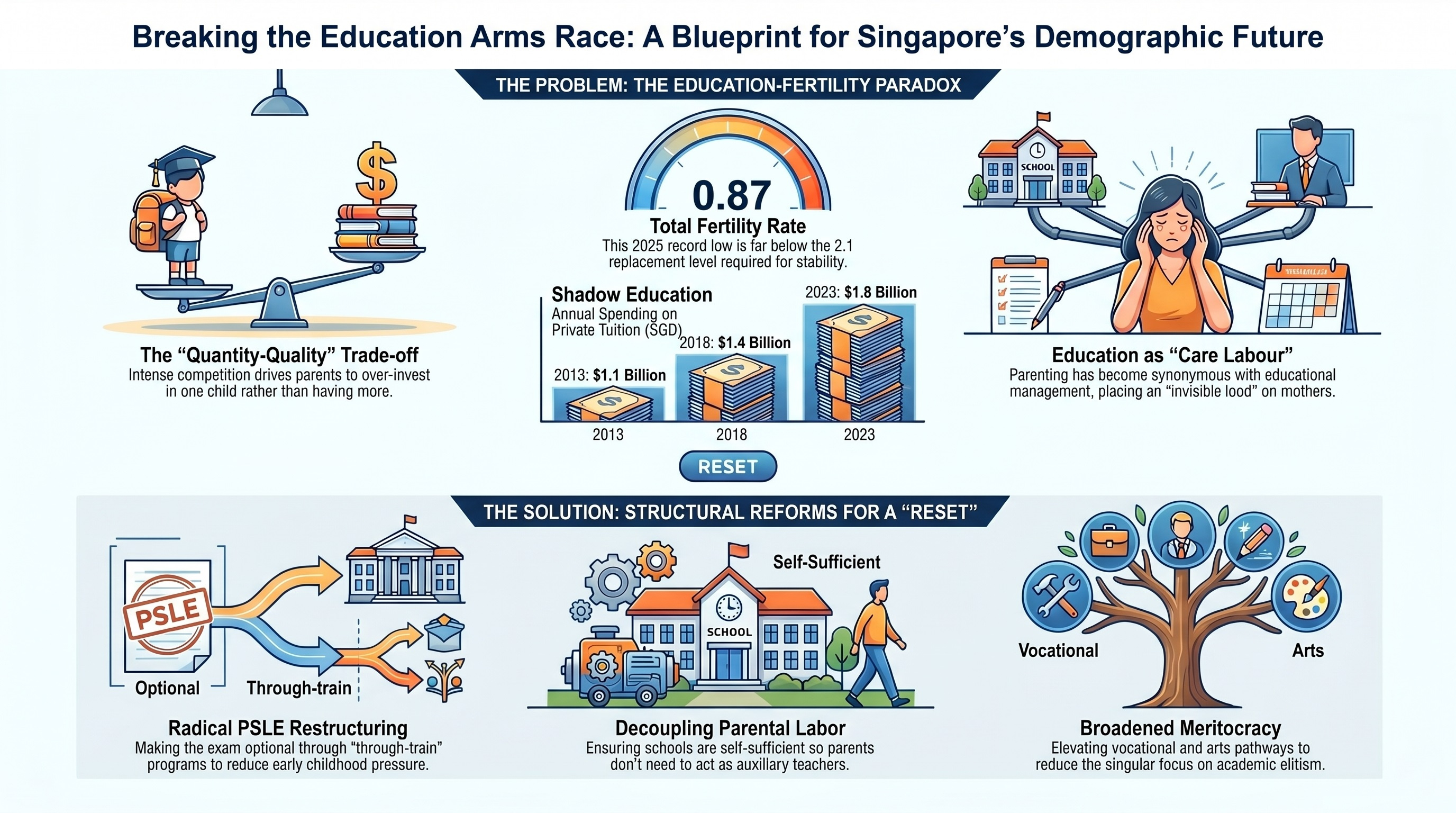
Summary: Singapore is currently facing an unprecedented demographic crisis, marked by a historic low Total Fertility Rate of 0.87 in 2025. In response to this existential challenge, the government established the inter-agency Marriage and Parenthood Reset Workgroup to formulate comprehensive strategies. A growing body of sociological and economic research indicates that Singapore's highly competitive education system is a primary deterrent to family formation. The intense "education arms race," characterised by early high-stakes sorting, immense parental care labour, and substantial financial investment in shadow education, creates a zero-sum environment where parenthood is perceived as an overwhelming sacrifice. This research paper critically examines the anticipated educational reforms likely to be proposed by the workgroup. Drawing on academic literature, government discourse, and advocacy group proposals, the paper explores structural interventions, including the radical overhaul or optionalisation of the Primary School Leaving Examination, the centralisation of primary school admissions, and the broader decoupling of educational success from intensive parental care labour. By shifting from a steeply hierarchical academic tournament to a more holistic, broad-based developmental model, these reforms aim to alleviate parental anxiety and reframe parenthood as a joyful, manageable endeavour, thereby contributing to a sustainable demographic future.
Keywords: Singapore fertility crisis, education reform, Primary School Leaving Examination, parental care labour, shadow education, demographic policy.
1. Introduction: The Demographic Imperative and the Educational Paradox
Singapore, a nation renowned globally for its rapid economic development, stellar infrastructure, and highly lauded education system, is confronting a severe and accelerating demographic crisis that threatens the very foundations of its success. In February 2026, Deputy Prime Minister Gan Kim Yong delivered a sobering announcement to Parliament during the Budget debate: Singapore's resident Total Fertility Rate (TFR) had plunged to a historic low of 0.87 in 2025, representing only 27,500 resident births [1]. This figure falls drastically below the replacement level of 2.1 and positions Singapore among the lowest fertility nations globally, alongside South Korea, Japan, and other East Asian economies that share similar cultural and structural paradigms [2]. The government has unequivocally classified this demographic trajectory as an "existential challenge" [1], warning that without significant and immediate intervention, the citizen population will begin to shrink by the early 2040s, with profound implications for economic vitality, national defence, and social cohesion. The sheer magnitude of this demographic shift cannot be overstated; it threatens to unravel the social compact and economic model that has propelled Singapore from a developing nation to a first-world metropolis in a single generation.
For decades, the Singaporean government has relied on a robust suite of pro-natalist policies to encourage family formation. These have included direct financial incentives such as the Baby Bonus and MediSave Grants, expanded mandatory paternity and maternity leave, priority schemes for public housing allocation, and heavily subsidised childcare and preschool services [3]. The rationale behind these policies was largely economic, operating on the assumption that alleviating the direct financial and logistical burdens of child-rearing would naturally lead to an increase in birth rates. However, the continued and precipitous decline in the TFR suggests that these policy levers, while necessary and appreciated by existing parents, are fundamentally insufficient to reverse the overarching trend. The formation of the inter-agency Marriage and Parenthood Reset Workgroup in 2026, chaired by Minister in the Prime Minister's Office Indranee Rajah, signals a critical shift in the government's approach and a tacit acknowledgement that the current paradigm is failing [4]. The workgroup's mandate is to develop a "whole-of-society" strategy that goes beyond mere material incentives to address the underlying mindset shifts, workplace realities, and societal norms that are actively deterring young couples from embracing parenthood [4]. This represents a crucial pivot from treating low fertility as a purely economic problem to recognising it as a deeply entrenched sociological and structural issue.
A significant and growing consensus among academics, sociologists, economists, and grassroots parent advocacy groups points to the nation's highly competitive education system as a primary source of parental anxiety and a major structural deterrent to having children [5, 6]. The "education arms race" in Singapore demands immense financial, temporal, and emotional investment from parents, effectively transforming child-rearing from a natural life stage into a high-stakes, resource-intensive project [7]. This research paper critically examines the intricate, causal link between Singapore's competitive education landscape and its declining birthrate. It anticipates and systematically analyses the educational reforms likely to be proposed by the Marriage and Parenthood Reset Workgroup, evaluating their potential to alleviate parental stress, reshape societal definitions of success, and ultimately contribute to a sustainable demographic future for the city-state. The paper argues that without a fundamental dismantling of the hyper-competitive educational structures that currently define Singaporean childhood, any broader attempts to boost the fertility rate will likely fall short.
Singapore's education system is widely considered one of the best in the world, consistently topping international rankings such as PISA and TIMSS. However, this excellence comes at a profound societal cost. The paradox of Singapore's success is that the very system designed to produce world-class human capital is simultaneously suppressing the production of human beings. The intense focus on academic achievement, driven by a meritocratic ideology that rewards cognitive ability above all else, has created an environment where parenting is synonymous with educational management.
The subsequent sections of this paper are structured as follows. Section 2 explores the nexus of education and fertility in the broader East Asian context, applying economic and sociological theories to understand the phenomenon of "education fever." Section 3 zeroes in on the Primary School Leaving Examination (PSLE) as the epicentre of educational anxiety in Singapore, examining its cascade effects and the limitations of recent reforms. Section 4 presents a detailed analysis of the anticipated educational reforms likely to be proposed by the Marriage and Parenthood Reset Workgroup, categorising them into structural overhauls, admission reforms, and the decoupling of education from parental care labour. Section 5 broadens the scope to address systemic challenges, including economic rewards, workplace norms, and cost of living, arguing for a holistic approach. Section 6 expands the discourse to address cultural narratives and mental health. Finally, Section 7 synthesises the findings and concludes with a call for a paradigm shift in how Singapore values success and supports parenthood.
2. The Nexus of Education and Fertility in East Asia: A Theoretical Framework
To fully comprehend the nuances of the Singaporean context, it is essential to situate it within the broader East Asian fertility puzzle. The phenomenon of ultra-low fertility is pervasive across East Asia, with countries like South Korea, Japan, Taiwan, and urban centres in China experiencing similar, if not identical, demographic declines [8]. A defining characteristic of these societies is the intense cultural and institutional emphasis on educational achievement, often termed "education fever," which acts as a powerful suppressive force on fertility [8]. This "fever" is not merely a cultural quirk but a deeply rational response to economic structures that heavily reward specific types of human capital and penalise those who fail to acquire them.
2.1 The Quantity-Quality Trade-off in Hyper-Competitive Societies
Economic theories of fertility, particularly the "quantity-quality trade-off" model first popularised by Nobel laureate Gary Becker, provide a foundational framework for understanding this dynamic. As societies develop and transition to knowledge-based economies, parents increasingly face a trade-off between the number of children they have (quantity) and the level of resources they invest in the human capital of each child (quality) [9]. In East Asian systems, which heavily reward extreme human capital investment and where academic credentials are the primary currency for social mobility, the perceived returns on investing in a child's education are exceptionally high [10].
Dr. Poh Lin Tan's extensive research for the International Monetary Fund highlights that Singapore's system exemplifies this trade-off in its most acute form [10]. The institutional structure, which sorts students early based on rigorous academic performance, dramatically increases the marginal benefit of intensive parental investment. Consequently, parents rationally choose to concentrate their finite financial and emotional resources on one or two children to ensure their competitive edge, making each child significantly more expensive to raise [10]. This economic and social system heavily rewards achievement while severely penalising a lack of ambition or academic success, leading to a logical, albeit societally detrimental, decision at the household level to limit family size [11].
The fear of downward social mobility for one's offspring drives this hyper-investment, creating a cycle that is difficult to break without structural intervention. In essence, the system demands that parents produce highly polished "products" for the labour market, a process so resource-intensive that mass production—that is, having many children—becomes impossible for the average family. The state's emphasis on human capital as its only natural resource has been internalised by citizens, who view their children as human capital projects requiring meticulous management and substantial capital injection. Furthermore, the quantity-quality trade-off is exacerbated by the highly stratified nature of the Singaporean education system. The difference in resources, peer networks, and future opportunities between top-tier schools and neighbourhood schools is perceived by parents to be vast. This perception, whether entirely accurate or somewhat magnified by anxiety, drives a winner-takes-all mentality where parents are not just investing to ensure their child is educated, but to ensure their child is educated in the "right" institutions—a goal that requires exponential increases in investment for marginal gains in competitive advantage.
2.2 Education as Intensive Parental Care Labour
Beyond the direct financial costs, the educational system exacts a heavy and often unacknowledged toll on parents' time and energy. Sociologist Teo You Yenn has extensively documented how children's education in Singapore has evolved to become a central, demanding component of parental "care labour" [12]. The system, implicitly and sometimes explicitly, relies heavily on parents to manage daily homework, coordinate complex schedules of private tuition and enrichment classes, and navigate the intricacies of the evolving curriculum [12]. This is not merely passive oversight; it requires active pedagogical engagement from parents, essentially turning them into auxiliary teachers.
This "invisible load" of educational management disproportionately affects women, reinforcing traditional gender roles even within dual-income households that ostensibly espouse egalitarian values [12]. Mothers frequently report adjusting their career trajectories, transitioning to part-time work, or taking extended unpaid leave—particularly during crucial examination years like the PSLE—to personally supervise and support their children's academic pursuits [13]. The phenomenon of the "PSLE mother," who sacrifices her career progression to manage her child's exam preparation, is a well-documented sociological reality in Singapore.
The perceived cost of having children, measured not just in dollars but in career sacrifice, loss of personal autonomy, and sheer physical and mental exhaustion, deters many young women from embracing parenthood [14]. When the prevailing societal script dictates that being a "good" or "responsible" parent requires managing a high-stakes educational tournament on behalf of the child, the prospect of having multiple children becomes overwhelmingly daunting [7]. The state's provision of childcare centres solves the problem of physical supervision for younger children, but it does nothing to alleviate the intense cognitive and emotional labour required to manage a child's educational trajectory in a hyper-competitive environment during the primary and secondary school years. The conceptualisation of education as care labour also highlights the emotional toll on parents. The constant monitoring of academic progress, the management of a child's stress and motivation, and the navigation of a complex educational bureaucracy create a state of chronic anxiety for many parents—an anxiety that is contagious, often transferring to the child and creating a fraught family dynamic centred around academic performance.
2.3 The Shadow Education System and Financial Strain
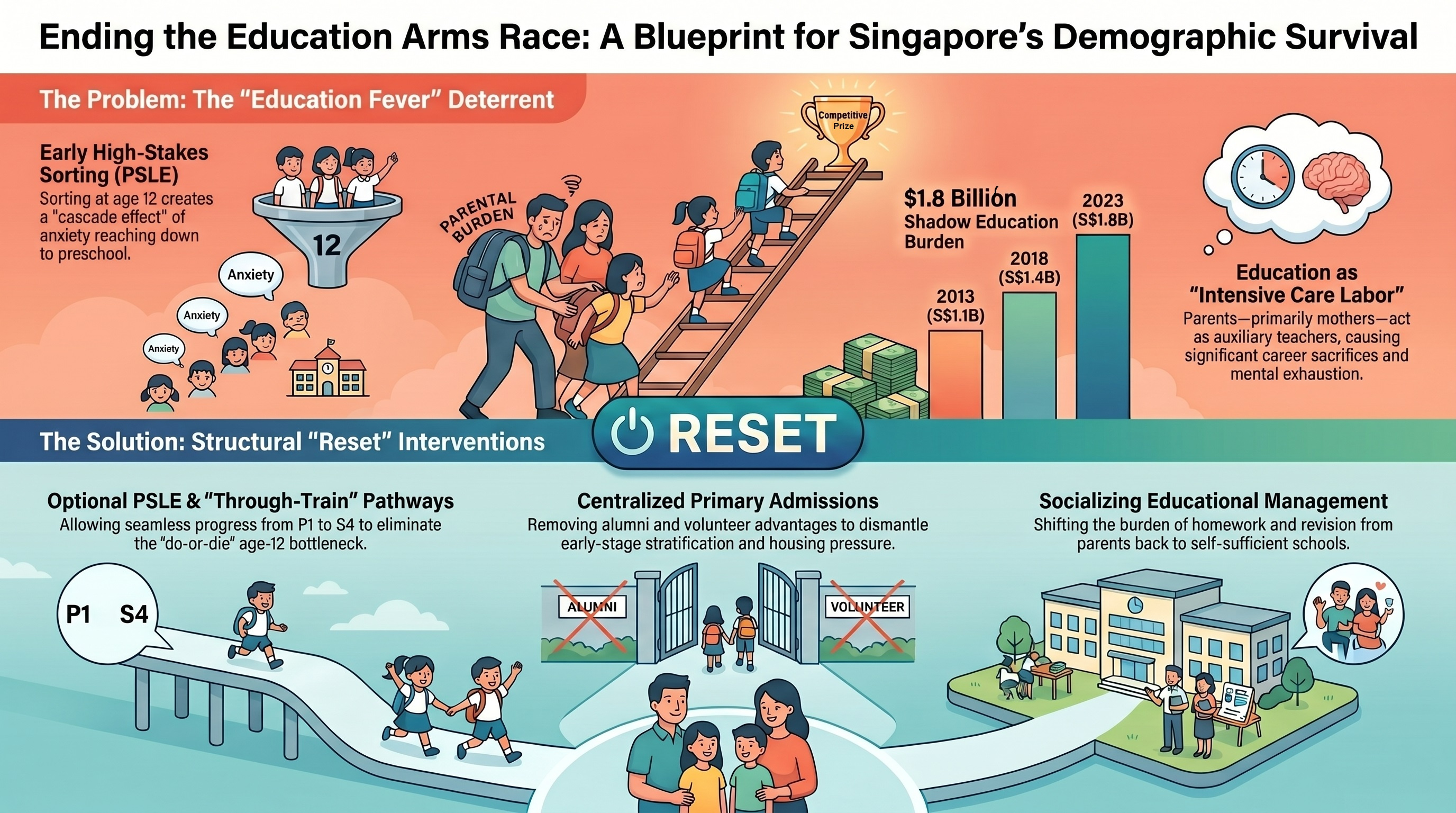
The intense competition within the formal school system has inevitably spawned a massive and lucrative "shadow education" industry. In 2023, Singaporean families spent an estimated S$1.8 billion on private tuition and enrichment, a significant and rapid increase from S$1.4 billion in 2018 and S$1.1 billion in 2013 [15]. This staggering expenditure underscores the pervasive, deeply ingrained belief that formal schooling, despite being globally top-ranked, is insufficient for securing success and that supplementary tutoring is an absolute necessity rather than a discretionary luxury.
The financial burden of the tuition industry directly competes with the costs of family expansion [7]. For a middle-class family, the cost of tuition for two children can easily exceed S$1,000 to S$2,000 a month, directly crowding out the possibility of affording a third—or even a first—child [7]. This shadow education system not only exacerbates inequalities between socioeconomic classes but also creates a baseline expectation of expenditure that all prospective parents must factor into their family planning decisions. The normalisation of tuition means that the "cost of a child" in Singapore includes not just food, clothing, and shelter, but a decade of expensive supplementary education. The shadow education system operates on a logic of relative advantage; parents enrol their children in tuition not because they are failing, but to ensure they stay ahead of peers—creating an arms race where the baseline level of necessary investment continually rises, further increasing the financial barriers to parenthood.
3. The Primary School Leaving Examination: The Epicentre of Anxiety
At the very core of Singapore's educational anxiety and the ensuing demographic suppression is the Primary School Leaving Examination (PSLE). Administered at the tender age of 12, the PSLE acts as a definitive, high-stakes national sorting mechanism, dictating a student's secondary school trajectory, their peer group, and, by extension, their perceived future prospects in the labour market [5]. The PSLE is not merely an assessment of learning; it is a profound societal event that commands the attention and resources of the entire nation.
3.1 The Cascade Effect of Early Sorting
Unlike most developed nations, such as Finland, where high-stakes sorting occurs in late adolescence (if at all) and education systems prioritise low-stress, holistic development and equity [16], Singapore subjects its children to intense academic pressure from a very young age. The high stakes associated with the PSLE create a severe cascade effect, pushing academic anxiety down to the early primary and even preschool years [5]. Parents, acutely aware of the narrowing funnel of opportunities, feel compelled to engage in what researchers term "concerted cultivation on steroids," meticulously planning educational pathways and enrolling toddlers in phonics, mathematics, and even coding enrichment classes to secure an early advantage [11].
This environment fosters "kiasuism"—a uniquely Singaporean colloquialism describing a pervasive fear of losing out—where parents view education as a zero-sum game [11]. Advocacy groups like EveryChild.SG argue persuasively that the PSLE essentially transforms childhood into a forced competitive arena, stripping away the intrinsic joy of learning and replacing it with rote memorisation, drill-and-practice routines, and exam strategy [6]. The pressure peaks during the upper primary years (Primary 5 and 6), often damaging parent-child relationships through constant nagging and conflict over academics, and contributing significantly to mental health burdens for young students [6]. The system inadvertently creates a situation where a child's worth is conflated with their academic performance, leading to immense psychological pressure on both the child and the parents who feel responsible for their success.
Furthermore, the early sorting mechanism of the PSLE assumes that a child's academic potential is largely fixed and accurately measurable at age 12. This contradicts modern developmental psychology, which emphasises that children develop at different rates and that early academic performance is not always a reliable indicator of long-term potential. By locking students into specific pathways early on, the system risks squandering late-blooming talent and reinforcing early disadvantages that are often correlated with socioeconomic background.
3.2 The Limitations of Recent Reforms and Persistent Pressures
The Ministry of Education (MOE) has, over the past decade, acknowledged these pressures and initiated several reforms aimed at softening the edges of the system. The recent transition from the finely differentiated T-score (which ranked students down to the decimal point) to the broader Achievement Level (AL) scoring system was explicitly intended to reduce the intense competition for single marks and blur the fine lines between students [7]. Under the AL system, students are graded into eight bands for each subject, theoretically reducing the need to fight for every single mark. Additionally, the removal of mid-year examinations across primary and secondary levels was intended to free up instructional time and mental space for holistic development and deeper learning [7].
However, critics, educators, and parents note that these reforms, while well-intentioned, have not fundamentally altered the underlying tournament mindset. The competition for entry into elite secondary schools, particularly those offering the Integrated Programme (IP) which bypasses the O-Level examinations and provides a direct route to university, remains incredibly fierce [7]. Parents now find themselves stressing over AL brackets instead of T-scores, fearing that dropping a single AL band could alter their child's trajectory [7]. Furthermore, in the absence of mid-year exams, some parents have simply turned to private tuition centres to provide "mock exams" to gauge progress, highlighting a crucial reality: structural tweaks without deeper systemic changes to the reward structure merely shift the anxiety rather than alleviate it [7]. The underlying architecture of the system—early sorting based on high-stakes academic performance—remains intact, and thus the associated anxieties persist. The MOE's efforts to reduce the emphasis on academic grades are often undermined by the realities of a highly competitive society where educational credentials remain the primary currency for success. The persistence of these pressures suggests that incremental reforms are insufficient to address the root causes of educational anxiety, pointing to the necessity of more radical and structural interventions.
4. Anticipated Educational Reforms by the Workgroup: A Structural Reset
Given the profound and documented impact of the education system on fertility decisions, the Marriage and Parenthood Reset Workgroup is widely expected to propose structural educational reforms as a core, non-negotiable component of its strategy to boost the birthrate. These anticipated reforms must aim to dismantle the "education arms race" at its roots and reframe parenthood as a manageable, fulfilling journey rather than an endless administrative and financial burden. The focus must shift from incremental tweaks to fundamental structural changes that alter the incentives and pressures facing parents.
4.1 Radical Overhaul or Optionalisation of the PSLE
The most significant anticipated intervention, and the one most fiercely advocated for by parent groups, is a radical restructuring of the PSLE. To genuinely reduce early-stage academic pressure and the associated parental care labour, the workgroup may seriously consider proposals to make the PSLE optional or significantly reduce its high-stakes sorting function [6].
One proposed and highly viable model is the widespread establishment of "through-train" programmes linking primary and secondary schools. This would allow a large majority of students—perhaps 80 to 90 per cent—to progress seamlessly from Primary 1 to Secondary 4 without facing a definitive national exam at age 12 [6]. Such a model, common in other high-performing systems globally, would enable children to learn at their own developmental pace and drastically reduce the "do-or-die" pressure that currently dominates family life during the primary school years [5]. By removing the hard stop at age 12, parents would no longer feel compelled to engage in the frantic arms race of tuition and enrichment during the primary years.
Instead of a single high-stakes exam, the system could pivot towards continuous, low-stakes, computerised adaptive assessments—such as the MAP testing used in international schools—to track progress, identify learning gaps, and guide subject-based banding without the intense anxiety associated with a single, public sorting event [5]. This approach maintains the systemic academic rigour Singapore is known for while mitigating the psychological toll on families. It shifts the focus from ranking students against each other to measuring individual growth over time, providing a more accurate and less stressful picture of a child's capabilities. Furthermore, reducing the stakes of the PSLE would have a profound impact on the shadow education industry: if the exam is no longer the sole determinant of a child's future, the perceived necessity of expensive private tuition would diminish, alleviating a major financial burden on parents and making family expansion more economically viable.
4.2 Reforming Primary School Admissions: Dismantling Early Stratification
The stress of the education system begins long before the PSLE, rooted deeply in the primary school admission framework. The current system, which often privileges alumni connections, sibling priority, geographic proximity (which drives up housing prices near elite schools), and parent volunteerism, exacerbates social stratification and fuels intense competition for spots in perceived "elite" or "brand-name" schools [5]. Parents engage in strategic planning years in advance, volunteering hundreds of hours or moving houses, contributing to the early onset of educational anxiety and reinforcing the notion that parenting is an arduous task [11].
To dismantle this early-stage arms race, the workgroup may recommend centralising and automating primary school admissions [5]. A computerised allocation system, designed to reflect the national demographic profile in each school while taking reasonable parent choices into account but removing the advantages of alumni status and volunteer hours, would create a more equitable playing field [5]. This reform would tangibly promote the MOE's stated ideal that "every school is a good school" and significantly reduce the initial, exhausting anxieties that deter couples from starting families [11]. By decoupling housing decisions from educational decisions, this reform would also alleviate another major source of stress for young families. The phenomenon of parents paying a premium for housing within a one-kilometre radius of a popular primary school not only drives up property prices but also creates a sense of financial strain and inequity. A centralised, equitable admission system would reduce this pressure, making housing more affordable and family planning more feasible.
4.3 Decoupling Education from Intensive Parental Care Labour
A critical area for reform, highlighted by sociological research, is reducing the system's implicit reliance on intensive parental care labour. The workgroup must address the "shadow curriculum" and the pervasive expectation that parents must heavily supplement formal education at home [12]. Reforms should aim to make schools entirely self-sufficient in delivering the curriculum. This involves ensuring that homework and revision can be managed independently by students or with school-provided after-school support, rather than requiring extensive parental supervision, marking, or the hiring of private tutors [5].
By lessening this invisible load, the perceived cost of having children—in terms of parental time, energy, and career sacrifice—can be significantly reduced [12]. This is particularly crucial for supporting women in the workforce and promoting equitable gender roles within the household, which are key determinants in modern fertility decisions [11]. If mothers feel they do not have to sacrifice their careers to become full-time educational managers for their children, the prospect of having more children becomes infinitely more viable. The state must step in to socialise the cost of educational management, much as it has socialised the cost of early childhood care. This could involve expanding after-school care programmes to include supervised homework sessions and academic support, thereby shifting the burden from parents to the school system. Specific policy mechanisms could include mandating strict limits on homework in the primary school years, expanding school-based after-school care into structured academic support environments, and recalibrating the communication channels between schools and parents to reduce the expectation of continuous parental surveillance and intervention.
4.4 Broadening the Definition of Success: Moving Beyond Academic Elitism
The MOE's ongoing implementation of Full Subject-Based Banding (FSBB) in secondary schools represents a positive, structural step towards dismantling rigid academic streaming and allowing students to learn subjects at a level suited to their individual strengths [17]. However, to truly impact fertility rates, this broadening of pathways must extend deeper into the societal psyche and the economic structure.
The workgroup is expected to advocate for a curriculum that genuinely prioritises 21st-century competencies—such as analytical thinking, creativity, adaptability, and collaboration—over rote memorisation and stack-ranking [5]. Furthermore, there must be a concerted, whole-of-government effort to elevate the prestige and remuneration of vocational, technical, and arts pathways, ensuring they are viewed as viable, respected, and financially rewarding alternatives to the traditional university academic route [5]. If the broader economy and societal norms reward a wider array of talents, parents will feel less compelled to force their children through a narrow academic bottleneck, thereby reducing the intense pressure to over-invest in a single child's traditional human capital [10]. This requires a fundamental shift in how the civil service and government-linked companies recruit and reward talent, setting an example for the broader private sector. The government must actively demonstrate that success is not solely defined by a degree from a top-tier university, but by a diverse range of skills and contributions to society.
5. Systemic Challenges and the Need for a Holistic Approach
While structural educational reforms are essential and long overdue, the workgroup's mandate rightly acknowledges that education is only one piece of the complex fertility puzzle. The "tournament competition mindset" is deeply ingrained in Singapore's social DNA and reflects broader economic realities that cannot be solved by the MOE alone [7]. A truly effective strategy must address the systemic challenges that reinforce the education arms race and deter family formation.
5.1 Aligning Economic Rewards and Redefining Meritocracy
As sociologist Dr. Vincent Chua observes, the education system is ultimately a reflection of the economic reward structure. If societal "prizes"—high-paying jobs in finance or government, social status, housing mobility—remain heavily skewed towards those who win the academic tournament and secure specific credentials, parents will continue to behave rationally as tournament participants [7]. Educational reforms must therefore be coupled with shifts in the labour market, where employers, led by the public service, increasingly value diverse skills, portfolios, and non-traditional credentials over mere academic grades. A true meritocracy must recognise multiple forms of merit, not just the ability to perform well in standardised testing. The government must lead by example in its hiring practices, moving away from a strict reliance on academic pedigree and embracing a more holistic assessment of candidates. This would send a powerful signal to the private sector and to parents that the pathways to success are indeed broadening. Furthermore, efforts to narrow the wage gap between graduates and non-graduates, and to improve the working conditions and social status of essential workers, are crucial steps in reducing the high stakes associated with academic achievement.
5.2 Evolving Workplace Norms and Supporting Working Parents
The workgroup must also aggressively address the intersection of work and family life. The demanding, often inflexible nature of Singapore's corporate culture implicitly penalises those who prioritise caregiving [18]. To support parents, workplaces must normalise flexible work arrangements, remote work options, and ensure that taking time off for family responsibilities does not derail career progression or invite stigma [18]. Furthermore, fostering a culture where fathers are not just permitted, but encouraged and expected to take on equal caregiving roles—such as through the newly announced Shared Parental Leave—is vital for reducing the disproportionate burden on mothers and making family expansion a joint enterprise [18]. The state may need to move beyond mere encouragement and implement stronger legislative frameworks to protect the rights of working parents and ensure that family-friendly policies are not just corporate window dressing. This includes addressing the long working hours culture and ensuring that employees have the right to disconnect, allowing them the time and energy to engage meaningfully in family life.
5.3 Addressing Housing and Cost of Living Pressures
Material constraints, such as housing affordability and the general cost of living, remain significant, tangible barriers to family formation. While recent initiatives like the Large Families Scheme and enhanced housing priority for families with multiple children provide crucial support [18], continuous efforts are required to ensure that young couples feel financially secure enough to embark on parenthood without fear of economic hardship. The perception of stability is as important as the reality. Ensuring that public housing remains affordable and accessible for young couples, and addressing the rising costs of essential goods and services, must remain central pillars of the government's demographic strategy. The workgroup must consider how housing policies intersect with educational policies—as discussed in the context of primary school admissions—and develop integrated solutions that alleviate the financial and logistical burdens on young families.
6. Expanding the Discourse: Cultural Narratives, Mental Health, and the Future of Singaporean Parenting
To truly understand the depth of the demographic challenge, one must delve into the psychological landscape of the modern Singaporean parent. The anxiety surrounding education is not merely a product of the system's design, but a reflection of a deeply internalised fear of failure. In a society that has so successfully marketed the narrative of meritocracy, the implicit corollary is that failure is a personal shortcoming, not a systemic flaw. This places an immense psychological burden on parents, who feel entirely responsible for their children's outcomes. The proposed reforms by the Marriage and Parenthood Reset Workgroup must therefore address not just the structural elements of the education system, but also the cultural narratives that sustain it.
6.1 The Role of Media and Societal Expectations
The media plays a significant role in shaping societal expectations of parenting. The glorification of "top scorers" and the intense media coverage of the PSLE results, although somewhat mitigated in recent years, continue to reinforce the importance of academic achievement. The workgroup should consider initiatives to promote alternative narratives of success, highlighting individuals who have achieved fulfilment and success through non-traditional pathways. By showcasing diverse role models, the media can help to broaden the definition of success and reduce the singular focus on academic credentials. Public campaigns that celebrate different forms of intelligence, creativity, and resilience can help to shift the cultural paradigm and alleviate parental anxiety. This cultural work is as important as any structural reform; without a shift in the stories Singaporeans tell themselves about success, structural changes risk being undermined by persistent social pressures.
6.2 The Impact on Mental Health and Well-being
The intense pressure of the education system has profound implications for the mental health of both students and parents. Studies have shown a correlation between high-stakes testing and increased levels of stress, anxiety, and depression among youth. For parents, the constant worry about their children's academic performance can lead to burnout and a sense of inadequacy. The workgroup must prioritise mental health support as an integral part of its educational reforms. This could include expanding access to counselling services in schools, providing resources for parents to manage stress, and promoting a culture of well-being that values mental health as much as academic achievement. A society that prioritises well-being over relentless competition is inherently more conducive to family formation. The investment in mental health infrastructure is therefore not merely a social good, but a demographic imperative.
6.3 Building a Supportive Community: From Individual Burden to Collective Endeavour
The current education system is underpinned by a social contract that places the primary responsibility for a child's success squarely on the individual family. This individualisation of risk and responsibility creates immense anxiety and isolates families, making parenthood a daunting endeavour. The anticipated reforms must signal a shift towards a more collective, communitarian approach to child-rearing. The state must take a more active role in supporting families by creating an environment where children can thrive without requiring heroic efforts from their parents—investing in high-quality public education that does not require private supplementation, expanding community-based support networks, and fostering a culture of collective responsibility for the well-being of the next generation. By redefining the social contract, Singapore can create a society where parenthood is viewed as a shared, joyful experience rather than a solitary, high-stakes project.
Conclusion: A Paradigm Shift for a Sustainable Future
Singapore's plummeting Total Fertility Rate presents an existential challenge that demands a profound societal reset, moving beyond incremental policy tweaks to fundamental structural changes. The anticipated educational reforms by the Marriage and Parenthood Reset Workgroup—ranging from radically overhauling the PSLE and centralising primary school admissions to systematically reducing parental care labour and broadening societal definitions of success—are critical, indispensable steps in addressing the deep-seated anxieties that deter young Singaporeans from having children. The current education system, while highly effective at producing strong test scores and world-class human capital, is inadvertently functioning as an effective contraceptive, suppressing the very population it seeks to educate.
However, reforming the "education arms race" is not a standalone panacea. It must be integrated into a comprehensive, multi-pronged strategy that includes evolving workplace norms, promoting genuine gender equity in caregiving, and aligning economic rewards with a broader array of talents. Only by fundamentally shifting the societal paradigm from one of intense competition and perceived "loss" to one of support, assurance, and "gain" can Singapore hope to make parenthood a joyful and manageable endeavour. Securing a sustainable demographic future requires nothing less than redefining what it means to be a successful child and a supported parent in modern Singapore. The task before the workgroup is monumental, requiring courage and political will to dismantle deeply entrenched structures. But the cost of inaction is a slow, irreversible demographic decline that threatens the very foundation of the nation's success.
References
- Ang Hwee Min. Singapore's fertility rate drops to historic low of 0.87 as country faces 'existential challenge': DPM Gan. Channel News Asia(Singapore); 26 February 2026. Available from: https://www.channelnewsasia.com/singapore/total-fertility-rate-tfr-2025-record-low-citizen-population-5954306
- United Nations, Department of Economic and Social Affairs, Population Division. World Population Prospects 2024: Summary of Results. New York: United Nations; 2024.Available from: https://population.un.org/wpp/assets/Files/WPP2024_Summary-of-Results.pdf
- Chin Soo Fang. Beyond loss and gain: Reframing parenthood to tackle Singapore's fertility crisis.Singapore: The Straits Times (Singapore); 12 May Available from: https://www.straitstimes.com/singapore/community/beyond-loss-and-gain-reframing-parenthood-to-tackle-singapores-fertility-crisis
- Nyi Nyi Thet. 'This is an existential issue': New workgroup to tackle S'pore's falling fertility rate, full report out in 2027. Mothership(Singapore); 29 April Available from: https://mothership.sg/2026/04/tfr-workgroup/
- Imran Johari. My wife and I nearly passed our PSLE trauma on to our kids. Here's how we realised something had to change. Channel News Asia (Singapore); 29 November 2025. Available from: https://www.channelnewsasia.com/today/voices/psle-parents-exam-results-children-academic-stress-pressure-5493506
- SG. Raising Fertility Rates - Bring Back the Joy of Parenting [Internet]. Singapore: EveryChild.SG; [date unknown]. Available from: https://everychild.sg/raising-fertility-rates-bring-back-the-joy-of-parenting/
- Ministry of Education, Singapore. Why is MOE changing the PSLE scoring system? Available from: https://www.moe.gov.sg/psle-fsbb/psle/changing-psle-scoring-system
- Anderson T, Kohler HP. Education fever and the East Asian fertility puzzle: A case study of low fertility in South Korea. Asian Popul Stud. 2013;9(2):196–215.
- Li J, Dow WH, Rosero-Bixby L. Education gains attributable to fertility decline: Patterns by gender, period, and country in Latin America and Asia. Demography. 2017;54(4):1353–73.
- Tan PL. Reversing Demographic Decline.International Monetary Fund Finance and Development Magazine. March Available from: https://www.imf.org/en/publications/fandd/issues/2020/03/lessons-from-singapore-on-raising-fertility-rates-tan
- Alexis Heng Boon Chin. Why Singapore's fertility crisis is partly an education crisis - and how to fix it. The Star, 18 May 2026. https://www.thestar.com.my/aseanplus/aseanplus-news/2026/05/18/why-singapore039s-fertility-crisis-is-partly-an-education-crisis---and-how-to-fix-it
- Teo Y. Education as care labor: Expanding our lens on the work-life balance problem. Current Sociology, 71(7), 1312-1329.
- Teo You Yenn. "Be decent mother, go through PSLE": when children's education becomes parental care labor.sg (Singapore); 24 February 2021. Available from: https://www.academia.sg/academic-views/be-decent-mother-go-through-psle-when-childrens-education-becomes-parental-care-labor/
- Kalpana Commentary: To raise fertility rates, Singapore needs to make parenthood seem less like the ultimate sacrifice. Channel News Asia (Singapore); 1 March 2024. Available from: https://www.channelnewsasia.com/commentary/singapore-falling-fertility-birth-rate-parent-child-cost-stress-family-population-policy-4159716
- Elisha Tushara. Spending by S'pore families on private tuition rises to $1.8 billion in 2023. The Straits Times(Singapore); 19 January 2025. Available from: https://www.straitstimes.com/singapore/spore-families-spent-1-8-billion-on-private-tuition-for-children-in-2023
- Mike Colagrossi. 10 reasons why Finland's education system is the best in the world [Internet]. Geneva: World Economic Forum;10 September 2018. Available from: https://www.weforum.org/stories/2018/09/10-reasons-why-finlands-education-system-is-the-best-in-the-world/
- Ministry of Education, Singapore. Full Subject-Based Banding (Full SBB). Ministry of Education(Singapore); [date unknown]. Available from: https://www.moe.gov.sg/psle-fsbb/full-subject-based-banding/main
- Indranee Rajah. Speech by Minister Indranee Rajah on Population at the Committee of Supply Debate 2026.National Population and Talent Division (Singapore); 26 February Available from: https://www.population.gov.sg/speech-by-minister-indranee-rajah-on-population-at-the-committee-of-supply-debate-2026/