Regional bias in research on land use change, ecosystem restoration and zoonotic disease risk
Published in Microbiology





Land use change and zoonotic disease
Land use change (LUC) like deforestation, habitat fragmentation, agricultural expansion and urbanisation have a negative impact on the environment and can increase the risk of zoonotic disease transmission. LUC alters population dynamics, including those of pathogens and their vectors and hosts like insects or livestock, and often increases human-animal contact, which can result in increased opportunities for disease spillover. There are initiatives at various scales that aim to reverse human impact on the environment, for example several of the UN’s Sustainable Development Goals or their Decade on Ecosystem Restoration. As well as restoring landscapes for biodiversity and conservation purposes, it is thought that this will help decrease zoonotic disease risk. However, in some cases, in the early stages of landscape recovery, an increase in biodiversity can increase the risk of disease, albeit temporarily.
Emerging zoonotic diseases account for over 60% of infectious diseases worldwide. They pose a particular public health challenge in LMICs, as many endemic zoonoses that have been eradicated in wealthy countries remain prevalent here. For example, malaria, one of the greatest public health threats, was eradicated from the US in 1950 but is still a huge burden in Sub-Saharan Africa. Socioeconomic factors like poor sanitation or lack of clean water in LMICs combined with weaker healthcare infrastructure and other factors contribute to this higher disease burden. Thorough, geographically diverse research into how LUC can impact zoonotic disease transmission is vital for understanding disease risk and helping to prevent future epidemics and pandemics. Furthermore, evidence is needed on the possibility of increasing disease risk through landscape restoration to help inform these strategies.
The impact of LUC on zoonotic diseases is well researched, with thousands of studies addressing various forms of land alteration and the impacts on various diseases. Fell et al., conducted a systematic review of research on LUC and zoonotic disease transmission between 2000-2024 to determine trends, identify any gaps in the literature, and ultimately to inform which regions and topics need further research. Specifically, they aimed to:
- Assess whether any regions, vectors, hosts, pathogen groups are under- or over-represented
- Understand how different pathogen groups respond to different land use changes
- Note the extent that various themes are covered and any gaps
- Create a visual interactive atlas showing patterns and gaps across the literature
Varied effects of land use change
Certain vectors, hosts and reservoirs were seen repeatedly across studies, with mosquitoes, ticks and rodents most frequently studied (68% of studies). In North America ticks were the most studied vector, mosquitoes were the focal vector in most other regions, and bats were frequently studied across Southern Asia, Oceania, and parts of Africa.
Fell et al., conducted hierarchical cluster analysis to compare how different types of LUC influenced disease transmission across vectors and reservoirs. Clustering can indicate consistency across studies; however, this is only suggestive. They saw that bat and mosquito-borne diseases clustered with deforestation and habitat degradation. Bat diseases were also impacted by habitat fragmentation, while rodent diseases experienced pronounced changes in the face of biodiversity loss. Studies also consistently showed that the transmission of diseases from mosquitoes to humans is impacted particularly by deforestation, fragmentation and anthropisation.
Restoration
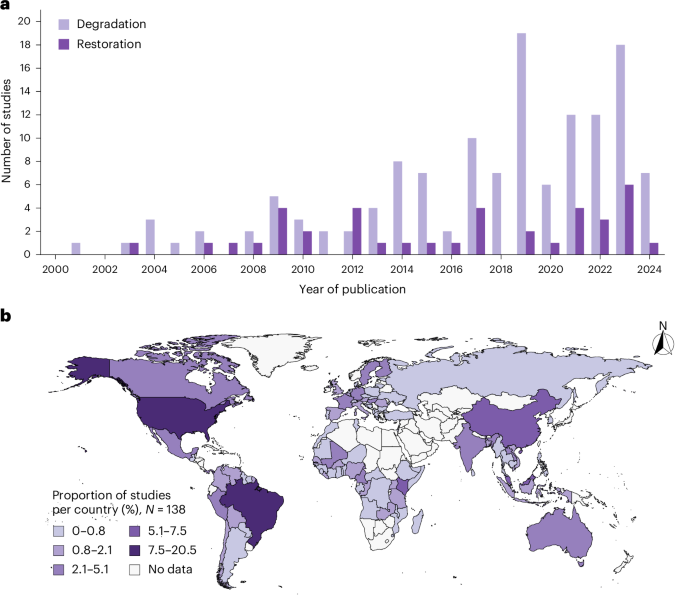
Fell et al.’s literature search showed that there have been few studies on how restoration efforts can impact disease transmission, with less than 40 up until 2023. Most of these studies were in Middle Africa, of which biodiversity conservation and natural resource management were the most commonly described techniques. Studies showed that interventions had varied effects on disease transmission risk. For example, wetland restoration reduced the disease risk of mosquito-borne diseases, while reforestation is associated with increased risk of tick-borne diseases, and the removal of invasive animals can be seen to increase diseases transmitted by rodents.
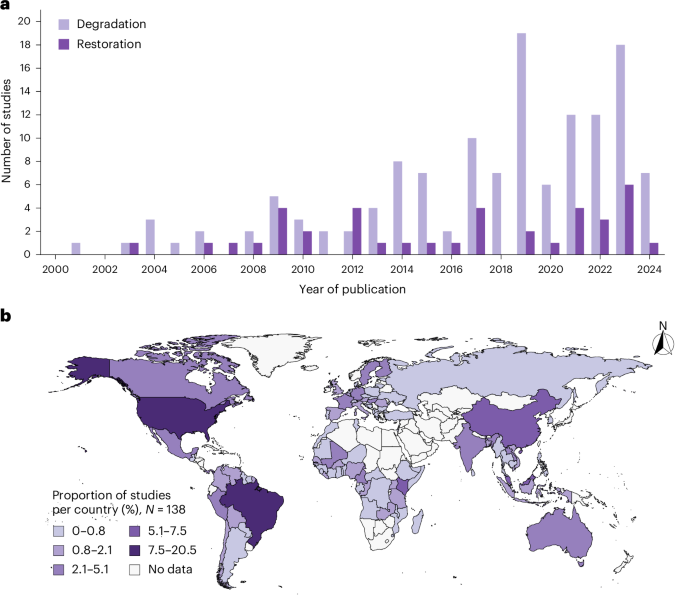
distribution of studies.
Fell, A., Jagadesh, S., Duthie, A.B. et al. Global evidence synthesis on land-use change and
zoonotic risks. Nat Sustain 9, 142–152 (2026).
Regional bias
65% of studies were conducted across multiple UN Geoscheme regions (North America, South America and South East Asia), and just less than half of the studies were spread across only 4 countries: Brazil (20.3%), USA (18.8%), Kenya and Malaysia (both 7.2%). The literature review found a clear geographical and socio-economic bias across research, with 80% of all studies analysed coming out of upper-middle or high-income countries. This leaves gaps in the research across key regions where land use change and restoration initiatives are both prominent and where zoonotic disease risk is highest.
The authors identified 50 locations that are undergoing LUC that would benefit from further research, 84% of which were distributed equally across West and Middle Africa, and South East Asia, 12% were in Central and South America, and one site in both Oceania and North America. The authors used their literature review to create an interactive Atlas that shows users patterns and helps researchers identify research gaps. The development of this tool aims to facilitate more informed planning of restoration initiatives and directions for future research.
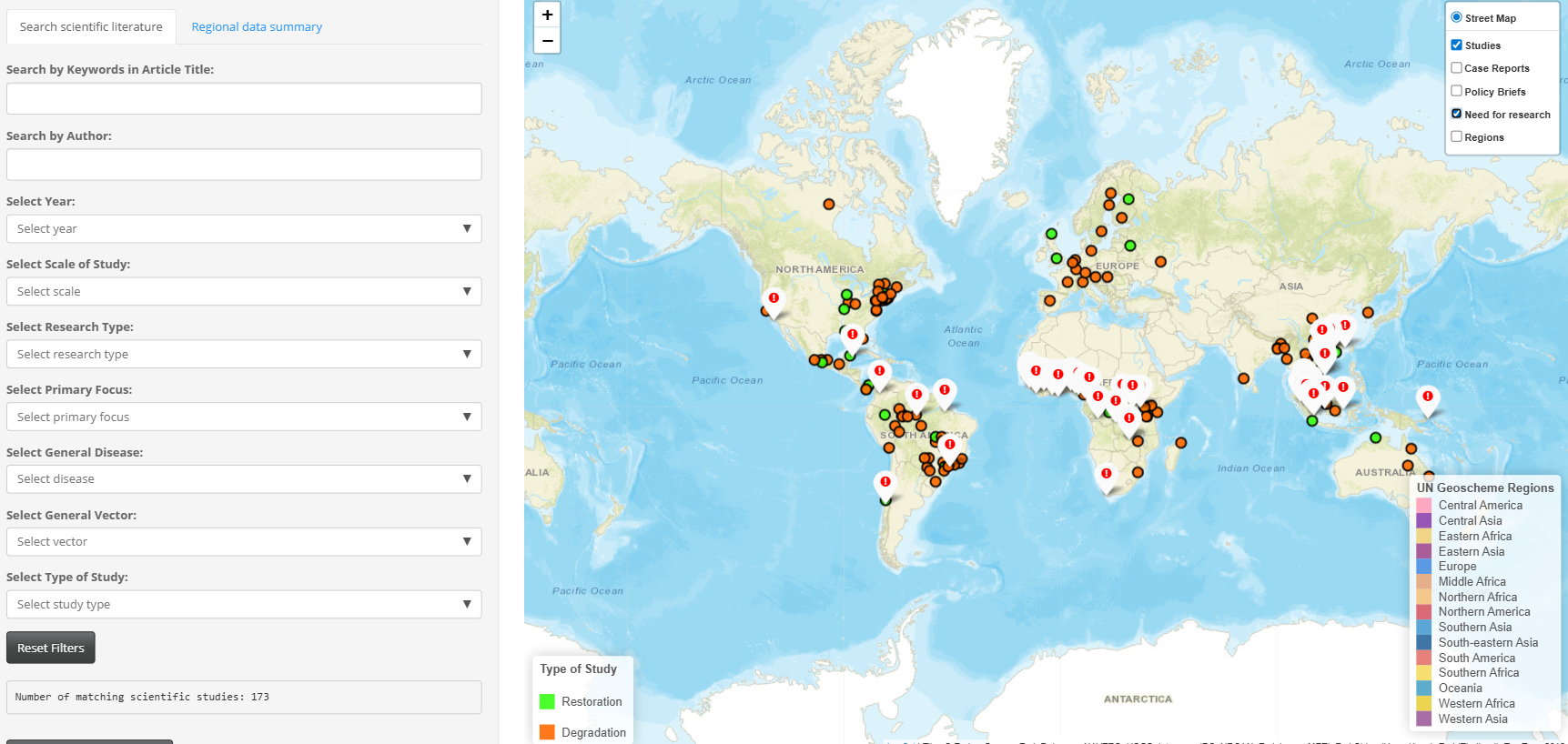
Overview of the online evidence atlas (https://bradduthie.shinyapps.io/atlas/) interface displaying the interactive map and filtering panels. Region boundaries from Our World in Data under a Creative Commons licence CC BY 4.0. Credit: map, Esri and its licensors. Screenshot from online evidence atlas.
Fell et al.’s literature review makes it clear that although we know land use change can strongly influence zoonotic disease transmission, there is a regional bias leaving glaring gaps where research is needed most. The authors atlas can help researchers to undertake targeted, regionally diverse research crucial for consolidating understanding on the effects of land use change and informing landscape restoration strategies.

Freyja has a BSc in Zoology, and an MSc in the History of Science, Technology and Medicine from The University of Manchester. She currently works as an Associate Publisher for BMC's open access portfolio.
Follow the Topic
-
Nature Sustainability
This journal publishes significant original research from a broad range of natural, social and engineering fields about sustainability, its policy dimensions and possible solutions.
-
BugBitten
A blog for the parasitology and vector biology community.