Reimagining Travel with Blockchain Technology: Lessons Learned from the Failure of Winding Tree
Published in Computational Sciences and Business & Management






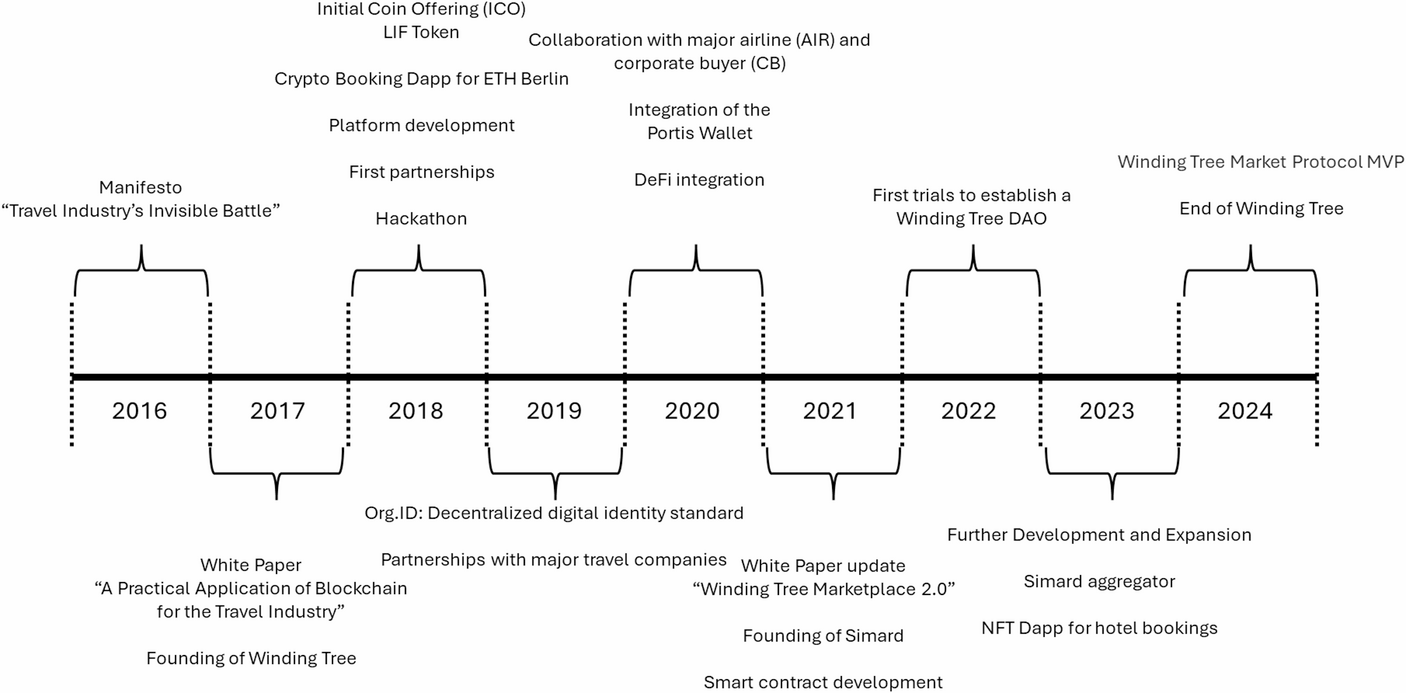

After Winding Tree gave up in July 2024, I was approached by Maksim Izmaylov, who founded the company together with Pedro Anderson and Jakub Vysoky, to document the case. They gave me full access to the available material and connected me with 19 interview partners, all of whom provided their own viewpoint on why the business model did not work out.
Winding Tree was a bold blockchain initiative that set out in 2017 to disrupt the travel and tourism industry. Their ambition was to build a decentralized, open-source marketplace allowing direct transactions between travel service providers (e.g., airlines, hotels) and customers that bypass traditional intermediaries such as global distribution systems (GDSs) and online travel agencies (OTAs). By eliminating middlemen, the platform strived to enhance transparency, reduce costs, and empower smaller players. The project attracted substantial interest and conducted a successful token sale, but was finally shut down in 2024. Rather than label it a failure, I argue that Winding Tree offers critical insights for future ventures in digital transformation and blockchain implementation in the tourism and travel industry.
Study Design and Methods
I applied a rigorous case study methodology to uncover why Winding Tree failed to achieve its mission, consisting of:
- A quantitative survey of 86 industry stakeholders to assess blockchain sentiment and Web3 readiness,
- 19 in-depth interviews with founders, partners, investors, and industry experts, and
- an analysis of secondary data, including white papers, source code, blog posts, and public documentation.
The study explores two research questions:
1. Which key factors prevented Winding Tree from achieving success?
2. How can the failure of Winding Tree be explained from a theoretical perspective?
What I found: A Web of Challenges
The study results revealed a complex interplay of internal, technological, organizational, and environmental barriers that ultimately led to Winding Tree's demise.
-
Philosophical Commitment to Decentralization
Winding Tree’s refusal to accept venture capital, which can be explained by the commitment to maintain decentralization and public ownership, left it vulnerable to financial constraints. -
Immature Technology Stack
Building on Ethereum during its early development phase exposed Winding Tree to the limitations of blockchain at that time. These hindered integration with industry players’ legacy systems and complicated user experiences. -
Misaligned Market Fit
The initial focus on B2B solutions and corporate travel proved ill-suited to blockchain’s strengths. Despite potential cost savings, businesses lacked motivation to adopt a system that required significant change and offered unclear advantages. A typical "chicken-and-egg" problem emerged such that widespread benefits depended on a critical mass, yet adoption stalled without existing users. -
Resistance from Incumbents
Efforts to bypass powerful intermediaries met with substantial resistance. Established players discouraged adoption, and the lack of regulatory clarity around crypto payments and smart contracts deterred risk-averse partners. -
Usability and Organizational Readiness
Both corporate users and travelers were reluctant to manage crypto wallets, private keys, and new platforms. Corporate IT teams lacked the capacity or incentive to replace familiar systems with an unproven alternative. -
Financial Fragility
The initial ICO funding proved insufficient over time. Without a robust revenue model, Winding Tree was unable to sustain its operations. Its token-based model also attracted speculators rather than long-term stakeholders. -
External Shocks
COVID-19 drastically curtailed global travel, eroding momentum and capital. Although some partnerships were formed during the pandemic, they were insufficient to ensure survival.
Theoretical Implications
I assessed Winding Tree’s story through several established frameworks:
- Diffusion of Innovation: Winding Tree struggled to move from early adopters to the early majority due to a lack of perceived advantage and high implementation complexity.
- Resource-Based View and TOE Framework: Internal capabilities, technological constraints, and environmental pressures turned out to be major hurdles.
- Disruptive Innovation Theory: Though Winding Tree targeted market inefficiencies, it failed to gain traction in underserved niches.
- Behavioral Economics: Rational cost-benefit arguments alone did not motivate companies to change entrenched processes.
No single theory can fully explain the project’s failure. Instead, the case highlights the need to refine and contextualize existing models for emerging technologies, such as blockchain.
Practical Lessons for Practitioners
The authors provide three critical recommendations:
- Know the Market and Its Power Structures: Successful disruption requires a deep understanding of industry dynamics and stakeholder incentives. Blockchain alone is not enough, but the value propositions must be concrete, measurable, and easily communicable.
- Secure Sustainable Funding: Decentralized ideals must be matched with viable business models. Hybrid structures such as consortium chains may offer a middle path between public blockchains and investor-driven platforms.
- Leverage Existing Knowledge: Future projects can build upon Winding Tree’s open-source work and avoid repeating its history.
Conclusion
Winding Tree's collapse is not only a story of a failed business model —it is a case rich in lessons for practitioners who actively seek to transform traditional industries using disruptive technologies. Its experience reveals the complex, often underestimated interplay between ideology, technology, industry inertia, and human behavior. Blockchain remains a powerful enabler, but its promise can only be realized through pragmatic execution, ecosystem alignment, and sustained organizational effort.
The paper can be found here:
Lessons learned from an abandoned tourism and travel blockchain project: the case of winding tree

I am a Full Professor at Modul University Vienna, Austria. My research interests include the business implications of blockchain and artificial intelligence, the evolution of Web3, and digital transformation in general. I teach blockchain-related topics and frequently speak at academic conferences and industry events. In 2022, I won the Blockchain Frontier Award from the Blockchain Research Institute (BRI).
Follow the Topic
-
Information Technology & Tourism
Information Technology & Tourism is the first interdisciplinary journal focusing on the nature and role of digital technology in tourism, travel and hospitality.

Related Collections
With Collections, you can get published faster and increase your visibility.
Digital Platforms for Sustainable Community-Based Tourism Management
Summary & Background:
Community-based tourism (CBT) provides an authentic avenue for sustainable development through the active involvement of local communities in conserving cultural heritage and natural resources. With the development of the tourism industry balancing its impact and equitable participation becomes more difficult. Digital ecosystem platforms are arising as key solutions to enable collaborative, transparent and responsive management of CBT projects. These platforms unify various stakeholders, facilitating cooperative planning, joint management of resources and constant feedback. Functionalities such as real-time updates, visitor engagement and decentralized service coordination improve operational effectiveness and community participation. They also facilitate the marketing of off-the-beaten-path destinations, hence sharing tourism benefits more evenly. Introducing digital platforms in community-based tourism is not without challenges. Digital competency gaps, infrastructure constraints and disconnected stakeholder involvement tend to undermine implementation. Domestic tourism plans can be deprived of the instruments to track visitor patterns, measure environmental footprint or be coordinated with wider policy objectives. Inadequate harmonized procedures and digital coordination result in inefficiencies and missed opportunities. To bridge these gaps emerging technologies such as mobile apps, geospatial technologies and AI tools are being utilized. These advance technologies are intended to facilitate well-informed decision-making, sustainable operations and inclusive tourism development.
While digital ecosystem platforms promising innovations for CBT, there are some important limitations to their full potential. Most communities remain hindered by infrastructure limitations, a lack of training or low confidence in advance technologies. If not localized, digital platforms tend to neglect cultural customs or exclude non-dominant languages, diminishing community participation. There is also the risk of diluting local control when digital systems are constructed or administered externally with no long-term engagement by the communities they are supposed to serve. There is also the problem of scattered data practices and non-integration across systems which inhibits continuity and responsiveness in tourism management. These issues result in coordination failure, redundant work and ineffective policy fit. Co-designed systems that are aligned with the values, languages and capacity of each community are what future research must examine. Ethical data practices with transparency and community ownership are significant. Support in the long term via digital literacy, participatory governance and adaptive system design can make digital platforms empowering instruments in the development of sustainable, community-driven tourism.
This special collection calls for original research, innovative frameworks and applied methodologies dedicated to the contribution of digital ecosystem platforms to strengthening sustainable community-based tourism. Submissions should examine inclusive technology, stakeholder-led solutions and adaptive digital approaches to develop solutions to infrastructural deficits, cultural integration and governance issues to enable local communities and support equity, environmentally sound tourism development.
List of Topics:
- Designing Low-Bandwidth Digital Platforms for Remote Tourism Communities.
- Augmented Reality for Immersive Eco-Cultural Storytelling in CBT Destinations.
- Cloud-Based Resource Management Systems for Decentralized Tourism Operations.
- Human-Centered Interface Design for Inclusive Tourism Digital Platforms.
- Participatory Design Methodologies for Localized CBT Platform Development.
- Mobile App Frameworks for Real-Time Local Experience Curation in Community Tourism.
- IoT-Enabled Sensing Networks for Environmental Monitoring in Tourist Hotspots.
- NLP-Enhanced Feedback Systems for Sentiment-Aware Tourism Planning.
- Knowledge Graphs for Mapping Indigenous Knowledge and Heritage Sites.
- Crowdsourced Data Integration for Dynamic CBT Decision Support Systems.
- Data Interoperability Standards for Regional Collaboration in CBT Networks.
- Multilingual Voice Assistants for Breaking Communication Barriers in Local Tourism.
Publishing Model: Hybrid
Deadline: Jan 20, 2027
Ethics of Digital Transformation in Tourism and Hospitality
The digital transformation in the tourism and hospitality industry has accelerated at an unprecedented pace. However, mounting evidence suggests that its rapid expansion generates profound ethical challenges and consumer insecurity. These challenges may include algorithmic bias and discrimination, opacity and lack of explainability, privacy erosion and surveillance, misinformation and content manipulation, labor displacement, digital exclusion, and widening social and spatial inequalities (Law et al., 2025; Lin et al., 2026; Nam & Heo, 2025). Recent research has begun to highlight how ethical risks associated with smart technologies, including AI-robots, metaverse, and blockchain, influence trust, legitimacy, and adoption intentions among users, while also affecting organizational responsibility, policy design, and long-term societal resilience (Alonso-Muñoz et al., 2025; Dwivedi et al., 2025; Hao & Wang, 2025; Wong et al., 2024).
As digital platforms and intelligent systems evolve into powerful intermediaries, ethical concerns are no longer peripheral but central to questions of governance, accountability, and sustainable development associated with the integration of high-tech with high-touch in tourism and hospitality. This collection aims to advance understanding of the ethical digital transformation in tourism and hospitality through rigorous conceptual and empirical research.
All manuscripts for this collection must be submitted via the journal’s online submission system. All papers submitted for consideration in the collection will be double-blind reviewed following the review process guidelines of Information Technology & Tourism.
This collection seeks to provide a critical, interdisciplinary, and empirically grounded platform to explore how ethical considerations can be integrated into the design, deployment, governance, and evaluation of smart technologies and digital transformation. We welcome conceptual and empirical contributions that critically analyze the ethical dimensions of digital transformation.
Topics of interest include, but are not limited to:
- Ethical frameworks and moral philosophies for digital transformation
- Governance systems and accountability mechanisms
- Algorithmic bias, fairness, transparency, and explainability
- Privacy, surveillance, and data ethics in digitally mediated environments
- Consumer insecurity and risk perceptions in digital consumption
- Trust, legitimacy, and user acceptance of digital transformation
- Digital labor, automation, and the ethics of job displacement and reskilling
- Digital inequality, accessibility, and inclusion in platform-based societies
- Ethical risks and responsibilities of generative AI and synthetic content
- Platform power, data ownership, and asymmetries in value distribution
- Responsible innovation and ethics-by-design approaches
- Cultural, institutional, and policy differences in digital ethics governance
- Digitalization, sustainability, and the ethical dimensions of environmental impact
- Resistance, activism, and public engagement related to unethical digital practices
Authors are encouraged to submit a preliminary abstract (300 – 500 words) to the Guest Editor (Boyu Lin, boyulin@utm.edu.mo) before full paper submission. This step is intended to help assess the fit of the proposed manuscript within the scope of the collection. Please note that this is optional and does not guarantee acceptance of the full paper, which will be subject to the journal’s standard peer-review process.
Important Dates
Submission of abstract by e-mail due: 15th August 2026
Feedback to authors: 1st September 2026
Submission of full paper starts: 1st September 2026
Submission of full paper due: 15th March 2027
Anticipated completion: Beginning of 2028
References:
- Alonso-Muñoz, S., González-Sánchez, R., González-Mendes, S., & García-Muiña, F. (2025). The role of blockchain-related technologies in transforming the tourism and hospitality industry: an overview and research guidelines. International Journal of Contemporary Hospitality Management, 37(13), 84-102.
- Bingöl, S., & Yang, Y. (2025). Integrating smart technologies and artificial intelligence to build smart tourism destination ecosystems: A model for smart destination management. Tourism Management Perspectives, 58, 101380.
- Borges-Tiago, M. T., & Avelar, S. (2025). Co-creation dynamics in tourism and hospitality: a horizon 2050 paper. Tourism Review, 80(1), 194-208.
- Buhalis, D., Lin, M. S., & Leung, D. (2023). Metaverse as a driver for customer experience and value co-creation: implications for hospitality and tourism management and marketing. International Journal of Contemporary Hospitality Management, 35(2), 701-716.
- Dwivedi, Y. K., Helal, M. Y. I., Elgendy, I. A., Albashrawi, M. A., Hughes, L., Shawosh, M., ... & Jeon, I. (2025). Artificial intelligence agents and agentic systems in hospitality and tourism: challenges, opportunities and research agenda. International Journal of Contemporary Hospitality Management.
- Hao, L., & Wang, S. (2025). Dehumanized by automation: how guest–robot interactions foster the objectified perception of hotel frontline employees. Journal of Hospitality and Tourism Technology, 1-24.
- Law, R., Ye, H., & Lei, S. S. I. (2025). Ethical artificial intelligence (AI): principles and practices. International Journal of Contemporary Hospitality Management, 37(1), 279-295.
- Lin, B., Lee, W., Choi, H. C., & Andereck, K. (2026). Developing and validating an ethical risk scale for service robots in hospitality. International Journal of Hospitality Management, 132, 104383.
- Nam, S., & Heo, J. (2025). Rethinking smartness in hospitality and tourism: a critical reflection. International Journal of Contemporary Hospitality Management, 37(9), 3121-3135.
- Wong, L. W., Tan, G. W. H., Ooi, K. B., & Dwivedi, Y. K. (2024). Metaverse in hospitality and tourism: a critical reflection. International Journal of Contemporary Hospitality Management, 36(7), 2273-2289.
- Zimmerman, A., & Baur, C. (2016). The digitalization of financial services and its impact on consumer insecurity. Dienstleistungen 4.0 (pp. 319-340). Springer Gabler, Wiesbaden.
Publishing Model: Hybrid
Deadline: Mar 15, 2027