Rice bean (Vigna Umbellata) the forgotten gold: unraveling the commercial, nutritional and medicinal value
Published in Chemistry, Research Data, and Biomedical Research

Rice Bean: Rediscovering a Forgotten Gold Through My Research Journey
Some of the most important research questions don’t begin in high-tech laboratories—they begin in the fields, kitchens, and everyday lives of people. My journey with rice bean (Vigna umbellata) started not as a grand research plan, but as a quiet curiosity about why certain crops, despite being nutritionally rich and culturally significant, fade into obscurity while others dominate global markets.
Rice bean is often called a “forgotten crop,” and the first time I encountered it in the field, that description felt painfully accurate. Farmers knew it well. Elders spoke of its resilience and health benefits. Yet outside these communities, it was nearly invisible. As a researcher, that gap between local knowledge and global recognition became impossible for me to ignore.
Meeting Rice Bean in the Field
During visits to hilly and resource-limited farming regions in South Asia, I noticed rice bean growing quietly alongside maize. It was not the star crop. It didn’t receive fertilizers, special care, or market attention. Yet it thrived. Farmers described it as reliable—something they could count on when other crops failed.
What struck me most was how deeply embedded rice bean was in daily life. It was part of meals, traditions, and local health practices. And yet, when I searched the literature or market data, rice bean barely appeared. That contrast sparked my motivation to explore its nutritional, medicinal, and commercial value more seriously.
Why Underutilized Crops Matter
As researchers, we often chase novelty—new molecules, new technologies, new breakthroughs. Rice bean taught me that rediscovery can be just as powerful. Underutilized crops like rice bean sit at the intersection of nutrition, sustainability, and social equity.
From a scientific perspective, rice bean is impressive. It belongs to the legume family, known for protein richness and soil-enriching properties. From a societal perspective, it supports marginalized farming communities, particularly in challenging terrains where few other crops succeed. Studying rice bean felt like working on a topic that mattered beyond publications—it felt relevant to livelihoods.
Exploring Nutritional Richness
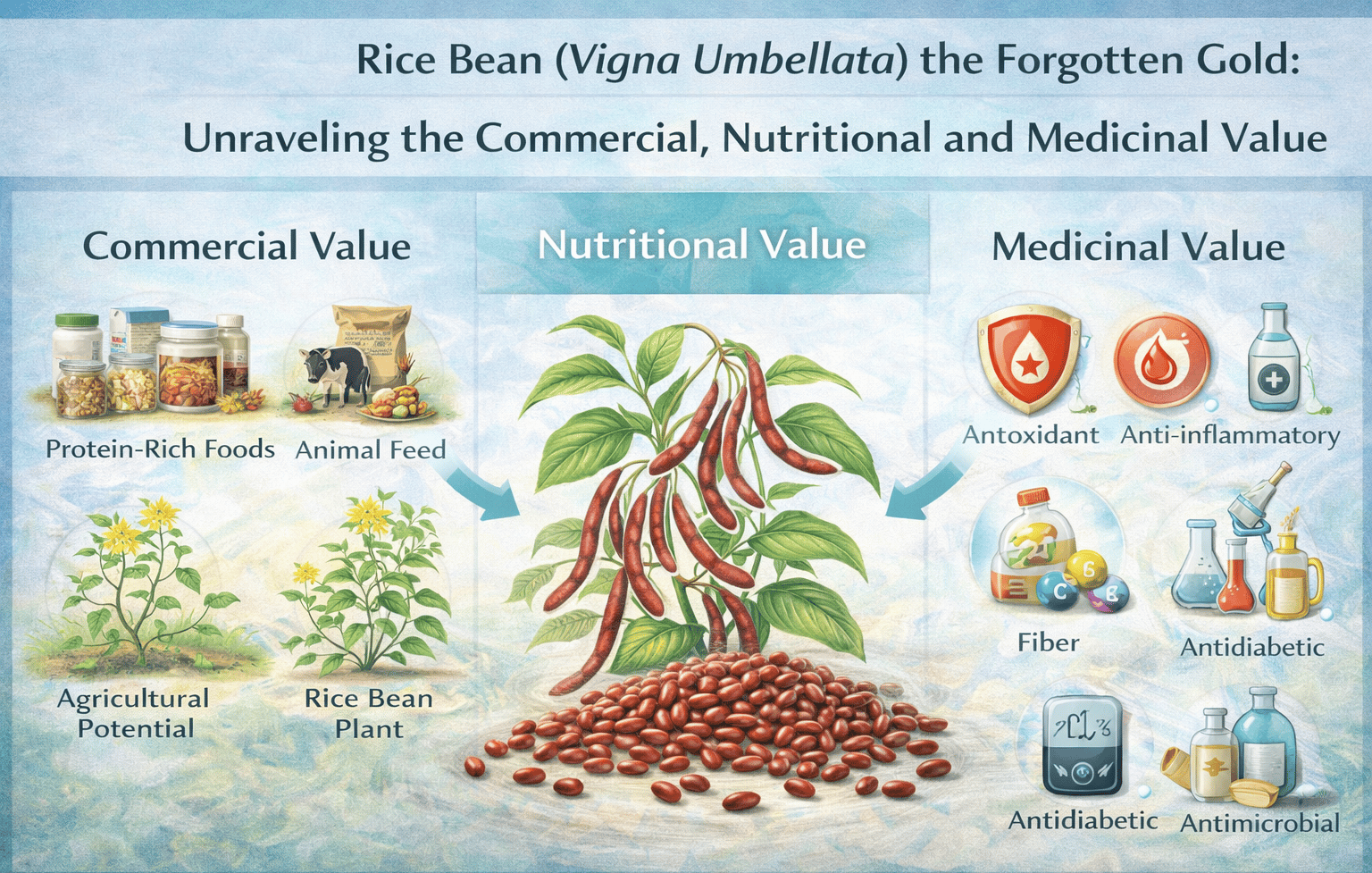
As I delved deeper into the research, the nutritional profile of rice bean stood out. It is rich in proteins, complex carbohydrates, dietary fiber, vitamins, and essential minerals. Compared to many commercial legumes, it holds its own—and in some cases, exceeds expectations.
What excited me most was realizing how this nutritional potential remains largely untapped at a commercial level. In a world grappling with malnutrition and rising food costs, rice bean represents a missed opportunity. This realization shaped my research questions: why hasn’t rice bean been scaled up, and what evidence is needed to bring it into mainstream food systems?
Medicinal Value: Where Tradition Meets Science
My background in pharmacognosy naturally drew me toward the medicinal aspects of rice bean. Traditional communities have long used it for health maintenance, but scientific validation has been slow.
Recent studies—and my own exploration of the literature—highlight its antioxidant, anti-inflammatory, and antidiabetic potential. These effects are linked to its bioactive compounds, including phenolics and flavonoids. For me, this was one of the most rewarding parts of the journey: seeing traditional knowledge slowly gain scientific backing.
It reinforced an important lesson I’ve learned repeatedly as a researcher—traditional medicine is not “unscientific.” It is often under-studied.
Commercial Potential and Missed Opportunities
Despite its strengths, rice bean remains commercially neglected. One reason, I believe, is the lack of awareness and value-chain development. Unlike soy or chickpea, rice bean lacks standardized processing methods, branding, and large-scale promotion.
Yet, its adaptability offers enormous potential. Rice bean can be processed into flours, fermented products, snacks, and functional foods. Each region that grows it already has its own methods of preparation, reflecting cultural identity and culinary creativity.
From a research perspective, this opens exciting opportunities: product development, functional food research, nutraceutical exploration, and sustainable agriculture models. Rice bean doesn’t need reinvention—it needs recognition.
Research with a Human Purpose
What makes rice bean research particularly meaningful to me is its human dimension. This is not just about improving yield or identifying compounds. It’s about empowering communities that have quietly preserved this crop for generations.
Working on rice bean reminded me why I entered research in the first place—not only to generate data, but to contribute knowledge that can improve lives. If scientific validation can help elevate rice bean’s status, it may support food security, farmer income, and dietary diversity in vulnerable regions.
Looking Forward
Rice bean is no longer just a research topic for me—it represents a philosophy. It reminds me to look beyond mainstream narratives, to listen to local knowledge, and to ask why some resources are overlooked while others are celebrated.
As researchers, we have the privilege—and responsibility—to shine light on such forgotten golds. I hope my work contributes, even in a small way, to bringing rice bean from the margins into meaningful scientific, commercial, and policy conversations.
If this blog inspires fellow researchers to look again at underutilized crops or traditional resources, then it has done exactly what Life in Research is meant to do: connect science with lived experience.
%20the%20forgotten%20gold%20unraveling%20the%20commercial,%20nutritional%20and%20medicinal%20value%20.png)

Salman Ahmed (ORCID: 0000-0003-2033-0181) holds a B.Pharm. degree from the University of Karachi, Pakistan, and a PhD and M.Phil. in Pharmacognosy from the same institution. He has gained valuable experience in the pharmaceutical industry, having worked at Helix Pharma, Pharm Evo (Pvt.) Ltd., and Searle Pakistan Ltd. Currently, he holds the position of Assistant Professor in the Department of Pharmacognosy at the Faculty of Pharmacy, University of Karachi, Pakistan.
Salman Ahmed has made significant contributions to the field with a decade-long career dedicated to teaching Pharmacognosy, also known as Natural Products Sciences. He has authored 125 research papers with an impact factor of 100 with 2297 citations, a h-index of 24, and an i10-index of 59. He has secured multiple research grants in Pharmacognosy (2021, 2018, 2016, and 2014) to study plants traditionally used for analgesic, anti-inflammatory, diuretic, and antidiarrheal purposes and their effects on digestive enzymes. Additionally, he has authored seven books and presented 16 posters at national and international conferences. Salman Ahmed's expertise is acknowledged by various esteemed journals published by Elsevier, Springer Nature, Wiley, MDPI, Hindawi, and Dove Medical Press Limited, as he serves as an invited reviewer for these publishers.
Scientific Achievements (2011–2015): He pioneered a cost-effective copper sulfate-induced chick emesis model for evaluating natural antiemetics. His research explores antiemetic, analgesic, and anti-inflammatory properties in Pakistani plants, herbs, and spices, reporting fixed oil's analgesic effects and discovering Bergenin as an antiemetic. He authored two state-of-the-art reviews on natural antiemetics, "Antiemetic effects of bioactive natural products" and "Natural antiemetics- an overview". He was awarded Nishan-e-Zafar by the University of Karachi in 2014.
Scientific Achievements (2016–2024): Dr Salman Ahmed pioneered glass slide models to grow Whewellite, Brushite, and Urate crystals for the evaluation of antiurolithiatic and anti-gout drugs, presenting key findings at international conferences such as MMDR-7, STEP-5, ISNPC-14, and ISNPF-2. His book “How to Grow Urinary Stone and Gouty Crystals on Glass Slide” provides detailed methodologies for replicating crystal growth in vitro and discusses the implications for understanding crystal morphologies, disease mechanisms and developing herbal treatment strategies.
Dr Ahmed's research highlights the antiurolithiatic potential of pentacyclic triterpenes and polyphenols. These compounds inhibit calcium oxalate crystallization, reduce oxidative stress, and modulate inflammation. They also promote nephroprotection, diuresis, and ACE inhibition, advancing natural therapeutics for kidney stone prevention.
His contributions include “Glossary of Globally Used Herbs and Animals for Urolithiasis” (2024), a comprehensive book exploring medicinal plants covering botanical families from A to Z and animal-based remedies covering their historical use, mechanism of action, and therapeutic spectrum against Whewellite, Brushite, and Urate crystals separately. His research on antiurolithiatic formulations compiles mono- and polyherbal remedies from diverse regions, including Appalachia, Canada, India, and the Middle East. His work provides critical data for future phytochemical, pharmacological, and toxicological studies, aiding in the discovery of safer, more effective treatments for kidney stones.
Additionally, he explores the anticancer potential of marine peptides against breast, ovarian, cervical, malignant melanoma, prostate, neuroblastoma, glioblastoma, leukemia and lymphoma, advancing natural therapeutics for cancer treatment.