Scalable-Designed Photonic Metamaterial for Color-Regulating Passive Daytime Radiative Cooling
Published in Materials
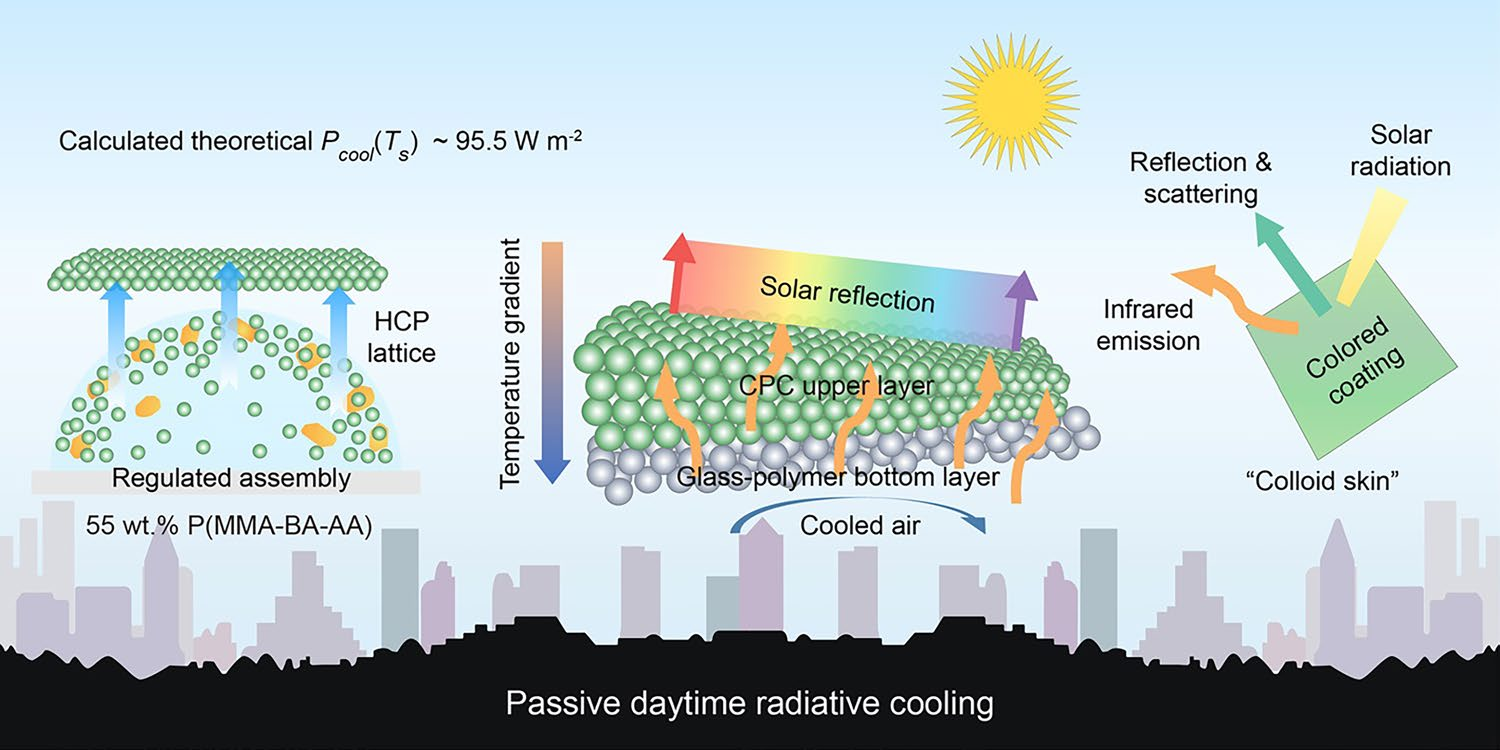
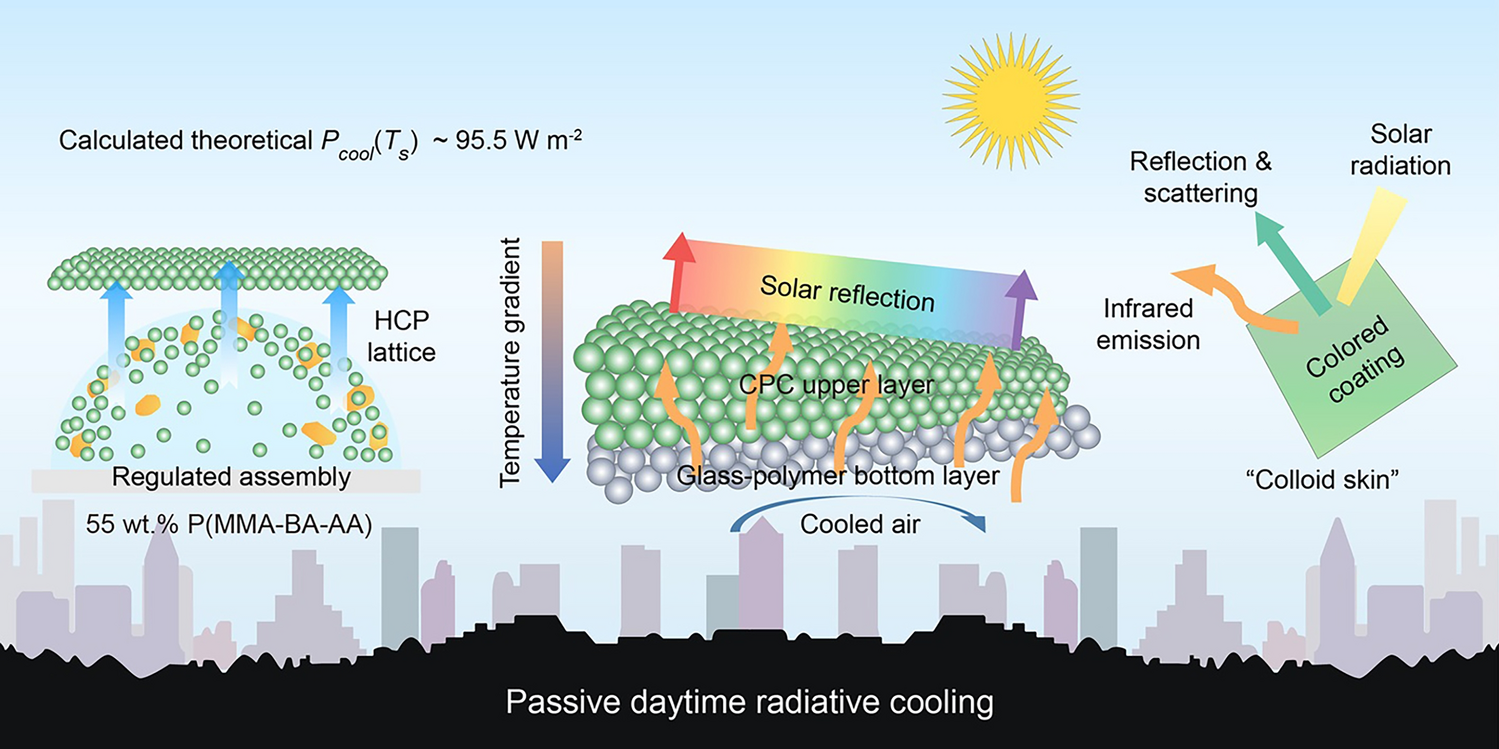
Methods allowing passive daytime radiative cooling (PDRC) to be carried out in an energy-efficient and scalable way are potentially important for various disciplines. Here, we report a sustainable strategy for scalable-designed and color-regulating PDRC coating based on high-crystallinity photonic metamaterial (crystallinity: 71.5%; enhanced assembly efficiency: 72%), that is derived from the as-prepared 55 wt% solid content poly(methyl methacrylate-butyl acrylate-methacrylic acid) P(MMA-BA-MAA) monodispersed latexes (approaching theoretical limit: 59 wt%). Robust meter-scale PDRC coatings are constructed by various industrial modes onto diverse surfaces, addressing bottlenecks like dull appearance, high cost, low efficiency, and hard construction. Notably, the solar reflectance, long-wave infrared emittance, and calculated theoretical cooling power of the designed PDRC coating, respectively, reach ~ 0.94, ~ 0.97, and ~ 95.5 W m−2 under solar radiation, which can achieve an average 5.3 °C sub-ambient daytime temperature drop in the summer in Nanjing. The cooling performance, scale preparation, and cost-effectiveness of the PDRC coating have extended into leading position compared with those of state-of-the-art designs. This work provides promising route to reduce carbon emissions and energy consumption for global sustainability.

Editor of Nano-Micro Letters, which is an Open-Access, peer-reviewed journal reported papers that have at least one dimension ranging from a few sub-nanometers to a few hundreds of micrometers. The journal is published by Springer Nature and indexed by SCI, EI, SCOPUS, Pubmed, etc. The 2025 JCR Impact Factor is 38.5. The 2025 CiteScore is 58.9.
Follow the Topic
-
Nano-Micro Letters
Nano-Micro Letters is a peer-reviewed, international, interdisciplinary and open-access journal that focus on science, experiments, engineering, technologies and applications of nano- or microscale structure and system in physics, chemistry, biology, material science, and pharmacy.