Space singularity and intrinsic quantum curvature in charged massive non-rotating Reissner–Nordström black hole
Published in Physics



Since I became involved in scientific research, I have been deeply intrigued by the various research directions, especially the one exploring the fundamental structure of matter, the governing laws of nature, and the intricate connections and interactions that shape the universe at its most basic level.
My exploration of the scientific realm commenced at a university situated in Upper Egypt in 1990s. At that time, I was facing significant challenges due to the severe lack of research resources and infrastructure, which limited my access to advanced laboratories, equipment, and scholarly materials. Despite these limitations, my passion and curiosity drove me to focus exclusively on high-energy physics, as it appeared to hold the most promise for unraveling the deepest mysteries of matter and the Universe. Initially, my research was rooted in statistical and phenomenological studies of high-energy nuclear collisions, methods that allowed me to glean meaningful insights despite the constraints of limited experimental facilities. These early efforts laid a foundational understanding of particle interactions at extreme energies.
Later, when I moved to Germany to pursue my doctoral studies, my focus shifted towards engaging with more sophisticated tools such as mathematical models and computer simulations. This transition marked a significant turning point, enabling me to explore complex phenomena like quantum chromodynamics (QCD) and its lattice simulations, which offered a more detailed and rigorous approach to understanding the strong nuclear force. As I delved deeper into these advanced topics, I became increasingly interested in the broader implications of high-energy phenomena, particularly how they might shed light on the conditions of the early Universe. The involvement in planning and developing larger, more complex particle colliders was driven by the hope that these facilities could recreate, even momentarily, the extreme conditions present moments after the Big Bang. Such experiments could potentially provide invaluable insights into the nature of matter, the origins of cosmic structure, and the fundamental laws that govern the cosmos. This pursuit gradually fostered a reciprocal relationship between quantum mechanics and general relativity, two pillars of modern physics that, despite their individual successes, remain difficult to reconcile within a single, unified framework. The question of how to unify these theories continues to challenge physicists worldwide. To contribute to this ongoing quest, I began focusing on identifying possible connecting relationships between high-energy physics and the physics of the early Universe, seeking pathways that might bridge the gap between quantum mechanics and general relativity.
In my review of the extensive body of work by colleagues aiming to unify these fundamental frameworks, I observed that the research trajectories had become increasingly complex and sprawling, dispersing into numerous specialized subfields. This divergence made it seem as though the overarching goal was drifting further away, obscured by a multitude of competing approaches and theories. Despite these challenges, I found myself pondering: what unique contributions could I make to this already vast and pioneering field? How could I carve out a meaningful niche within this complex landscape of scientific inquiry?
The approach to quantizing the fundamental metric was rooted in a key assumption: that the existing formulations of the two core theories - general relativity and quantum mechanics - appear fundamentally contradictory or at least irreconcilable in their current forms. This perceived incompatibility prompted the necessity to generalize both theories, creating a more flexible framework in which the quantization process could be meaningfully carried out. To facilitate this, the geometry underlying general relativity was extended beyond the classical Riemannian framework, incorporating more generalized geometrical structures such as Finsler geometry or Hamilton geometry, which can capture more complex and nuanced spacetime properties. Similarly, the generalization of quantum mechanics involved integrating gravitational effects into the uncertainty principle, thereby addressing the influence of gravity at the quantum level and modifying the traditional Heisenberg uncertainty relations to include gravitational considerations.
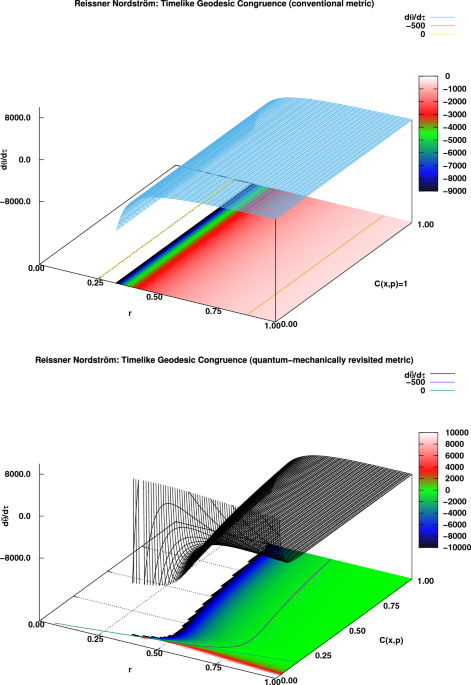
The research published in this domain demonstrates an application of the quantized version of general relativity to the spacetime surrounding a Reissner–Nordström black hole, illustrating how quantum effects alter the classical understanding of such extreme objects. Furthermore, the calculations reveal that quantum curvature effects, even when estimated approximately and qualitatively, suggest a far more intricate and complex structure of spacetime than previously recognized. This complexity appears to be overlooked in the semiclassical approximation commonly employed in conventional approaches to general relativity, which tends to smooth out or neglect subtle quantum features. Recognizing these quantum-induced modifications opens new avenues for understanding the true nature of spacetime, especially in regimes where classical theories break down, providing deeper insights into the quantum structure of the Universe at its most fundamental level. We conclude that the curvature observed in charged, massive, non-rotating, and spherically symmetric Reissner-Nordström black holes is probably affected by supplementary gravitational sources arising from quantum mechanically induced modifications, which could alter the black hole's geometry, especially in relativity and quantum approach.

Follow the Topic
-
The European Physical Journal C
This is a full open-access single-blind peer-reviewed journal, fully sponsored by SCOAP3 . EPJ C presents new and original research results in experimental, theoretical and computational high-energy physics, in a variety of formats, including also Reviews and Letters.




Please sign in or register for FREE
If you are a registered user on Research Communities by Springer Nature, please sign in