Structure of human mitochondrial Mg2+ channel Mrs2
Published in Neuroscience and Cell & Molecular Biology


As the most abundant divalent cation in the cell, magnesium ions (Mg²⁺) are involved in numerous enzymatic reactions and play a critical role in cellular metabolic pathways. The human mitochondrial Mg²⁺ channel, Mrs2, is essential for maintaining Mg²⁺ homeostasis in the mitochondrial matrix and regulating the production of ATP, the primary energy molecule. However, the three-dimensional structure of Mrs2 and the molecular mechanism underlying Mg²⁺ permeation have remained unclear.
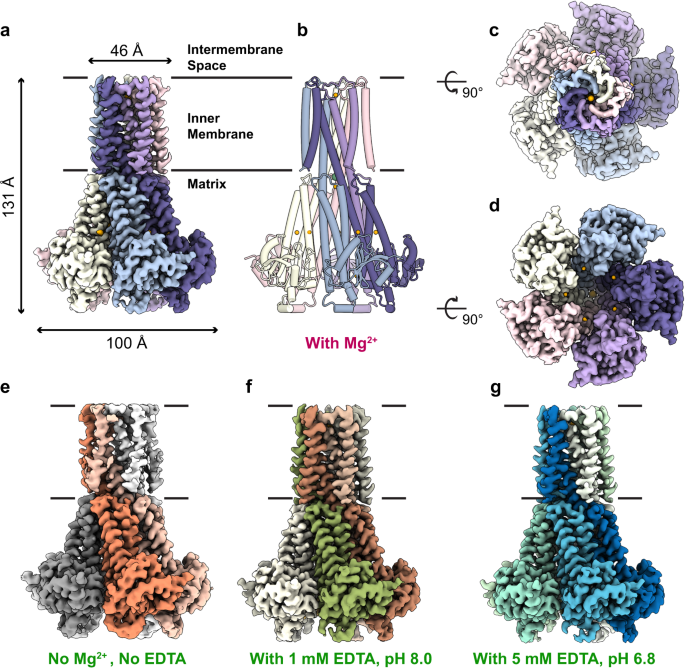
On August 5, 2023, Yuequan Shen and Xue Yang's team from Nankai University published an article titled Molecular basis of Mg²⁺ permeation through the human mitochondrial Mrs2 channel in Nature Communications. In this study, cryo-EM was employed to resolve the structure of full-length Mrs2 molecules under four different conditions.
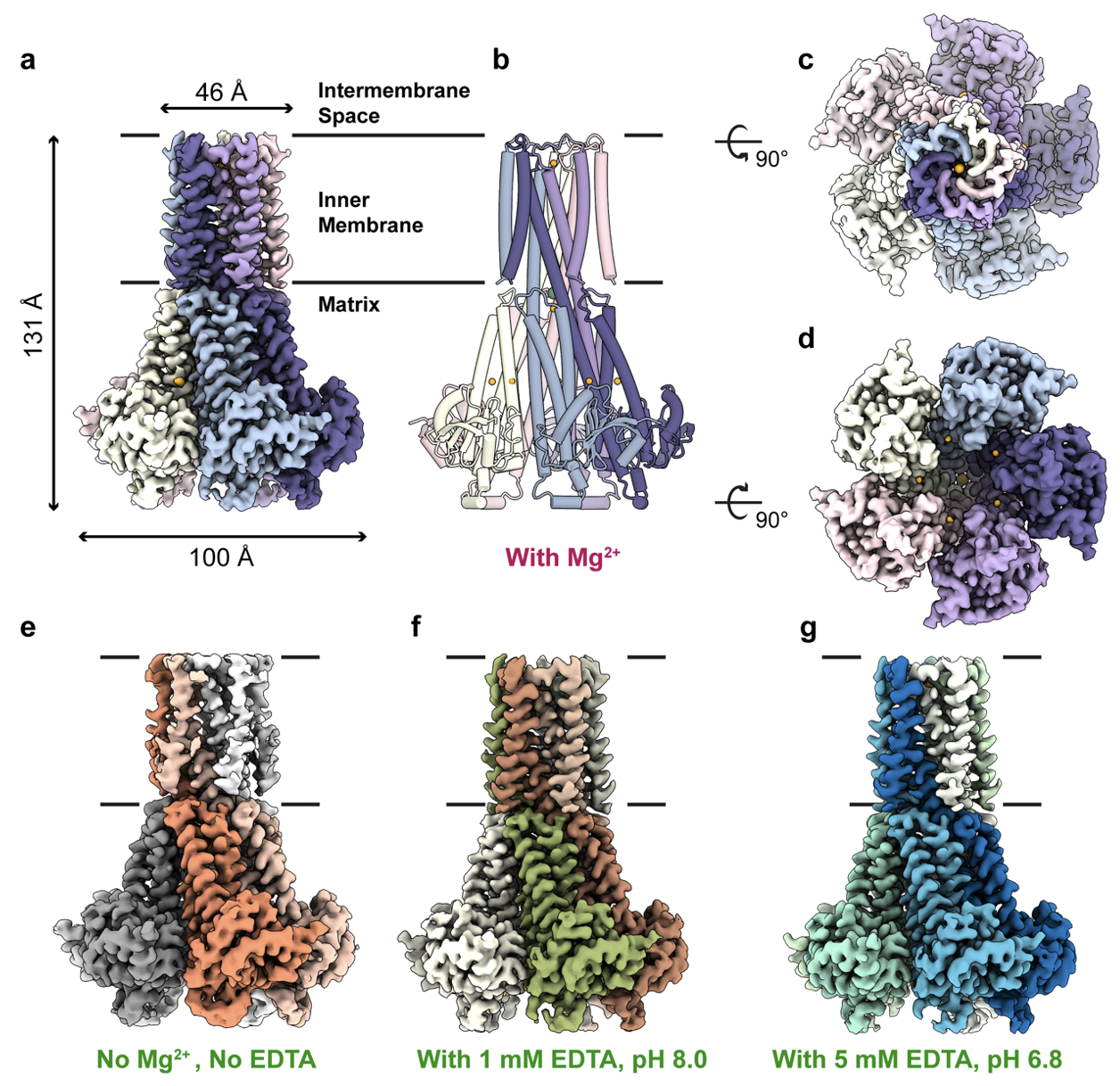
The structure revealed that hMrs2 adopts a five-fold symmetrical arrangement across different states, with the Mg²⁺ pore located at the center of the channel. Structural and functional studies showed that hMrs2 channels are permeable to Mg²⁺ in response to membrane potential, a conclusion that contradicts previous reports. Earlier studies suggested that changes in mitochondrial matrix Mg²⁺ concentrations induce conformational changes in the protein, thereby facilitating Mg²⁺ permeation.
Our findings indicate that the gating of the hMrs2 channel is mediated by a unique structural feature: five arginine residues (R332) form a ring with a Cl⁻ ion bound at its center. Molecular simulations revealed that Mg²⁺ hexahydrate attracts Cl⁻ binding, reducing Mg²⁺’s hydration number from six to four. This reduction allows Mg²⁺ to overcome the positively charged barrier formed by R332. With assistance from the negatively charged amino acid D329 in the mitochondrial matrix, Mg²⁺ tetrahydrate dissociates from Cl⁻, reverting to Mg²⁺ hexahydrate.
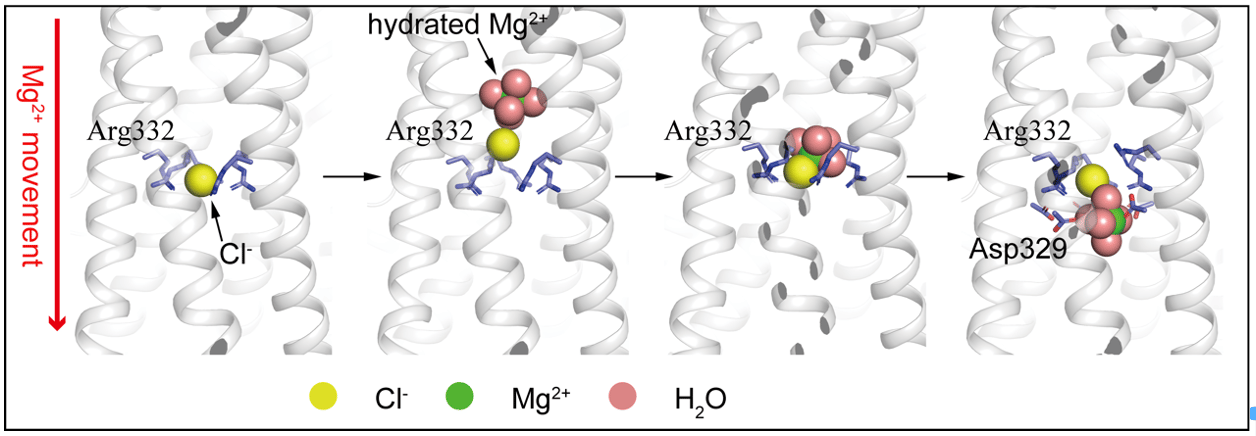
This mechanism of "cation transmembrane permeation" facilitated by negative ions is also observed in the permeation of Ca²⁺ through the extracellular calcium channel Orai. We anticipate that future research on ion channels will uncover more similar molecular mechanisms.

Biochemistry
ion channel
GPCR
calcium signaling
Follow the Topic
-
Nature Communications
An open access, multidisciplinary journal dedicated to publishing high-quality research in all areas of the biological, health, physical, chemical and Earth sciences.

Related Collections
With Collections, you can get published faster and increase your visibility.
Women's Health
Publishing Model: Hybrid
Deadline: Ongoing
Tumor Microenvironment Crosstalk and Therapeutic Implications
Publishing Model: Hybrid
Deadline: Nov 02, 2026