Survive, Adapt & Return—that’s how cancer wins!

There are many quiet struggles within the body—little skirmishes that go unnoticed, at least initially. Prostate cancer commonly begins this way, without clear warning signs. Early therapies can slow the disease, offering a period of meaningful progress. Yet for many men, the cancer quickly adapts—making it particularly difficult to track not only how it grows, but how it changes. Treatments meant to stop prostate cancer can sometimes drive certain tumor cells to adapt and survive. Once prostate cancer reaches this stage, known as castration-resistant prostate cancer because of how it evades current therapies, it has become one of the most challenging diseases to treat.
By 2025, prostate cancer is expected to claim the lives of tens of thousands of men in the United States. This is more than a number—it’s a call to action, driving an urgent search for answers that still lie beyond reach.
How it begins
For many years, prostate cancer research focused primarily on androgen receptor-positive (AR+) cells, which depend on androgen signaling and tend to respond well to standard treatments. When these therapies are applied, AR+/high cells are preferentially eliminated, while AR-/low populations survive and expand.
For a long time, these AR-/lo cells were largely overlooked. Work from Dr. Dean Tang’s lab helped shift that perspective. In 2012, this team identified AR-/low (PSA−/lo) cells and showed that these were not irrelevant, but instead represented a population capable of driving resistance. RNA sequencing later revealed that these cells were enriched for survival pathways, including elevated expression of BCL2.
At the time, the field remained focused on targeting AR-positive cells. But years later, around 2018, the picture began to change. Tang lab studies of advanced CRPC out of Roswell Park Comprehensive Cancer Center showed that both AR+/high and AR-/lo cells expressed high levels of BCL-2. What once seemed like a minor observation became central, and that’s when we decided to take a closer look at BCL2.
Challenges and turning points
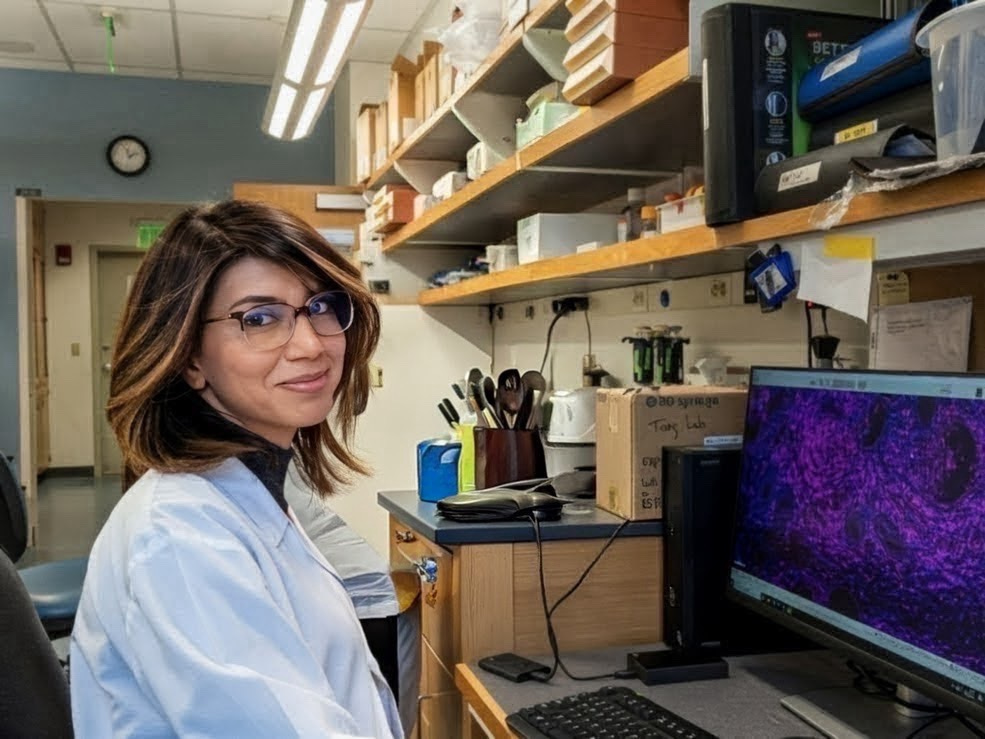
On paper, research often looks neat and orderly. In reality, it is much messier—more like finding your way in the dark through trial and error. That uncertainty has been a constant in our work, but one experience in particular reshaped how I understood it.
In December 2022, a fierce blizzard brought the City of Buffalo to a standstill. What began as an ordinary day became dangerous very quickly. I made it to my lab at Roswell Park, but on the way home, visibility disappeared and the cold became overwhelming. It was not just uncomfortable, it was disorienting. I could feel my strength fading in a way that felt both distant and immediate. I eventually found my way to safety after being rescued by a neighbor, but the experience stayed with me. When I returned to the lab, the survival of the cancer cells I had been studying no longer felt abstract. I understood them differently—not just in terms of how they grow, but how they endure under stress.
That shift in perspective followed me back into the lab. Problems that once felt purely technical began to take on a different weight. The BCL-2 antibody problem, for example—which stems from a protein known to help cancer cells thrive and reproduce—required testing at least 12 different antibodies. Most showed no signal at all, while a few produced incorrect signals. Each round added time and, with it, a measure of doubt. When one antibody finally worked reliably, it felt like a genuine breakthrough.
Working with circulating tumor cells presented a different challenge. These cells are rare, which meant we were often working with very small numbers and had little room for error. Every experiment carried weight. After several iterations, we shifted to a droplet digital PCR (ddPCR) approach for our molecular analysis—a critical turning point that allowed the project to move forward.
Not all setbacks were gradual. Two days before submission, after a final quantitative polymerase chain reaction (qPCR) run, the machine disconnected from the computer and took all the data with it. Forty-eight samples in one run were suddenly gone, with no backup. What followed was an exhausting public holiday spent troubleshooting with Applied Biosystems technical support; we ultimately managed a successful recovery.
These moments do not appear in the final paper, yet they are central to how this work came together. Both in and out of the lab, progress depended not just on precision, but on persistence—the ability to continue under pressure, to adapt, and to recover. In that sense, the challenges and turning points of this work were not only technical. They shaped how I came to understand the biology I study, and the process of research itself.
Findings, From lab to clinic
One of the central ideas in modern cancer research is that tumors are not uniform. Even within a single patient, a single tumor, cancer cells can behave very differently. This heterogeneity is one of the main reasons treatments eventually fail.
In our study, we looked at tumors not as a whole, but at the level of individual cells. We observed a shift: As treatment pressures the tumor, the balance of cell types changes. BCL-2 levels increase in response to hormone therapy. Importantly, this increase was not limited to a single subtype. It appeared across multiple populations, including those already resistant to therapy. This suggested that BCL-2 might represent a shared vulnerability across advanced prostate cancer.
We also uncovered a relationship between two key players, AR and BCL-2. Under normal conditions, AR activity suppresses BCL-2. When AR is blocked by treatment, that suppression is lifted—like removing a brake. Weakening one pathway can unintentionally activate another.
This led us to a different way of thinking: While our work typically targets one pathway at a time, perhaps both need to be targeted together. To explore this idea, we conducted a Phase Ib clinical trial combining enzalutamide with the BCL-2 inhibitor venetoclax.
The trial was small, but our results were meaningful. Patients earlier in their treatment course tended to respond better than those who had already been heavily treated. Over time, the cancer appears to adapt further—activating alternative pathways such as AR-V7 and becoming less dependent on BCL-2.
Not every patient responded. But even stabilizing the disease or slowing its progression is meaningful. It suggests that targeting survival pathways alongside growth pathways may be a viable strategy, especially earlier in the disease course. BCL-2 is a kind of safety net. By identifying and targeting that safety net, we open the possibility of a more durable approach to treatment.
Looking ahead, there is still much to learn.
Why do some patients respond to these treatments better than others?
Can we predict who will benefit from BCL-2-targeted therapy?
Are there even more survival pathways waiting to be discovered?
These questions are already shaping our next steps. What is becoming clear, however, is that by studying cancer at the single-cell level, and by understanding how survival pathways interact, we begin to uncover therapeutic opportunities that might otherwise remain hidden.
A human perspective
At the center of the experiments in this study, there were real people.
Men who have sat in clinics and heard difficult news. Families who have waited, hoped, and worried. Patients who started treatment believing it would work—only to face the uncertainty when it didn’t.
That reality stays with you.
Science doesn’t move in big, dramatic leaps. It moves slowly, step by step. Sometimes those steps feel small. But each one carries meaning, because each one brings us a little closer to understanding.
And understanding matters.
Because when we begin to understand how cancer survives, how it adapts, how it escapes—we also begin to find ways to stop it. Not just for a short time, but in a deeper, more lasting way.
This work is part of that effort.
Follow the Topic
-
Signal Transduction and Targeted Therapy
This is an international, peer-reviewed, open-access journal publishing articles related to signal transduction in physiological and pathological processes, alongside signal transduction-targeted therapeutics in the form of biological agents and small molecular drugs used to treat human diseases.


Please sign in or register for FREE
If you are a registered user on Research Communities by Springer Nature, please sign in