Synthesis and guest inclusion for molecular catcher-based structure determination
Published in Chemistry, Materials, and Cell & Molecular Biology





In Prof. Feihe Huang’s research group at Zhejiang University, we focus on discovering supramolecular chemistry for functionalization and applications. We initiated this project on the interdisciplinary research between supramolecular chemistry and crystalline framework materials four years ago. In this project, we raise the concept of “molecular catcher” and use this strategy to solve the problem of structure determination of alkyl-bearing molecules, and establish a standardized technical operating procedure for the molecular catcher technique
Motivation and Key Challenges: Single-crystal X-ray diffraction (SCXRD) has long been considered the gold standard for determining the structures of compounds. This technique has been recognized multiple times by the Nobel Prize Committee and has significantly advanced our scientific understanding. In modern science, SCXRD is widely used to determine the chemical structures of natural products, pharmaceuticals, and organic synthetic intermediates. However, SCXRD requires samples to be in the form of diffraction grade single crystals. Many organic compounds tend to form oily or amorphous phases during crystal growth, making them unsuitable for crystallographic analysis. Even for compounds that can form single crystals, the complex crystal growth conditions may require several months of effort.
Over the past decade, techniques for determining the crystal structures of compounds by incorporating target molecules into metal−organic frameworks (MOFs) have emerged. In 2013, Fujita’s group pioneered a revolutionary technique for determining crystal structures—the “crystalline sponge” method. This approach enables the structure determination of target molecules by accommodating them into the pores of MOFs through weak interactions. This strategy effectively addresses the challenge of determining the crystal structures of oily and amorphous compounds. In 2016, Yaghi reported a powerful strategy for determining the crystal structures of small molecules by coordinating target molecules with metal sites within MOFs via metal−coordination interactions. This strategy was termed the “coordinative alignment” technique. However, powerful as they are, the current research in this field still faces limitations. For instance, the crystalline sponge method, cannot guarantee which guest molecules will be specifically included into the pores. Even when guest molecules are successfully incorporated, systematic crystallographic disorder often arises during structure determination. As for the coordinative alignment technique, it can only be used to target molecules containing coordinating functional groups. Therefore, there remains a need for strategies that exploit recognition processes to determine the crystal structures of various guest molecules while systematically reducing crystallographic disorder.
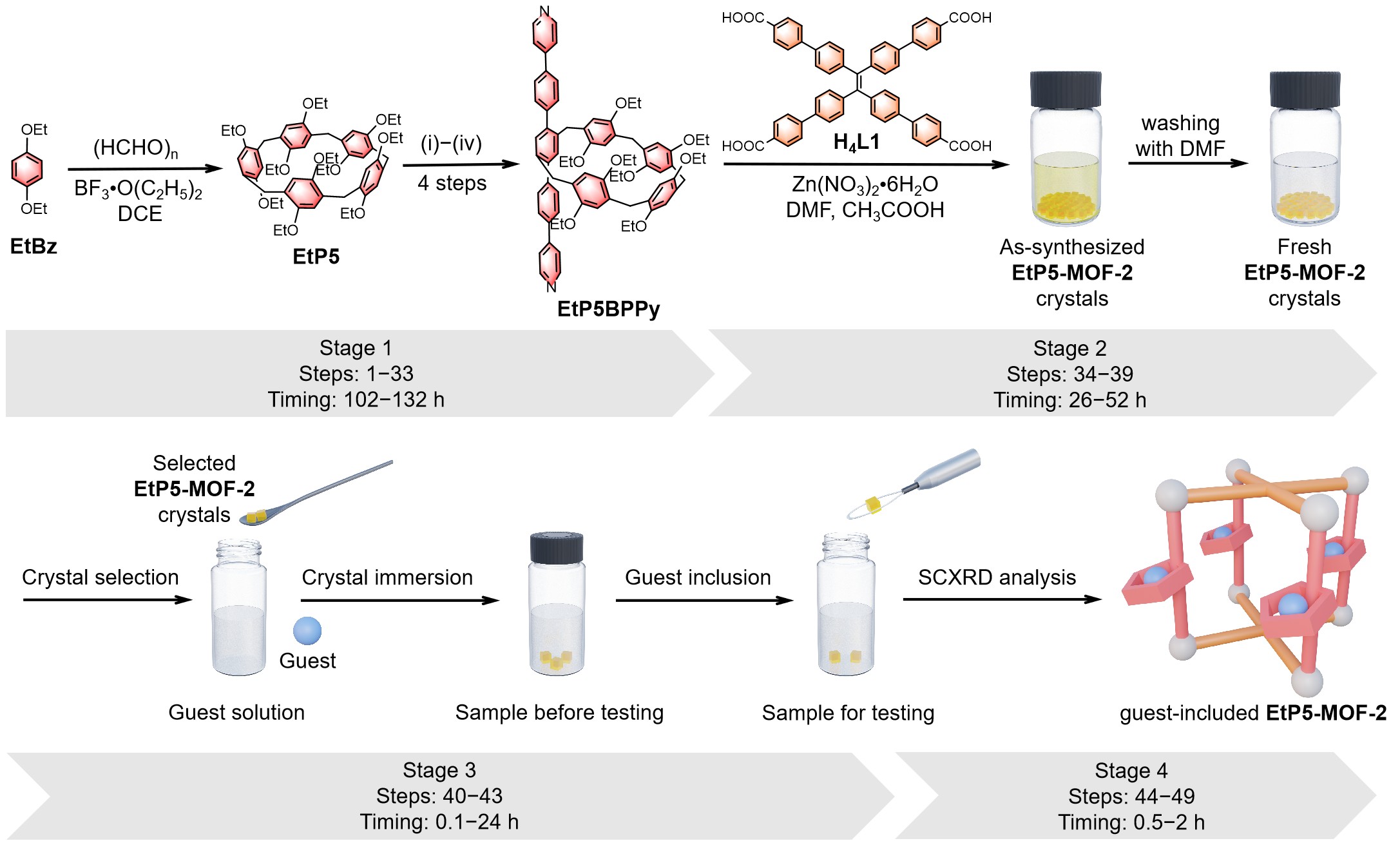
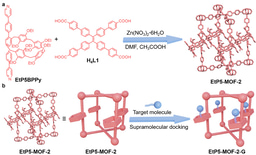
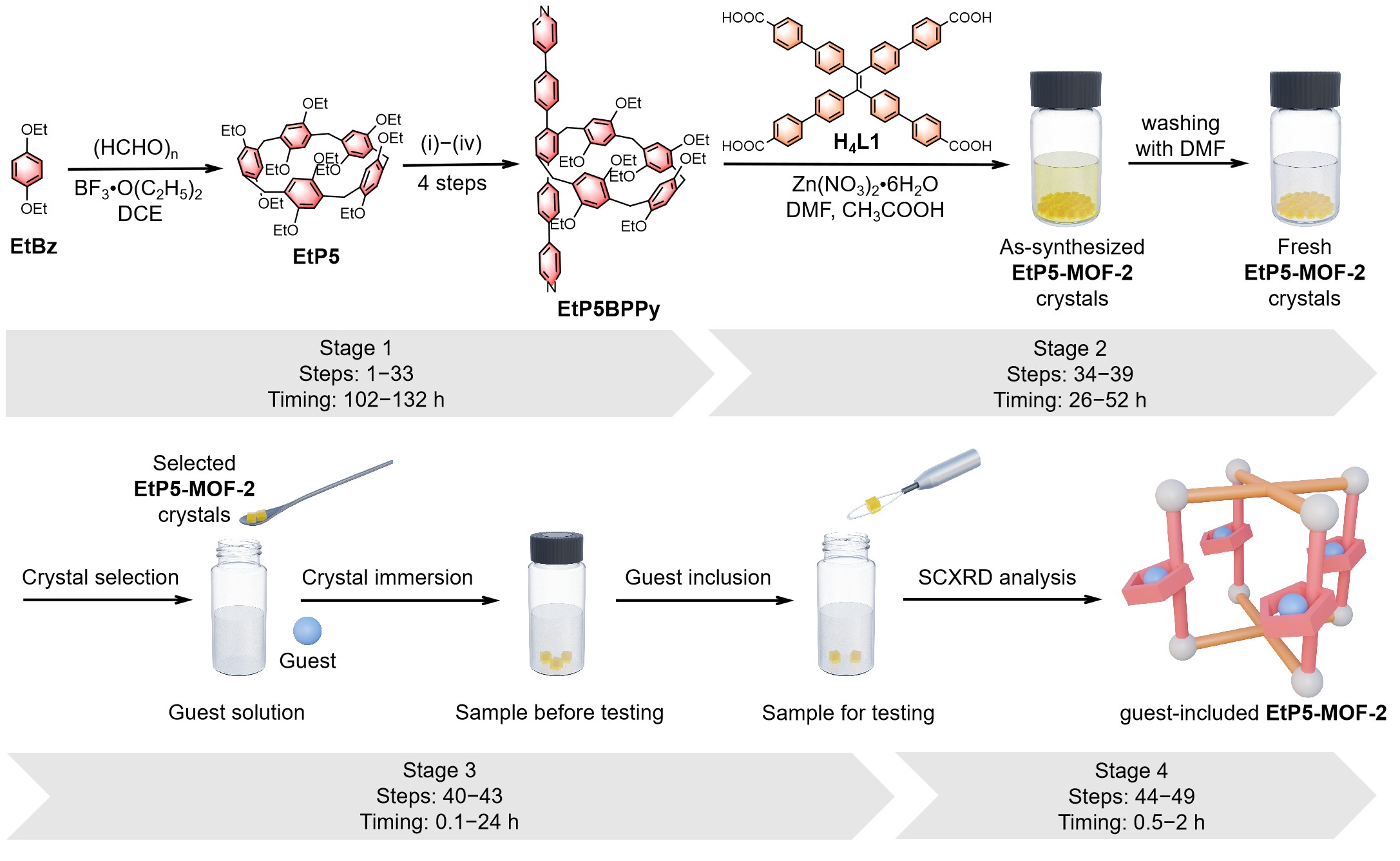
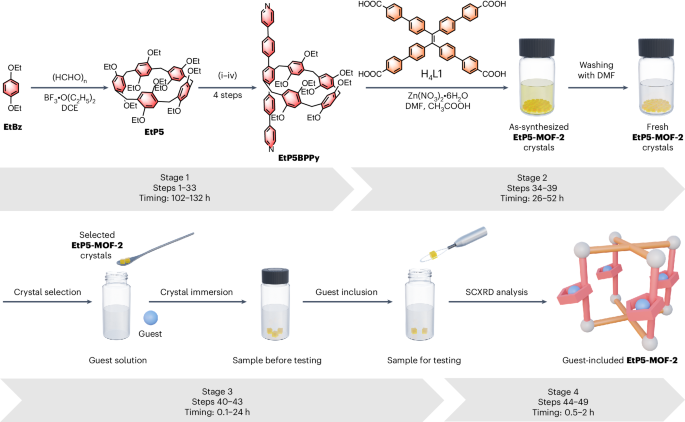
Conceptual summary of the protocols for the molecular catcher technique.
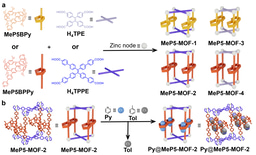
Key Findings: Building on our group’s foundation in supramolecular chemistry, we recently proposed a strategy (namely “molecular catcher” technique) for incorporating supramolecular macrocycles into MOFs to address the issue of systematic disorder while expanding the scope of target molecules amenable to SCXRD analysis. Leveraging the specific host−guest recognition between pillar[5]arene and alkyl chain-containing compounds, we designed and synthesized a pillar[5]arene-containing MOF for determining the crystal structures of alkyl chain-containing compounds and systematically reducing the disorder encountered during crystallographic analysis. This technique aims to resolve the challenges associated with determining the structures of alkyl chain-containing molecules, while providing a novel strategy for MOF-based structure analysis.
In this work, we detail the synthesis and guest inclusion protocols associated with our recently reported molecular catcher structure determination technique. We provide comprehensive experimental details that will facilitate adoption of the technique, including several typical examples and troubleshooting guidelines.
Impact: Our molecular catcher technique offers greater design diversity and simpler sample preparation. It also provides greater target molecule recognition capability, while systematically reducing crystallographic disorder. As such, it requires lower sample purities and concentrations. These putative advantages are expected to translate into greater ease in obtaining single-crystal structures of non-crystalline guests. Therefore, we believe our technique holds promise for widespread applications in research, particularly those where structure information is essential. This protocol is thus expected to attract interest across a broad range of fields, from basic scientific research to industrial applications, and from health to the environment to energy.
Follow the Topic
-
Nature Protocols
This journal publishes secondary research articles and covers new techniques and technologies, as well as established methods, used in all fields of the biological, chemical and clinical sciences.