Teaching the immune system to accept: a father, two patients, and a dream that has only just started
Published in Bioengineering & Biotechnology, Biomedical Research, and Immunology


Teaching the immune system to accept: a father, two patients, and a dream that has only just started
Behind the paper: Naïve T cell-depleted hematopoietic stem cell transplantation to minimize immunosuppression after solid organ transplantation: case report - Communications Medicine
Everything started with my father's illness.
He was diagnosed with hepatocellular carcinoma and underwent a liver transplant. The surgery went well, and he was a remarkably disciplined patient: he took his tacrolimus faithfully and exercised every single day. But the immunosuppression that keeps a transplanted organ alive came at a price. His immune system grew steadily weaker, he suffered recurrent cold sores, and, I have always believed, the same drugs that protected his new liver created the conditions for his cancer to come back. He died two and a half years after his transplant.
At the time I was a young paediatric haemato-oncologist, learning haematopoietic stem cell transplantation (HSCT) and cell therapy from some of the best physicians in the world: Rupert Handgretinger, Wing Leung, Miguel Ángel Díaz. And his death planted a question I have never been able to put down.
If in HSCT we are able to withdraw immunosuppression entirely, why can't we do the same after solid organ transplantation?
A hypothesis borrowed from leukaemia
I was finishing my thesis then, inspired by Megan Sykes's and Markus Mapara´s work on mixed chimerism, the state in which donor and recipient blood cells coexist peacefully in the same body. In leukaemia, non-myeloablative conditioning lets donor T cells attack residual leukaemic cells without destroying healthy tissue, an effect often amplified by delayed donor lymphocyte infusions. I published that work with the invaluable guidance of my thesis directors Dr. Manuel Ramírez Orellana and Dr. Miguel Ángel Díaz and spent the following two decades engineering grafts: adding what helps, removing what harms, in children with high-risk leukaemia.
Mixed chimerism is also, to this day, the only strategy that reliably induces donor-specific tolerance after organ transplantation. The idea is disarmingly simple and enormously difficult: to teach the recipient's immune system to see the donor organ as its own, while keeping intact its ability to fight infections. It is Peter Medawar's dream, made real in the laboratory.
The friend who asked the right question
The second turning point was Paco, Dr. Francisco Hernández-Oliveros, a friend since our student days at the Faculty of Medicine in Granada and now an internationally respected paediatric liver and intestinal transplant surgeon. He came to me with a question: could we treat graft-versus-host disease after intestinal transplantation the way we treat it in HSCT patients?
We began working together, built a rat model with fludarabine-based conditioning, and then moved to the everyday problems of transplanted children: viral reactivations, acute rejection, chronic rejection, and the slow, grinding burden of lifelong medication in a growing child. We launched a programme of memory T-cell infusions to control viruses, the same cells we were using in HSCT, and later during the COVID-19 pandemic.
The next step was a cocktail: CD34⁺ progenitors, plus T cells selected to be helpful rather than dangerous. In the animal lab the results were modest, the model was brutally aggressive, but we saw the fingerprints of tolerance: transient mixed chimerism, a peak of regulatory T cells, and delayed appearance of recipient T cells inside the graft. We then learned to harvest stem cells from vertebral bodies, with our eyes on the deceased donor.
“It’s his third and last chance. Are you ready?”
I was in the animal facility, working on a pig, when Paco and Dr. Manolo López Santamaría, the Head of the Pediatric Surgery Department we all call the God of transplantation, walked in and told me there was a boy who urgently needed a transplant. It would be his third and last chance. Was I ready?
I could not say no.
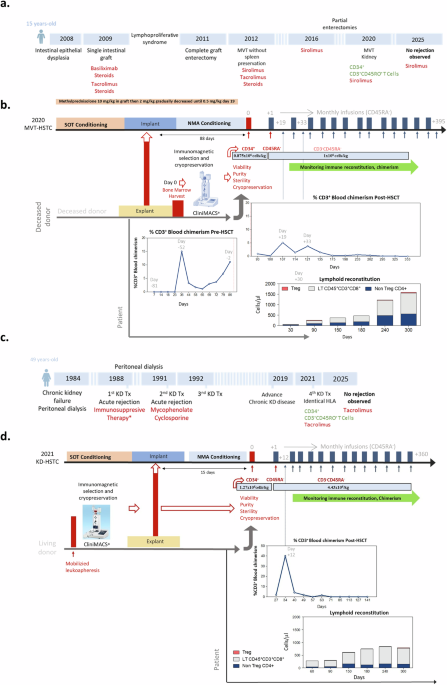
That boy is Patient #1 in our paper: fifteen years old, intestinal epithelial dysplasia caused by an EpCAM mutation, and a history of repeated rejections. His brother, with the same disease, had rejected three grafts and died. He seemed to be walking the same path. He received a multivisceral and kidney transplant from a completely HLA-mismatched deceased donor, and 88 days later, a graft of the donor's own CD34⁺ cells harvested from vertebral bodies, depleted of naïve T cells, followed by monthly infusions of memory T cells for a year.
Patient #2 came later: a 49-year-old woman receiving her fourth kidney, this time from her brother, after three previous grafts had failed.
What we found
Both patients developed the transient mixed chimerism we were looking for, briefly, imperfectly, but unmistakably. Neither developed graft-versus-host disease. Neither reactivated a virus. More than five years later, both are alive with functioning grafts, no signs of rejection, and a single drug: sirolimus for him, low-dose tacrolimus for her. In their clinical situation, a fully mismatched multivisceral recipient and a highly sensitised kidney recipient, standard care would mean two or three drugs indefinitely.
We wanted to understand why. In the laboratory, their T cells barely reacted to donor cells, yet responded vigorously to third-party cells and to cytomegalovirus: selective blindness, not global weakness. And using high-throughput TCRβ sequencing, we identified sixteen donor-reactive clones in Patient #2 before the cell therapy and could not find a single one of them afterwards.
To learn to do this, I spent time at the Columbia Center for Translational Immunology in New York, supported by Rio Hotels and the CRIS Cancer Foundation. We now run this monitoring at home, with immunologists Eduardo Pareja and Raquel Tobes.
What we did not achieve
We did not achieve operational tolerance. Both patients still take medication, and two patients are two patients: heterogeneous, exceptional, impossible to generalise from. That is precisely why we wrote this as a case report and not as a claim.
But the two cases differed in almost everything, organ, donor type, HLA match, conditioning, cell source, and behaved the same way. That consistency is what convinced us the approach was worth testing properly.
We are now running a phase I trial (NCT06997471) at Hospital La Paz with Paco's group at IdiPAZ, supported by the innovation programme of the Spanish National Transplant Organisation and the Mutua Madrileña Foundation. Building a harvesting team for procedures whose timing nobody can predict is close to impossible, yet we have completed fifteen harvests. We join the explant surgical team in the operating room, take as much as we can in about thirty minutes, and run back to the laboratory to begin our “cell surgery”.
The dance has only just started. Now it is time to make the dream universal.
In memory of my father, and with gratitude to the patients, the donors and their families, without whom none of this exists.
Follow the Topic
-
Communications Medicine
A selective open access journal from Nature Portfolio publishing high-quality research, reviews and commentary across all clinical, translational, and public health research fields.

Related Collections
With Collections, you can get published faster and increase your visibility.
Diagnosis and Care of Sepsis
Publishing Model: Open Access
Deadline: Jan 27, 2027
Exercise and Physical Activity in Health and Disease
Publishing Model: Open Access
Deadline: Dec 03, 2026