The accessory proteins of Sarbecovirus are important for their survival in cells
Published in Microbiology




Orignial paper: https://www.nature.com/articles/s41467-022-32489-5
Sarbecovirus includes SARS-CoV-2, SARS-CoV and other SARS-like viruses. This group of viruses encode a unique set of accessory proteins. Although accessory proteins are not required for replication, which gave rise to their names, they are important for virus fitness and survival in cell. One of the tasks of accessory proteins is to suppress antiviral immunity. For example, SARS-CoV-2 ORF9b and ORF6 are potent innate immune antagonists.
The heavily mutated SARS-CoV-2 variants of concern (VOCs) not only harbor major mutations in the spike protein, but also elevate the expression level of their accessory proteins ORF6 and ORF9b etc., thus, VOCs’ ability in suppressing antiviral immunity could improve.
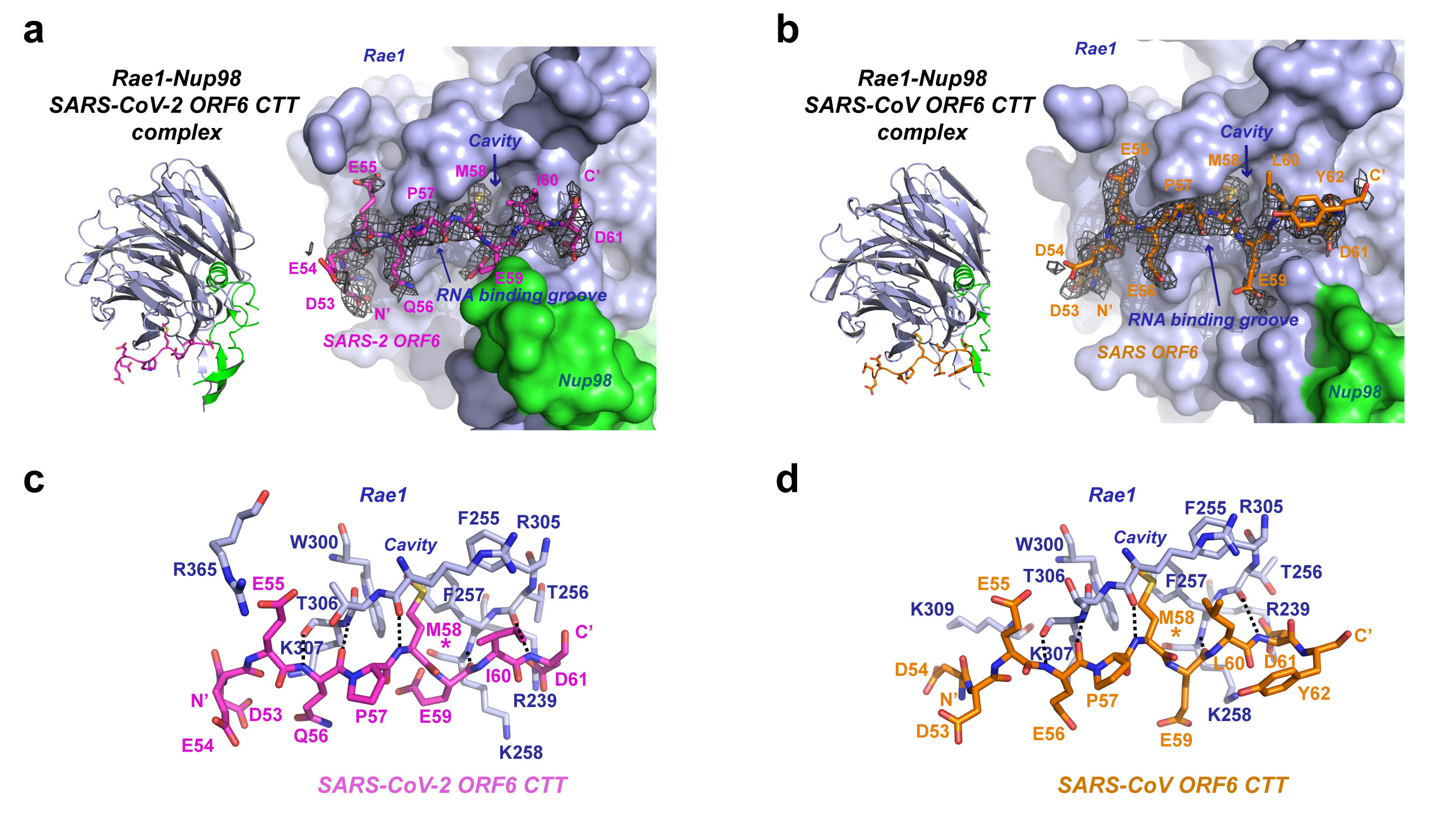
To shed light on the action of ORF6 during infection, we determined the crystal structures of Rae1-Nup98 (a component of the nucleopore complex, NPC) complexed by the C-terminal tails (CTT) of SARS-CoV-2 and SARS-CoV ORF6 respectively. We found an invariant methionine M58 of ORF6 CTT extends its side chain into a hydrophobic cavity in the Rae1 mRNA binding groove, resembling a bolt-fitting-hole; hence we call it “M-cavity”. Intriguingly, vesicular stomatitis virus (VSV) matrix protein (M) and herpesviruses MHV-68 ORF10 both target the M-cavity in Rae1 with their special methionines, VSV-M M51 and MHV-68 ORF10 M413. It is possible that the Rae1 M-cavity is the “Achilles heel” of the NPC, and this weakness is exploited by a variety of viruses (illustrated below).
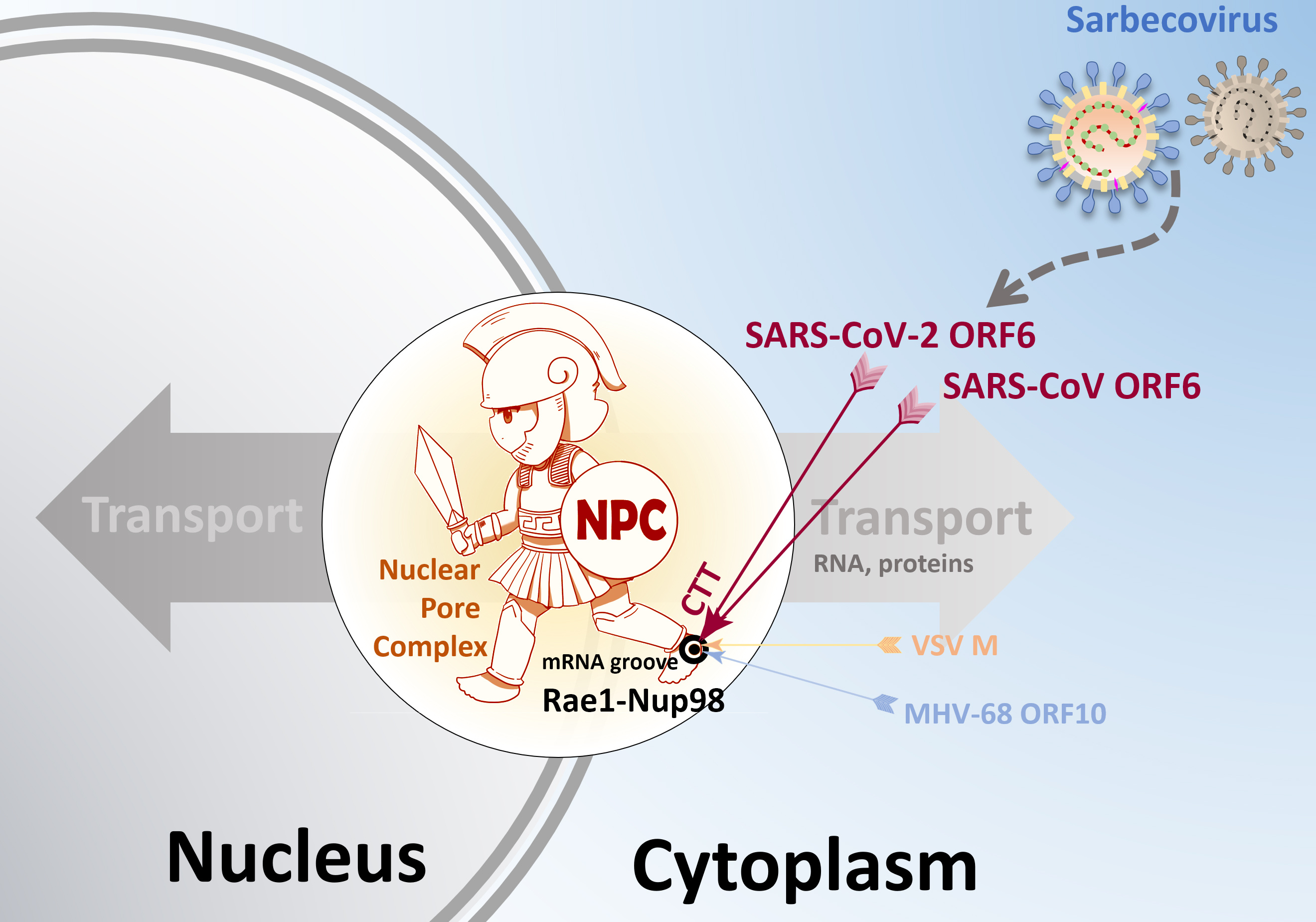
Another question to ask is: why only methionine is qualified for this interaction? Our mutagenesis studies all point out that the methionine was irreplaceable, not only for binding with Rae1-Nup98, but also for ORF6-mediated nucleocytoplasmic transportation and anti-IFN activity. An possible explanation is that methionine is the only essential amino acid having non-branched, non-aromatic hydrophobic side chain, and all that features are probably selected by the M-cavity.
Using Co-IP, nuclear and cytoplasmic RNA/protein fractionation and luciferase reporter assays, we evaluated a large selection of ORF6 mutants, and showed that ORF6-mediated blockade of mRNA and STAT1 nucleocytoplasmic transport correlated with the binding affinity between ORF6 and Rae1-Nup98. Finally, their binding affinity is also linked to ORF6-induced anti-IFN activity.
In summary, this study provides the molecular basis underlying antagonistic function of Sarbecovirus ORF6, which also implies a strategy of using ORF6 CTT-derived peptides for immunosuppressive drug development (patent pending).
The cartoon in the illustration was hand-drawn by Ms. Cui Yuchang.
Follow the Topic
-
Nature Communications
An open access, multidisciplinary journal dedicated to publishing high-quality research in all areas of the biological, health, physical, chemical and Earth sciences.

Related Collections
With Collections, you can get published faster and increase your visibility.
Women's Health
Publishing Model: Hybrid
Deadline: Ongoing
Tumor Microenvironment Crosstalk and Therapeutic Implications
Publishing Model: Hybrid
Deadline: Nov 02, 2026