The Generational Long View of AI: From Silent Cognitive Erosion to Cognitive Sustainability
Published in Social Sciences, Computational Sciences, and Philosophy & Religion


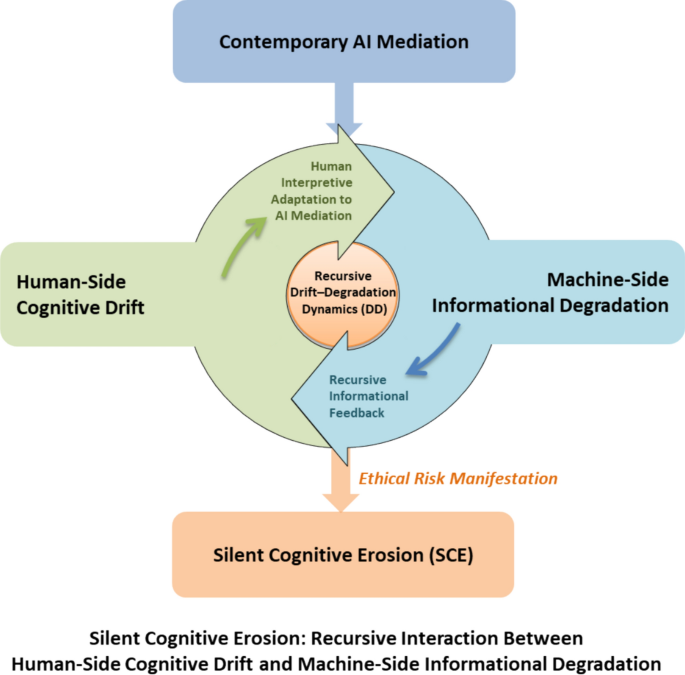

Artificial intelligence is rapidly becoming embedded in how we learn, work, communicate, decide, and govern. Much of the contemporary discussion surrounding AI focuses on fairness, transparency, accountability, explainability, safety, and regulation. These are important concerns and have significantly advanced the field of AI ethics and governance.
However, while following these developments, I found myself increasingly drawn to a different question:
What happens if AI systems become remarkably successful?
Not what happens if they fail, but what happens if they become so effective, accessible, and integrated that they mediate an increasing proportion of human cognitive and societal activities.
This question became the starting point for my article,
Ethical and Sustainable AI Mediation: A Generational Socio-Technical Framework of Silent Cognitive Erosion and Cognitive Sustainability, recently published in AI and Ethics.
https://link.springer.com/article/10.1007/s43681-026-01202-3
The idea emerged gradually through observations from education, governance, organizational systems, and the evolving information ecosystem. As generative AI tools became capable of assisting with information retrieval, writing, summarization, analysis, interpretation, and decision support, I began to wonder whether discussions about AI governance were focusing predominantly on governing intelligent systems while paying comparatively less attention to preserving the human capacities necessary to govern those systems.
Historically, societies have developed institutions, educational systems, and governance structures that depend upon human judgment, critical evaluation, contextual understanding, and oversight. Yet as AI-mediated assistance becomes increasingly integrated into everyday activities, it raises important questions about the long-term sustainability of these capacities.
This line of thinking led me to develop the concept of
Silent Cognitive Erosion (SCE).
The term does not imply a dramatic technological failure or a sudden decline in human intelligence. Rather, it describes a gradual and often unnoticed socio-technical process through which sustained AI mediation may weaken the cognitive, informational, educational, institutional, and governance capacities necessary for independent judgment, critical evaluation, interpretive autonomy, and meaningful human oversight.
The word “silent” is particularly important. Many technological risks are visible and immediate. Silent Cognitive Erosion concerns changes that may emerge slowly beneath conditions of apparent success. AI systems may continue improving efficiency, convenience, accessibility, and productivity while deeper capacities associated with verification, reflection, deliberation, and oversight become increasingly dependent upon technological mediation.
At the same time, I did not want the framework to become an argument against AI. AI possesses enormous potential to enhance learning, accessibility, innovation, healthcare, organizational effectiveness, and public services. Therefore, focusing exclusively on erosion would provide only part of the picture.
This realization led to the development of a complementary concept:
Cognitive Sustainability (CS).
Cognitive Sustainability represents the capacity of individuals, institutions, and societies to preserve and regenerate the cognitive, informational, educational, and governance conditions necessary for meaningful human participation in increasingly AI-mediated environments.
In many ways, Cognitive Sustainability became the normative foundation of the framework. It shifts the discussion from fear of technological change toward responsible and sustainable co-evolution between human societies and intelligent systems.
Another important aspect of the research was the adoption of a generational perspective. Many discussions about AI focus on immediate outcomes, short-term risks, or near-term regulatory responses. Yet some of the most important societal consequences of technological transformation unfold gradually across decades and generations.
Educational practices, institutional cultures, governance capacities, and informational ecosystems evolve slowly. Decisions made today may influence the capabilities available to future generations. This realization motivated me to examine AI mediation not merely as a contemporary technological phenomenon but as a long-term socio-technical sustainability challenge.
The framework therefore introduces a generational lens for exploring how differing balances between erosion-oriented and restorative dynamics may influence the future trajectory of AI-mediated societies.
Developing this work required integrating insights from multiple disciplines, including AI ethics, governance studies, socio-technical systems theory, distributed cognition, resilience research, information studies, and educational theory. One of the most rewarding aspects of the project was discovering how these diverse perspectives could be connected within a common framework.
Ultimately, the article argues that the future of AI governance depends not only on the capabilities of intelligent systems but also on the capacity of societies to sustain the human and institutional foundations necessary for meaningful oversight, adaptive governance, and democratic participation.
As AI continues to evolve, questions of sustainability may become as important as questions of capability.
My hope is that the concepts of Silent Cognitive Erosion and Cognitive Sustainability stimulate further discussion, empirical research, and interdisciplinary collaboration on what it means to create not only more intelligent technologies, but also more resilient and sustainable human futures.

Follow the Topic
-
AI and Ethics
This journal seeks to promote informed debate and discussion of the ethical, regulatory, and policy implications that arise from the development of AI. It focuses on how AI techniques, tools, and technologies are developing, including consideration of where these developments may lead in the future.

Related Collections
With Collections, you can get published faster and increase your visibility.
Participatory AI: Co-Designing Sociotechnical Systems
AI systems have become pervasive and deeply integrated into the fabric of social life. As they influence crucial everyday activities and decision-making processes, they hold the power to both support and harm people. Recognizing their dual potential and their sociotechnical nature is essential to rethinking how such systems are designed and how relevant stakeholders interact with them, fostering responsible and trustworthy human–AI interactions.
This topical collection examines how participatory approaches might address risks and limitations in AI-powered technologies by engaging diverse stakeholders in the design process. The collection explores what methods Participatory AI offers for shaping systems that better align with human values and community principles, while critically examining the challenges and tensions that these approaches encounter in practice.
Aim and scope
Drawing on the sociotechnical tradition that conceives social and technical elements as co-constructed, the aim of the collection is to bring together works at the intersection of sociotechnical studies and participatory design, exploring how AI and digital systems can be co-designed to reflect shared values, accountability, and agency. In particular, we welcome contributions that explore how participatory approaches can make AI systems more aligned with, responding to, and driven by specific users, communities, and contexts, rather than pursuing universal solutions. This collection emphasizes the inclusion of stakeholders in the earliest stages of decision-making, including discussions on whether a technology should be developed in the first place—welcoming submissions that ask whether these technologies are truly needed or wanted by communities.
Participatory AI is conceived not as a binary label but as a spectrum of practices and degrees of involvement, encompassing a variety of methods, intensities, and moments of engagement. Participatory approaches provide ways not only to design with and for communities to prevent bias from the outset, but also to perform bias control and mitigation in already deployed or existing AI systems, as well as possibilities of designing by communities. To advance these methods, we are also interested in critical discussions of the tensions and challenges they encounter in practice, such as the resource-intensive nature of genuine participation, how to address power imbalances that persist even in participatory settings, and how to mediate between community and individual values.
A central concern of this collection is ethical and responsible AI design, development, and deployment. Participatory approaches are uniquely positioned to both surface ethical challenges and embed values such as fairness, accountability, and inclusivity directly into the design process, rather than treating ethics as an afterthought. Submissions are expected to engage substantively with these dimensions; manuscripts addressing AI without a specific focus on ethics and/or participatory design are outside the scope of this collection.
Areas of Interest
We welcome technical and non-technical submissions with theoretical, methodological, or experimental contributions, explicitly encouraging interdisciplinary submissions.
Topics of interest include:
- Methods, frameworks, and design solutions for participatory AI (co)design
- Experiments, simulations, prototypes, or case studies of co-design processes in AI development
- Strategies for balancing individual and collective needs in AI design
- Critical reflections on the motivations, challenges, and limitations of participatory approaches
- Analyses of power dynamics and ethical considerations in participatory AI design
- Experiences and lessons learned from co-design and stakeholder engagement
- Assessing AI impacts on diverse stakeholders through participatory approaches and stakeholder engagement
This topical collection is based on the previously organized workshop Mind the AI GAP: Co-designing sociotechnical systems (https://aigap2025.isti.cnr.it/) hosted at the 4th International Conference on Hybrid Human-Artificial Intelligence, 2025, Pisa (Italy) but is also open to other non-listed topics closely aligned with the overall scope of the collection.
Publishing Model: Hybrid
Deadline: Sep 07, 2026
AI Ethics for Children and Adolescents
This topical collection invites contributions that critically examine how central concepts and theories of AI ethics function when applied to children and adolescents, and where their limits become visible. While terms such as trust, explainability, informed consent, privacy, bias, justice, and well-being are well established in AI ethics, they are usually developed with adult users and decision-makers in view, which means that in contexts concerning children and adolescents they frequently rest on assumptions that do not hold or at least require critical examination.
Children and adolescents encounter AI systems under conditions of developing autonomy, heightened vulnerability, and dependence on others, which does not mean, however, that they are merely passive objects of protection – rather, they possess emerging forms of agency and a moral right to participation and development. Ethical analysis must therefore go beyond simple transfers of adult-centered frameworks and instead ask how AI ethics concepts must be specified, adapted, or fundamentally reconceived in developmentally appropriate and relational ways, whereby it is likely to emerge that such adaptations are not only relevant for children and adolescents but can also enrich the general debate.
We welcome submissions engaging in conceptual and normative analysis, as well as ethically informed empirical work. Contributions may focus on individual concepts, compare different ethical approaches, or explore concrete application contexts, with particular welcome given to work that makes explicit which assumptions about agency, competence, responsibility, or rationality are embedded in existing AI ethics frameworks and how these assumptions are challenged by childhood and adolescence. Also of interest are contributions addressing the question of how AI systems must be designed to meet the particular needs and rights of children and adolescents, or examining what governance structures are required to ensure child-sensitive AI.
Topics
Topics may include, but are not limited to:
• Trust and trustworthiness of AI systems in childhood and adolescence, including questions of overtrust, emotional attachment, and manipulative design strategies
• Explainability and transparency under conditions of developing cognitive capacities, whereby the danger of "explainability washing" must also be considered
• (Informed) consent, shared decision-making, and participation, including the question of how concepts such as transitional paternalism are to be evaluated ethically
• Privacy, surveillance, and data protection for children and adolescents, particularly in the context of digital phenotyping and other data-intensive applications
• Bias, discrimination, and justice affecting marginalized children, whereby intersectional perspectives should also be taken into account
• AI and the well-being of children and adolescents, including the question of socialization effects of AI
• Autonomy development, vulnerability, and dependence in AI-mediated environments, whereby the role of human relationships in an AI-permeated childhood must also be reflected upon
• Ethical governance and child-sensitive AI design, including the question of democratic participation of children and adolescents in decisions about their technological future.
Please find a detailed call for papers and submission guidelines at https://link.springer.com/journal/43681/updates/27841622.
Publishing Model: Hybrid
Deadline: Nov 30, 2026
Please sign in or register for FREE
If you are a registered user on Research Communities by Springer Nature, please sign in