The importance of context in analyzing antibiotic resistance
Published in Microbiology


Our paper recently published in Microbiome is the third of what I call my trilogy on the impact of antibiotics upon the microbiome. In the first article (The ISME Journal, 2016), we determined how the intake of a commonly used antibiotic modulated the fecal microbiome. One of the strengths of this study was that we used deep shotgun metagenomics (up to 15 Gb per sample), which allowed us to not only do taxonomical profiling of the microbiomes, but also to mine these metagenomes for antibiotic resistance genes. We detected more than 43 000 putative antibiotic resistance genes!
Yes, 43 000 is a really big number. That’s a lot of potentially antibiotic resistant bacteria in only 24 healthy individuals (at three time points). At first, I was worried. Today, I see this number from a wholly different perspective.
A few months after the publication of this first article (and of the second also), I had the pleasure to attend the Advanced course on antibiotics organized by the Fondation Mérieux and the Institut Pasteur at Les Pensières, in Annecy, France (see picture above). In a nutshell, this was a two-week course about antibiotics and antibiotic resistance, given by more than a dozen experts in different areas related to the topic. It was more than a course, but also a human experience. At some point in the training, I was invited to briefly present about antibiotic resistance and the microbiome. I showed unpublished figures related to our 2016 ISME paper where specific antibiotic resistance genes were listed as prevalent in our microbiomes. At this point, an eminent microbiologist raised his hand and commented: “Many of these are present in all strains of E. coli. They are not clinically relevant. They are everywhere!”
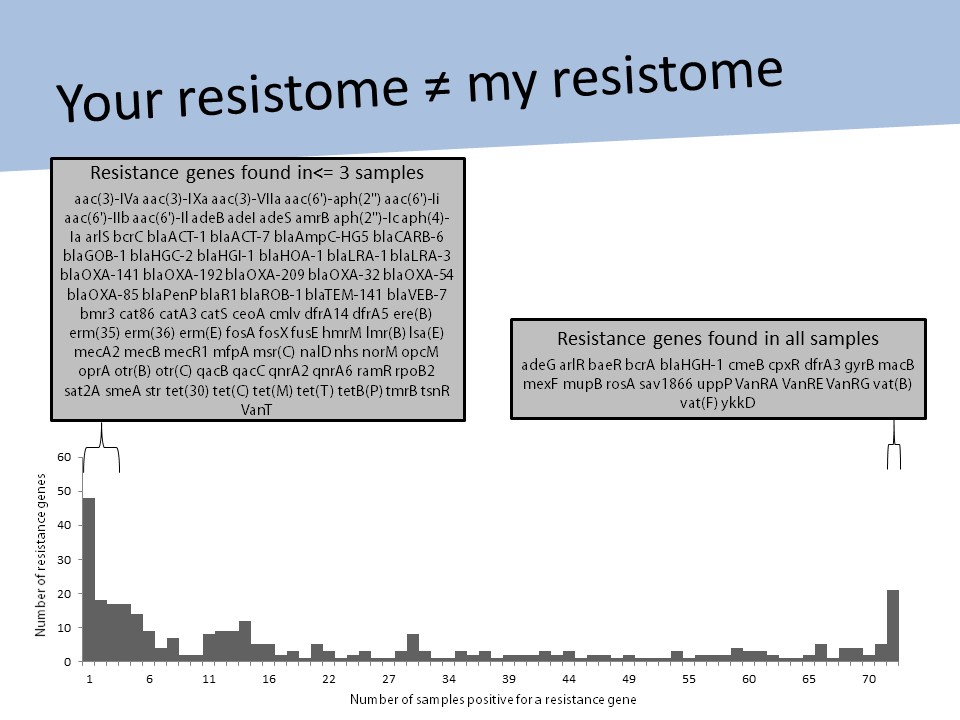
This got me thinking and, gradually, I became aware that these putative antibiotic resistance genes needed much more than cataloguing. 43 000 was just a scary number, it didn’t mean anything. These genes needed context.
Genomic context.
Epidemiological context.
Clinical context.
In the following year, my colleagues and I investigated approaches to conduct comparative genomics from a big data perspective (for example by using our Ray Surveyor software). This led me to wonder how we could use this expertise to better interpret the gene content of microbiomes based on genomes available in public databases. This is how we proceeded:
- Performed taxonomical identification of contigs containing antibiotic resistance genes.
- Annotated antibiotic resistance genes in all the available genomes from a bacterial species (for example E. coli).
- Compared the antibiotic resistance genes found in contigs potentially originating from E. coli to the genes that were actually found in E. coli genomes.
I won’t repeat here what we observed from these analyses (if you are interested, the paper is here), but it did help us in determining which antibiotic resistance genes were potentially relevant, and which had the most potential for horizontal gene transfer. How did we do that? By considering the genomic environment of these genes along with their distribution in different isolates.
The take-home message here is a single word: context.
There are so many sequences available to help contextualize our data, that we would be crazy not to use them. Truly, the only limitation here is our imagination. And maybe our computing power…
For more details, see our manuscript here: https://microbiomejournal.biomedcentra.com/articles/10.1186/s40168-019-0669-7

Follow the Topic
-
Microbiome
This journal hopes to integrate researchers with common scientific objectives across a broad cross-section of sub-disciplines within microbial ecology. It covers studies of microbiomes colonizing humans, animals, plants or the environment, both built and natural or manipulated, as in agriculture.

Related Collections
With Collections, you can get published faster and increase your visibility.
Oncobiome
This collection of papers delves into the burgeoning field of oncobiome research, exploring the intricate relationship between cancer and the microbiome. The oncobiome encompasses the diverse microbial communities residing in and on the human body, which influence cancer development, progression, and treatment responses. By examining these interactions, our aim is to unravel the complex mechanisms through which the microbiome impacts oncogenesis and therapeutic outcomes.
This compilation highlights cutting-edge research, offering insights into potential diagnostic markers and novel therapeutic strategies, thereby advancing our understanding of cancer biology and paving the way for innovative, microbiome-targeted cancer treatments.
This is a cross-journal collection between:
Experimental Hematology and Oncology
Articles will undergo the standard peer-review process of the journal to which they are submitted and are subject to either the BMC editorial policies or those of BJC Reports. Articles will be added to the Collection as they are published. The Editors have no competing interests with the submissions which they handle through the peer review process. The peer review of any submissions for which the Editors have competing interests is handled by another Editorial Board Member who has no competing interests.
Publishing Model: Open Access
Deadline: Ongoing
The Apple Microbiome
Microbiome and Environmental Microbiome are calling for submissions to our Collection on the Apple Microbiome.
With world apple production estimated at 84 million tons, the microbiome of the apple has significant implications for agriculture, food security, and human health. Understanding the complex interactions between apple plants and their associated microbial communities can lead to improved crop management strategies, enhanced fruit quality and longevity, and sustainable agricultural practices. Recent advances have highlighted the role of specific bacteria and fungi in promoting plant health and resilience against specific pathogens. Moreover, detailed profiling of these microbial communities, revealing their diversity and functional potential facilitate exciting future developments, such as the identification of beneficial microbial consortia for biocontrol and the formulation of tailored probiotic treatments for both plants and humans. By advancing our collective understanding in this area, we can work towards a more sustainable and resilient agricultural system.
Topics of interest include but are not limited to:
-Microbial diversity and function associated with apples
-Effects of soil health and rhizosphere interactions on apple production
-Impact of climate change on the apple microbiome
-Role of the apple microbiome in fruit quality
-Microbiome-driven strategies for disease resistance
This collection is open for submissions from all authors on the condition that the manuscript falls within both the scope of the collection and the journal it is submitted to.
All submissions in this collection undergo the relevant journal’s standard peer review process. Similarly, all manuscripts authored by a Guest Editor(s) will be handled by the Editor-in-Chief of the relevant journal. As an open access publication, participating journals levy an article processing fee (Microbiome, Environmental Microbiome). We recognize that many key stakeholders may not have access to such resources and are committed to supporting participation in this issue wherever resources are a barrier. For more information about what support may be available, please visit OA funding and support, or email OAfundingpolicy@springernature.com or the Editor-in-Chief of the journal where the article is being submitted.
Publishing Model: Open Access
Deadline: Sep 30, 2026