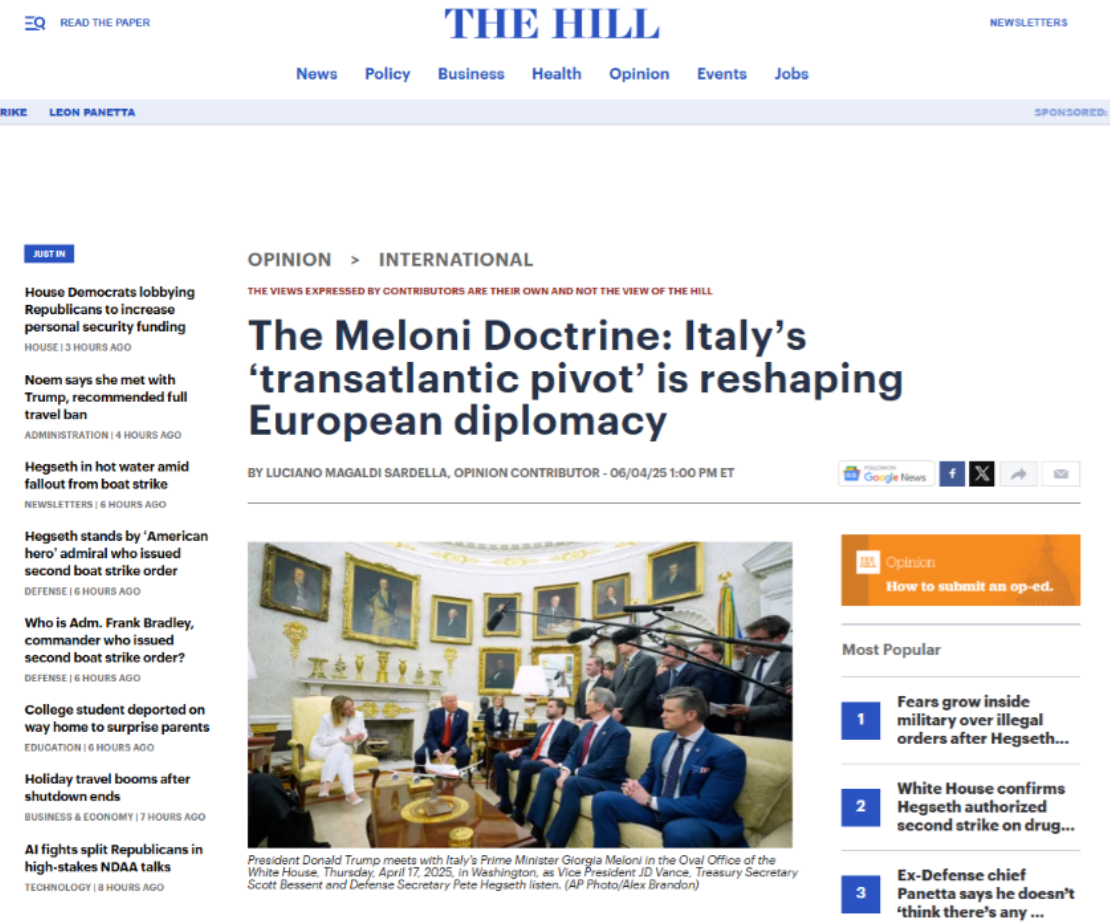
The Meloni Doctrine and Italy's Transatlantic Pivot: Repositioning Rome in Euro-Atlantic Diplomacy (THE HILL)
Published in Law, Politics & International Studies
SOURCE: https://doi.org/10.5281/zenodo.17786990
Italy's recent foreign policy trajectory marks a moment of strategic recalibration. Drawing on the Italy-United States Joint Leaders' Statement and related policy documents, this analysis examines how Rome has sought to reposition itself not as a peripheral participant but as an interlocutor between Washington and a fragmented European landscape.
Italy's foreign policy tradition and the pivot
Italian foreign policy scholarship has long described Rome's approach as one of multi-alignment anchored in three circles: European, transatlantic and Mediterranean [Diodato & Niglia, 2020; Andreatta, 2021]. The so-called Meloni Doctrine, as articulated in governmental programmes and diplomatic statements since 2022, re-emphasises the transatlantic circle as the primary organising principle, while instrumentalising the Mediterranean circle as added value for the alliance.
This is consistent with historical patterns. Since the 1949 Washington Treaty, Italy has used Atlanticism as a vehicle for international legitimation and status, a dynamic Croci and Valigi describe as 'asymmetric Atlanticism': loyalty as a resource for influence.[2013]
What distinguishes the current phase is the codification of a tripartite framework - security cooperation, shared prosperity and technological innovation - as seen in recent bilateral statements.
Security: the 2% threshold and Mediterranean energy
The first pillar concerns security. Italy's commitment to meeting NATO's 2% of GDP defence spending guideline, agreed at the 2014 Wales Summit and reaffirmed in Vilnius [NATO], is interpreted in alliance literature as both a capability and a credibility signal [Sperling & Webber, 2021]. For Italy, reaching this threshold after years of under-spending represents a strategic communication tool within the alliance.[2023]
Parallel to this, Rome has promoted its role as a Mediterranean energy gateway. Research on energy security in the Euro-Mediterranean highlights Italy's infrastructure - TAP, Transmed, LNG terminals in Piombino and Ravenna - as critical for diversification away from Russian gas. The Piano Mattei, Italy's cooperation framework for Africa officially launched in 2023, explicitly links energy partnership, development investment and migration governance. Early assessments by Carbone and others situate it within a broader attempt to reconcile development policy with geopolitical interest, moving beyond aid-centric models.[Tagliapietra][2022][Carbone][2023]
Embedding the Piano Mattei within Washington's geopolitical calculus therefore reflects a strategy of linking Mediterranean stability to transatlantic burden-sharing.
Technology: from transactional to structural partnership
The second distinctive element is the emphasis on frontier technologies: 6G and trusted-vendor ecosystems, artificial intelligence, quantum computing, biotechnology and space exploration including cooperation on NASA's Artemis programme.
This reflects an emerging field of technology diplomacy. Scholarship on digital sovereignty and trusted vendors shows that 5G/6G choices are now framed as alliance cohesion issues, with the EU 5G Toolbox and US Clean Network initiative converging around risk assessment of high-risk suppliers [Bauerle Danzman et al., 2022]. Italy's positioning as a digital-transformation hub for the Mediterranean and North Africa aligns with literature on 'digital geo-economics', where infrastructure becomes foreign policy.
Space cooperation provides continuity. Italy is a founding member of ESA and a major contributor to Artemis, with Thales Alenia Space Italy providing modules for the Lunar Gateway. Research on space diplomacy notes that Artemis Accords function as coalition-building instruments that reinforce norm-setting in cislunar governance [Dunnett et al., 2023]. Italy's participation thus links technological ambition to alliance architecture.
Reshaping European diplomacy?
Does this transatlantic pivot reshape European diplomacy? European foreign policy analysis suggests Italy is pursuing what can be termed bridging leadership: mediating between US priorities and European strategic autonomy debates at a moment of uncertainty following Brexit, war in Ukraine and US-China competition.
The Indo-Mediterranean framing, increasingly used in Italian naval doctrine and in recent academic work on the enlarged Mediterranean [Pavia & Giannotti, 2023], extends the geographic scope of Italian interests to connect Atlantic, Mediterranean and Indo-Pacific sea lines. This is not merely rhetorical; it informs naval deployments and energy diplomacy.
Critically, this approach does not imply disengagement from Europe. Rather, it follows a pattern identified by Dyson and others where Italy leverages Atlantic loyalty to increase bargaining power within the EU, particularly on fiscal rules, migration and industrial policy.[2020]
The analysis therefore contends that Italy emerges as a more assertive, values-driven but pragmatic actor seeking to stabilise the Indo-Mediterranean corridor, reinforce Western strategic cohesion, and recalibrate the balance between European representation and bilateralism in Washington.
Whether this equilibrium is sustainable will depend on two variables well-documented in alliance literature: domestic fiscal capacity to sustain defence commitments, and the ability to convert framework agreements into implementable industrial and technological cooperation.
References
Andreatta, F. (2021). Italian foreign policy in the age of uncertainty. Italian Political Science Review, 51(2).
Bauerle Danzman, S., et al. (2022). Trusted vendors and 5G. Journal of Information Technology & Politics.
Carbone, G. (2023). The Mattei Plan for Africa: continuity or change? ISPI Commentary.
Croci, O., & Valigi, M. (2013). Continuity and change in Italian foreign policy. Journal of European Integration.
Diodato, E., & Niglia, F. (2020). Italy in International Relations. Palgrave.
Dunnett, O., et al. (2023). The Artemis Accords and space governance. Space Policy, 64.
Dyson, K., et al. (2020). Italy and European economic governance. South European Society and Politics.
NATO (2023). Vilnius Summit Communiqué.
Pavia, R., & Giannotti, F. (2023). The Indo-Mediterranean as strategic space. Geopolitica.
Sperling, J., & Webber, M. (2021). NATO's 2% norm. European Security, 30(1).
Tagliapietra, S. (2022). Global Energy Transition and the Mediterranean.

- Pluriennal high-tech practictioner at Google Ireland (Dublin), Apple EU Headquarters (Cork), and Amazon Slovakia (Bratislava).
- Alumnus of Aspire Institute, Harvard Business School.
- Current Member of Harvard Aerospace and Defense Alumni Organization (HADAO).
- Former Member of the White House Historical Association (WHHA).
- Former Member of Yale Club of New Haven (YCNH).
- International Journalist with numerous pieces/interviews featured on London Daily News, New York Post, Los Angeles Journal, The Hill, The Washington Post Opinion, Fox News USA, The Associated Press, The Daily Mirror UK, Metro UK, BBC News World Services, AS USA, Yahoo, AOL, MSN, The Scottish Daily Express, The Daily Record Scotland's Champion, L' Essentiel Luxembourg, 20Minuten.ch, NYC Up Magazine, Yale Daily News, The Stanford Daily, The Psychologist, Popular Archeology, Hollywood Beats Magazine, Opera Gazet, Corriere della Sera, Blog L' Espresso-Repubblica "Fino a Prova Contraria", Blog Nicola Porro, Agenda Digitale.
- Contributing Academic Author to the "Stanford Social Innovation Review" at Stanford University.
- Contributing Academic Author to the Faculty of Law B., University of Oxford.
- Contributing Academic Book Critic to the LSE Review of Books with Executive Education Certificate in Communication from the London School of Economics (LSE) and Political Science.
- Alumnus of the Aspire Institute, Harvard Business School.
- Pro PhD and MBA at the European Open University, Germany.
- Open Researcher and Contributor ID (ORCID):
0009-0003-9392-9213
- Web of Science ResearcherID:
OYE-6074-2025
- Google Scholar:
https://scholar.google.com/citations?user=XALdgW8AAAAJ&hl=it
- Zenodo Author Page Profile:
https://zenodo.org/search?q=metadata.creators.person_or_org.name%3A%22Magaldi%20Sardella%2C%20Luciano%22&l=list&p=1&s=10&sort=bestmatch
- Academia.edu Profile: https://cambridge.academia.edu/LucianoMagaldiSardellaPhD
- ResearchGate Profile:
https://www.researchgate.net/profile/Luciano-Magaldi-Sardella