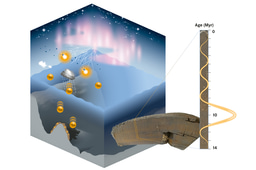
The missing curium: timing the last r-process event near Earth
Published in Astronomy, Earth & Environment, and Physics




Explore the Research
s41550-026-02841-6?utm_campaign=related_content&utm_source=HEALTH&utm_medium=communities
Kids love to ask "why?". It is this curiosity that drives science. One question that fascinated me during chemistry classes at school was not "why" but "where": where do all the elements come from?
I got my answer several years later during my studies in nuclear, particle and astrophysics. The lightest elements originate from the Big Bang, elements up to iron were forged in stars through nuclear fusion, and many of the heaviest elements are produced by either the slow or the rapid neutron-capture process, or r-process. Yet one crucial piece of the puzzle remained unresolved: where does the r-process actually happen?
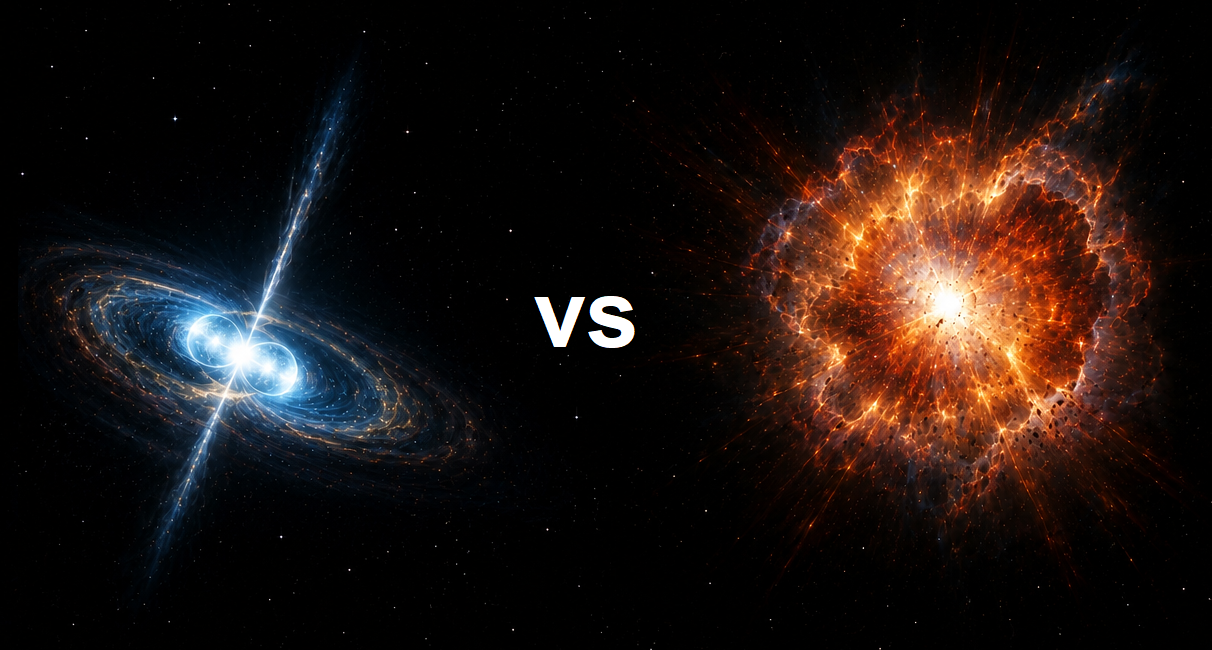
astrophysical r-process. Copyright: Dominik Koll
For decades, astrophysicists debated the answer. Supernovae were proposed, then largely ruled out. More exotic scenarios emerged. The discovery of a neutron star merger and its kilonova in 2017 provided spectacular evidence that neutron star mergers can produce heavy r-process elements. For many researchers, the case seemed almost settled.
A few atoms of plutonium-244 complicated the story
In 2021, traces of interstellar plutonium-244 were discovered in deep-sea archives on Earth. Intriguingly, the signal appeared to overlap with a previously observed influx of iron-60, a radioactive isotope that is widely regarded as a fingerprint of nearby supernova explosions. If both isotopes originated from the same event, it would suggest that at least some supernovae can produce heavy r-process nuclei. Such a result would have major implications for our understanding of cosmic element production. There was only one problem: the plutonium measurements lacked the time resolution needed to test this idea.
This became the starting point of our study. To investigate the origin of plutonium-244, we turned to one of the most unusual archives of cosmic history available on Earth: deep-sea ferromanganese crusts. These crusts grow only a few millimetres every million years and preserve traces of interstellar material arriving at Earth layer by layer over tens of millions of years.
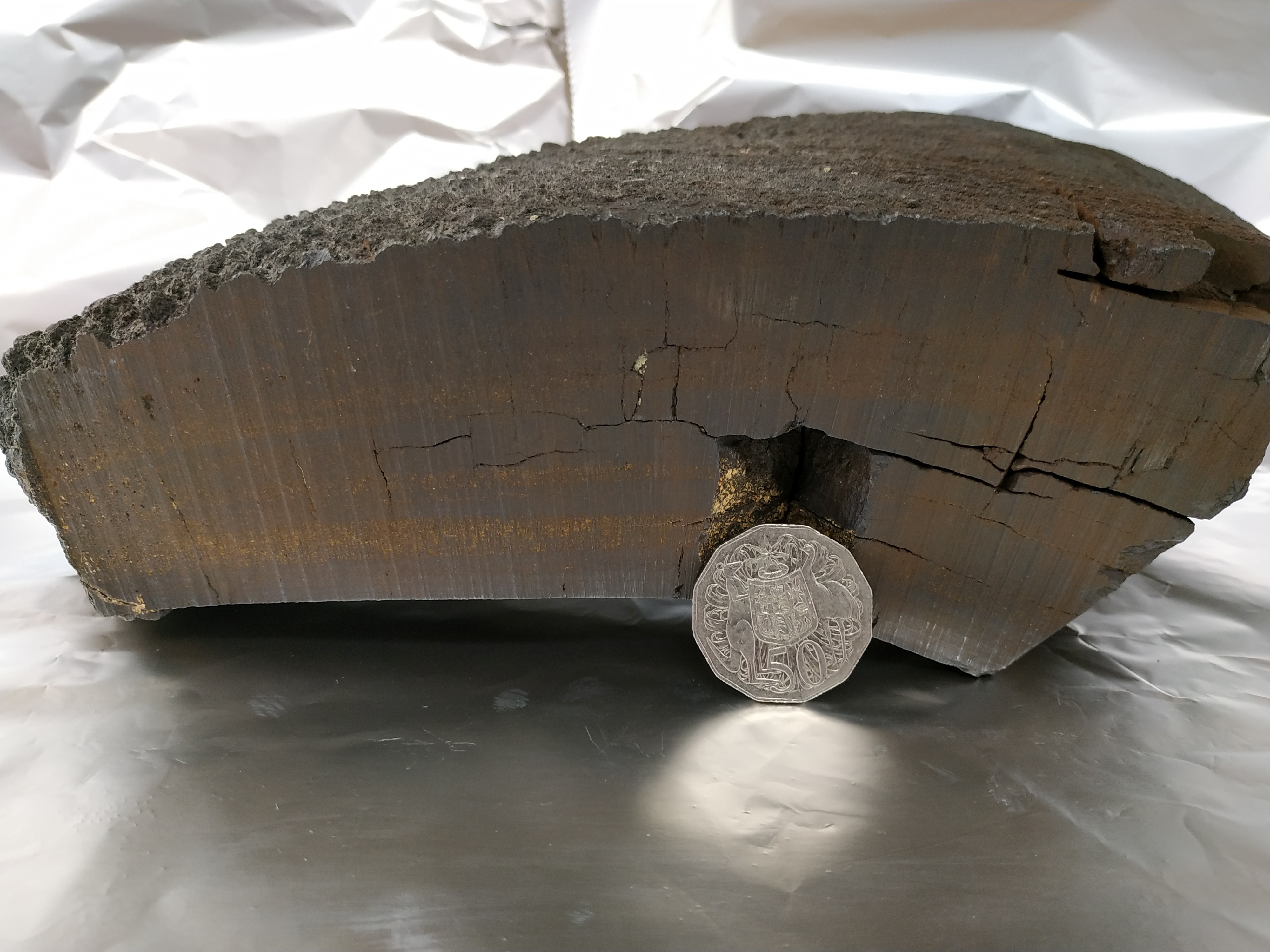
Working with these samples is challenging. In some layers, only a handful of plutonium-244 atoms are present. Detecting them requires accelerator mass spectrometry operating at the limits of sensitivity. A single plutonium atom may be hidden among roughly ten quadrillion other atoms, the needle in the endless haystack. This is because the influx of extraterrestrial plutonium is one atom at a time; only 0.06 g of plutonium-244 were dispersed across the whole world over a million years, the equivalent of a pinch of salt.
Our goal was not simply to detect plutonium-244, but to reconstruct its history through time. To achieve this, we divided a Pacific ferromanganese crust into individual layers and measured the concentrations of plutonium-244, iron-60 and curium-247. At the same time, we established a detailed age model using optical imaging, X-ray scans and cosmogenic beryllium-10 dating, allowing us to place every detected atom on a common timescale.
A cosmic veil emerges
If plutonium-244 originated from the same nearby supernovae that produced the iron-60 signal, we expected the two isotopes to show a similar temporal pattern. Instead, we found something different.
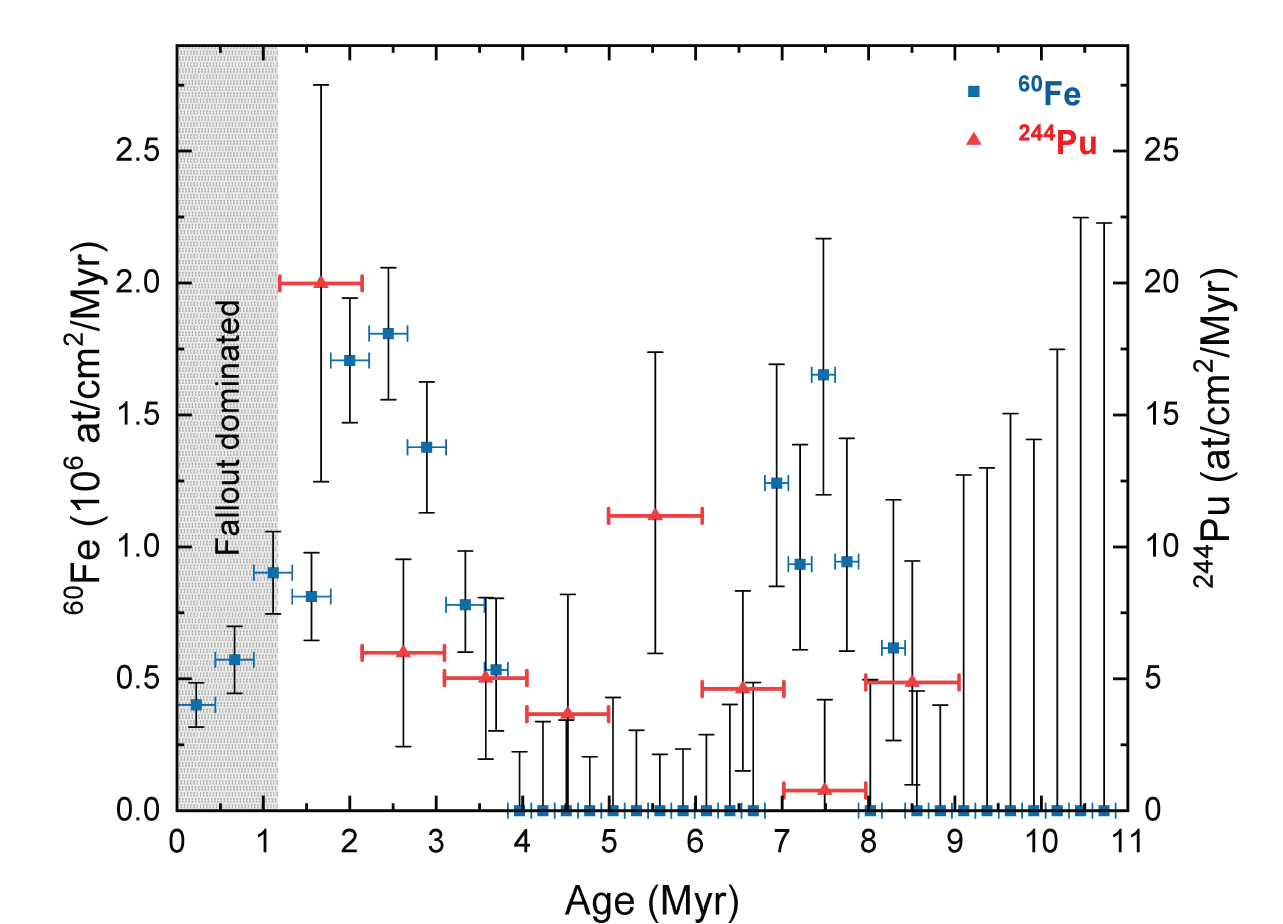
in the ferromanganese crust VA13-237KD over 10 million years.
No clear correlation between both isotopes is discernible.
Copyright: Nature Astronomy
The iron-60 record exhibits clear peaks corresponding to nearby supernova explosions a few million years ago. The plutonium-244 signal, however, appears much more uniform. Rather than tracing individual recent events, it resembles a persistent signal spread over millions of years. The picture that emerged was that of a cosmic veil. The plutonium could have been produced long before it reached Earth and had already become thoroughly mixed throughout the interstellar medium.
But we needed an independent test before drawing conclusions.
The radioactive twins
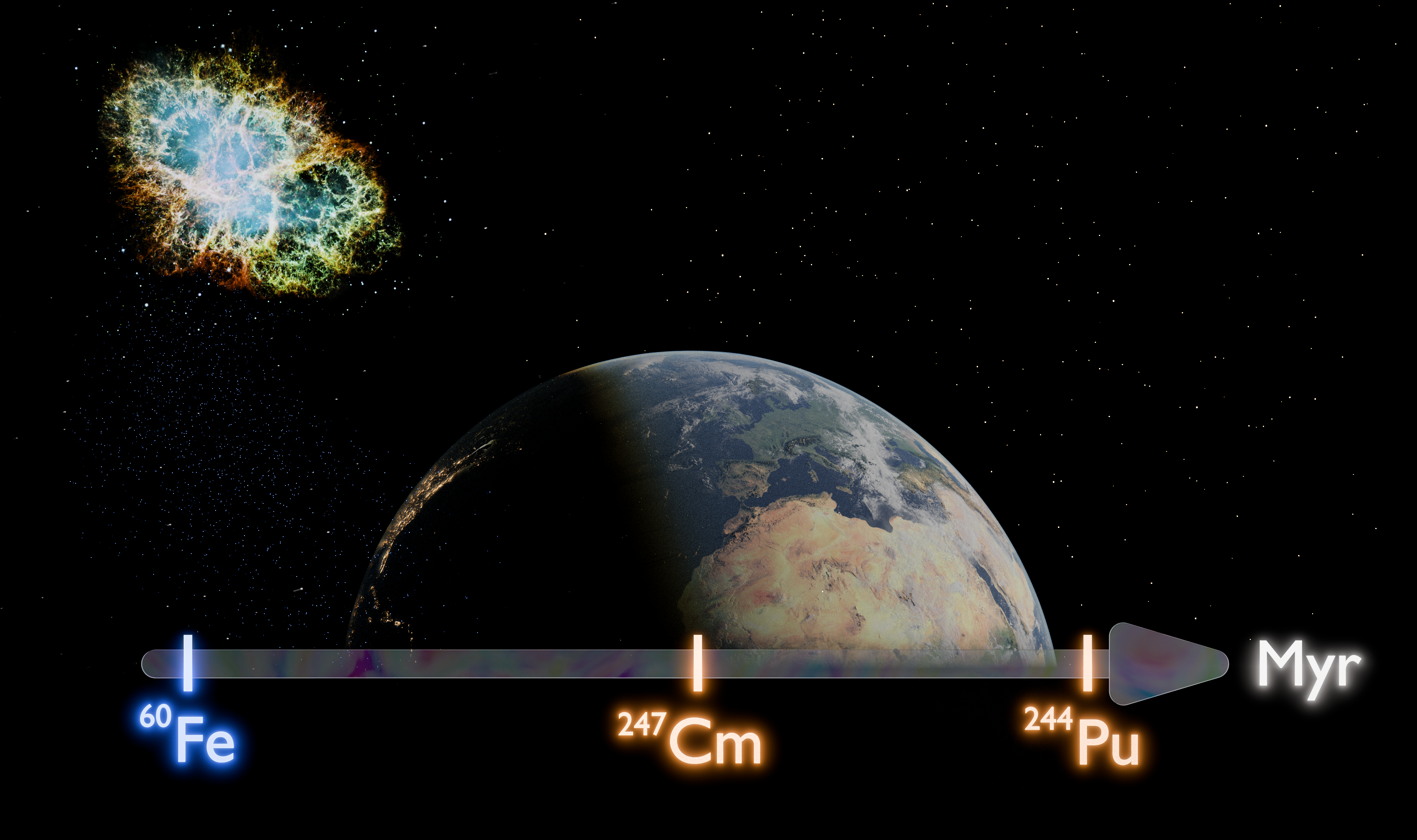
That test came from an isotope we never detected. Like plutonium-244, curium-247 is produced in the r-process. In many ways, the two nuclides are cosmic twins. They are born in the same astrophysical event and are expected to be produced in comparable amounts. The crucial difference is that curium-247 decays much faster. Its half-life is only 15.6 million years, compared with about 80 million years for plutonium-244. This means that the ratio between the two isotopes acts as a natural cosmic clock.
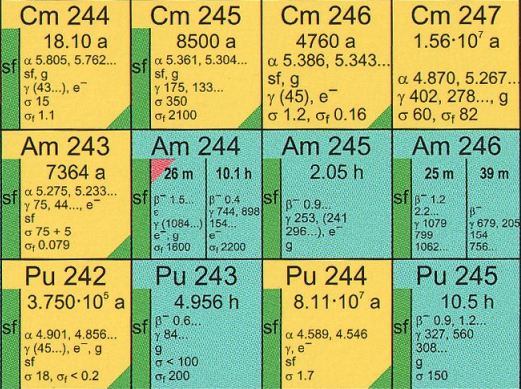
These two isotopes are the only transuranium isotopes
with half-lives beyond 10 million years.
Copyright: Nucleonica
If the r-process event that produced the plutonium had occurred relatively recently, some curium-247 should still be present today. Supernovae are relatively frequent with a few near-Earth supernovae happening over the last 10 million years.
If the event was sufficiently ancient, the curium-247 would have disappeared through radioactive decay while some plutonium remained. Rare events such as neutron star mergers occur about 1,000 times less frequently than supernovae.
The case of the missing curium
We searched for curium-247 with the highest sensitivity currently achievable. We found nothing except small traces of curium from the devastating nuclear weapons tests. And that turned out to be exactly what we were looking for.
At first glance, a non-detection of cosmic curium might seem disappointing. In reality, it became the key result of the entire study. The detection of nuclear weapons curium showed that the ferromanganese crust can incorporate curium similar to plutonium. The absence of cosmic curium-247, however, indicates that the r-process event responsible for the plutonium-244 detected on Earth must have occurred more than 100 million years ago. In other words, the plutonium-244 arriving at Earth over the last million years is not the direct product of nearby supernovae . Instead, it appears to be the lingering veil of a much older and much rarer astrophysical event, such as a neutron star merger.
Our results offer a glimpse into the recent nucleosynthesis history of the Solar System's galactic environment. They suggest that heavy r-process material was injected into the interstellar medium by a rare event more than 100 million years ago and subsequently dispersed throughout the Galaxy before a tiny fraction eventually reached Earth.
Further into the past
And the story is not over. Measurements of lunar samples are already underway and could extend this record hundreds of millions of years further into the past. At the same time, next-generation accelerator mass spectrometry facilities such as HAMSTER, currently under construction in Dresden, Germany, will allow us to search for additional radionuclides and open new windows onto the origin of the heavy elements.
It is remarkable that a handful of atoms hidden inside a deep-sea crust can reveal events that happened more than 100 million years ago. Yet this is precisely what makes these radionuclides such powerful cosmic messengers. Long after the original explosion faded from the sky, they continue to preserve its memory in the geological archives of Earth.
For me, they also provide some answer to a question I should have asked myself during school days: "when" were the elements produced.

Follow the Topic
-
Nature Astronomy
This journal welcomes research across astronomy, astrophysics and planetary science, with the aim of fostering closer interaction between the researchers in each of these areas.