The paradox of benign histology and malignant behavior: lymphatic metastasis in pleomorphic adenoma
Published in Biomedical Research

Explore the Research
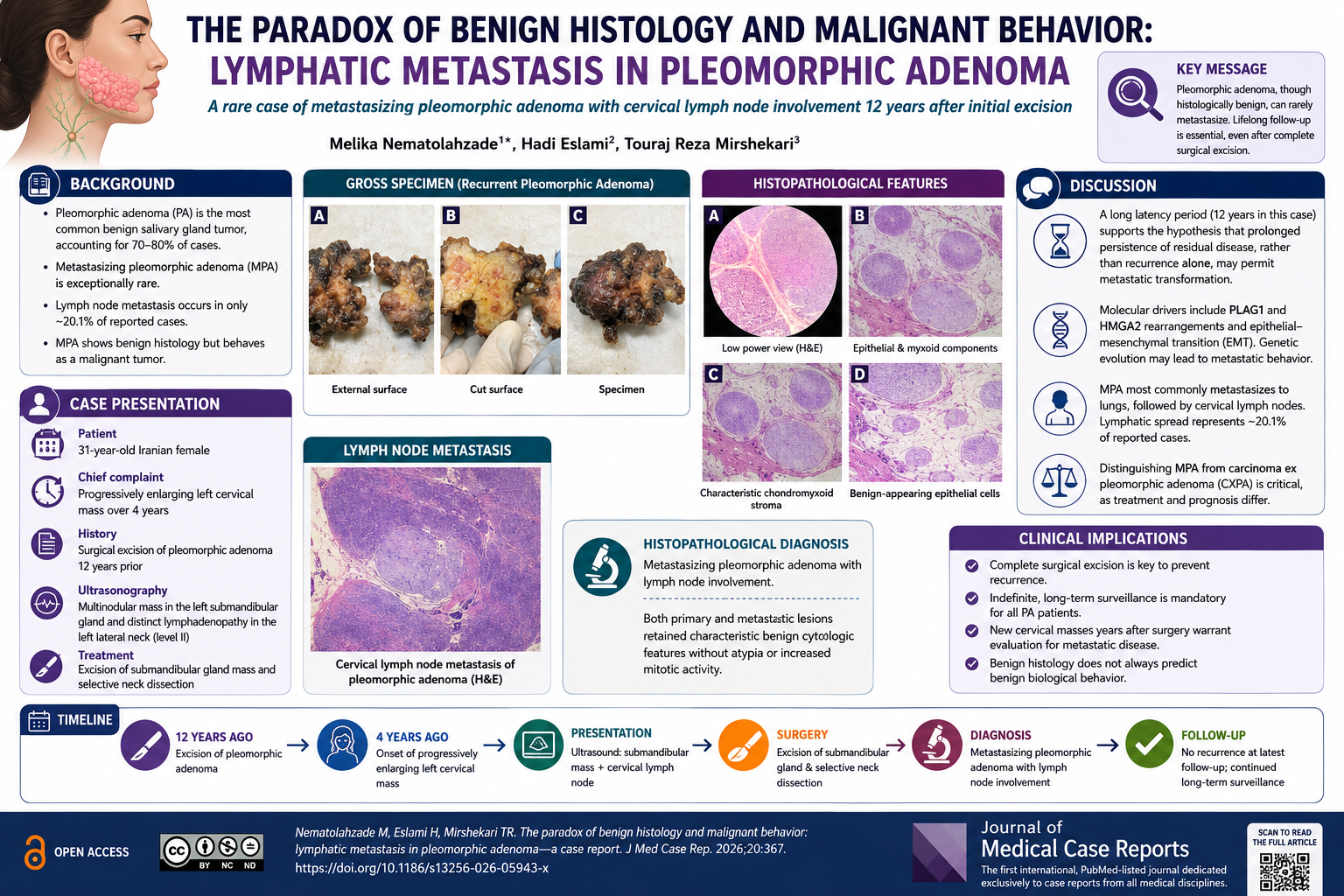
The paradox of benign histology and malignant behavior: lymphatic metastasis in pleomorphic adenoma—a case report
Background
Pleomorphic adenoma (PA) is the most common benign salivary gland tumor. Metastasizing pleomorphic adenoma (MPA) is an exceptionally rare entity in which histologically benign tumor cells spread to distant sites. Cervical lymph node involvement accounts for only about one-fifth of reported metastatic cases, making diagnosis particularly challenging.
The Case
A 31-year-old Iranian woman presented with a progressively enlarging left cervical mass that had developed over 4 years. Twelve years earlier, she had undergone excision of a pleomorphic adenoma. Ultrasonography demonstrated a multinodular submandibular mass and a separate enlarged level II cervical lymph node.
The patient underwent submandibular gland excision and selective neck dissection. Histopathology revealed recurrent pleomorphic adenoma with metastatic involvement of a cervical lymph node. Despite metastatic behavior, both lesions retained classic benign cytologic features without significant atypia or increased mitotic activity.
Why This Case Matters
This report illustrates one of pathology's most intriguing paradoxes: a tumor with benign microscopic appearance behaving as a malignant neoplasm. The 12-year interval between the original surgery and metastatic presentation supports the growing hypothesis that prolonged persistence of residual tumor cells, rather than recurrence alone, permits acquisition of metastatic potential.
Although molecular studies implicate PLAG1, HMGA2, epithelial–mesenchymal transition, and subsequent genetic evolution, advanced molecular testing is not always available. This case demonstrates that careful clinical correlation remains essential even when histology appears reassuring.
Clinical Implications
Complete surgical excision of the primary lesion remains the cornerstone of preventing recurrence. More importantly, patients with a history of pleomorphic adenoma require indefinite long-term follow-up, particularly after recurrence or incomplete excision, because metastatic disease may emerge many years after apparently successful treatment.
Clinical Take-Home Message
Histologic benignity does not always predict benign biological behavior. In patients with a history of pleomorphic adenoma, new cervical masses—even more than a decade after surgery—should prompt evaluation for metastasizing pleomorphic adenoma, reinforcing the importance of lifelong clinical surveillance.
Reference
Nematolahzade M, Eslami H, Mirshekari TR. The paradox of benign histology and malignant behavior: lymphatic metastasis in pleomorphic adenoma—a case report. Journal of Medical Case Reports. 2026;20:367. https://doi.org/10.1186/s13256-026-05943-x
Journal of Medical Case Reports is the world's first international, PubMed-listed medical journal devoted to publishing case reports from all medical disciplines and original research relating to case reports. The journal is fully open access and strongly endorses the CARE guidelines, requiring authors to submit completed CARE checklists to improve transparency and quality in case reporting.
Richard Alan Rison is the interim Editor-in-Chief of Journal of Medical Case reports. He is also an associate neurology editor (editorial board) for BMC Neurology, and the former lead editor for case reports of BMC Research Notes (currently on the editorial board). His scholarly work focuses on medical case reporting, reporting standards, and editorial methodology. Dr. Rison participated in the development and dissemination of the CARE guidelines for clinical case reporting and has authored numerous publications addressing both neurological disorders and the role of case reports in advancing medical knowledge. Dr. Rison practices general neurology and served as the founding medical director of the PIH Health Hospital-Whittier Stroke Program and the PIH Health Hospital-Whittier Non-Invasive Vascular Laboratory, is a clinical assistant professor of neurology at the University of Southern California Keck School of Medicine and Los Angeles County Medical Center, and is a Fellow of the American Academy of Neurology, the American Neurological Association, and the American Association of Neuromuscular and Electrodiagnostic Medicine. Dr Rison is board-certified by the American Board of Psychiatry and Neurology in neurology and vascular neurology, and neurocritical care and neuroimaging by the United Council of Neurologic Subspecialties. He is also board-certified by the American Board of Electrodiagnostic Medicine in electrodiagnostic medicine. Dr. Rison is a former president of the Los Angeles Neurological Society.
Follow the Topic
-
Journal of Medical Case Reports
This journal will consider any original case report that expands the field of general medical knowledge, and original research relating to case reports.



Please sign in or register for FREE
If you are a registered user on Research Communities by Springer Nature, please sign in