The Photocatalysis Lie: Why Floating Catalysts Are an Engineering Dead End
Published in Chemistry, Earth & Environment, and Materials
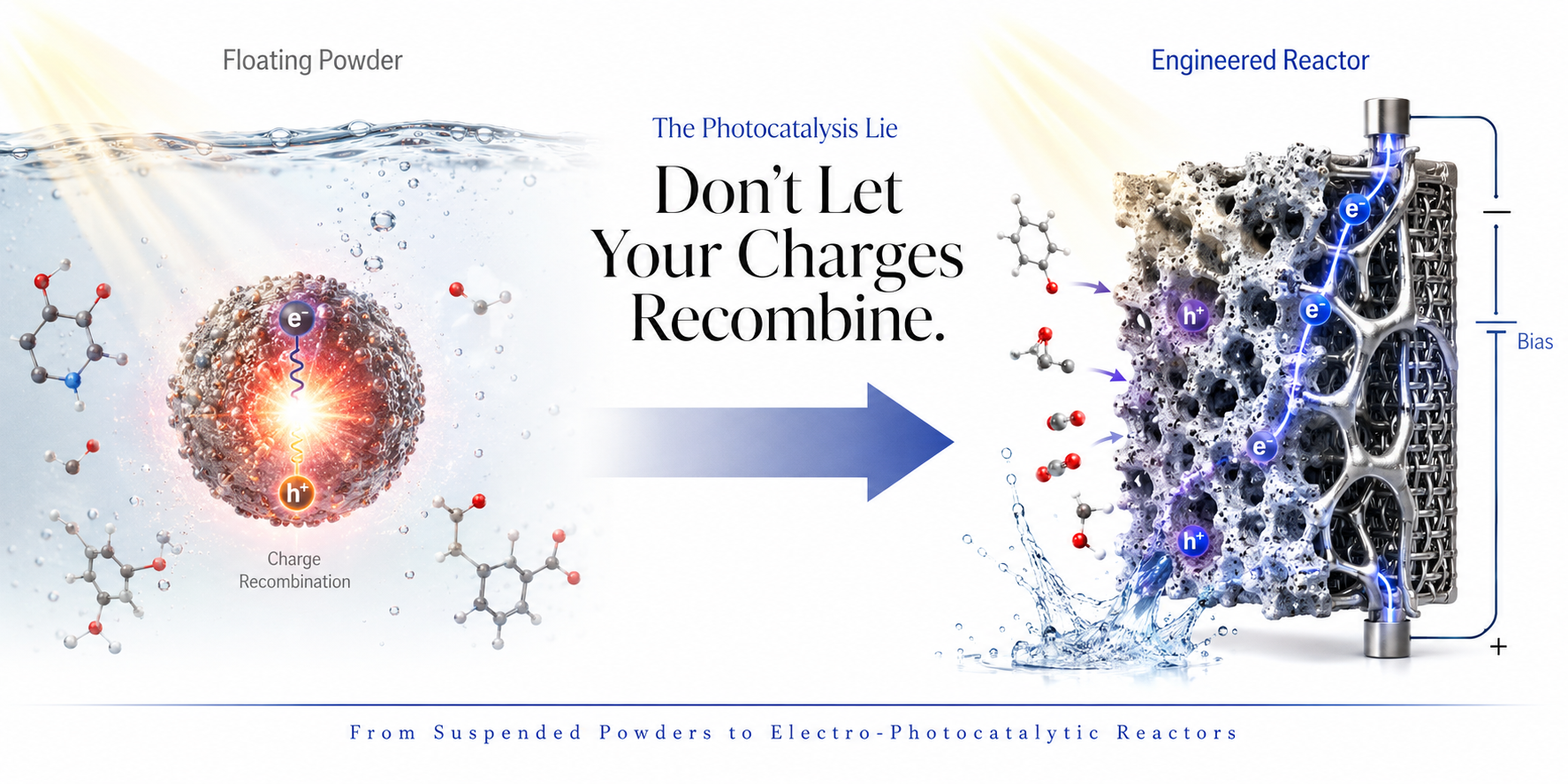
The Academic Obsession with "Suspended Powders"
Solar-driven photocatalysis is often marketed as the ultimate green chemistry solution for wastewater remediation. The narrative is beautiful: dump a semiconductor powder into contaminated water, shine sunlight on it, and watch organic pollutants magically degrade into carbon dioxide and water.
This narrative secures massive funding and fills high-impact journals. But from an engineering standpoint, it is a complete fantasy.
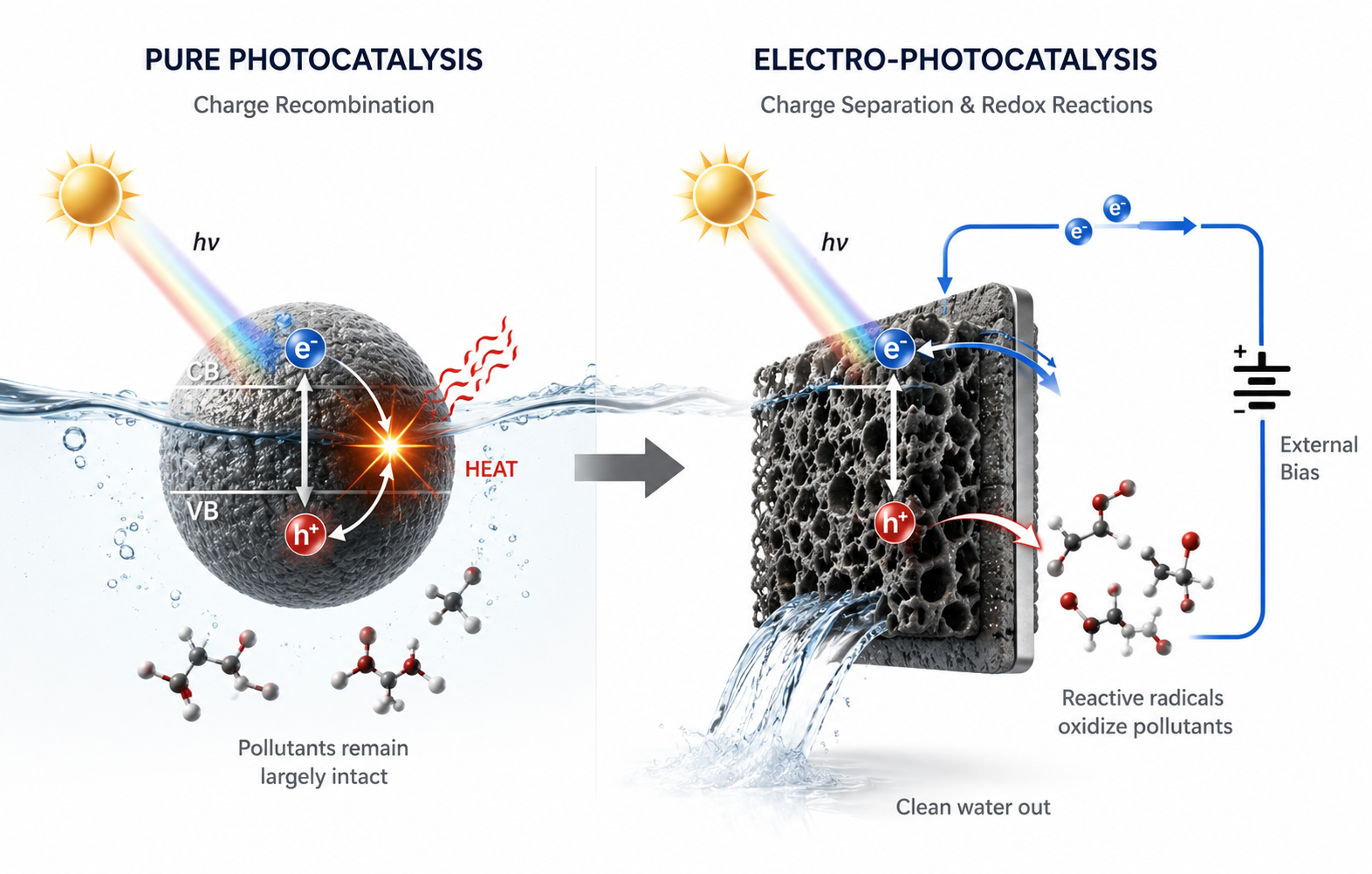
Suspended, floating nanoparticle catalysts suffer from two fatal flaws that the literature routinely downplays. First, the electron-hole pairs generated by light recombination occur in nanoseconds—meaning the vast majority of the harvested solar energy is wasted as heat before it can ever generate a reactive radical. Second, how do you get the nanoparticles back out of the water? Pumping treated water through downstream ultrafiltration just to recover a powder destroys the entire energy ledger of the process.
Enter Electro-Photocatalysis: The Electric Remedy
To cross the chasm from a laboratory curiosity to a scalable municipal technology, we must stop relying on light alone. We must introduce an external electrical bias. By immobilizing the photocatalyst onto a conductive substrate and applying a tight, low-voltage potential, we create an electro-photocatalytic (EPC) system.
The applied electrical bias acts as an atomic-scale vacuum cleaner. The moment light excites an electron to the conduction band, the electric field forcefully sweeps that electron away through the external circuit, leaving the photogenerated hole behind on the catalyst surface.
By physically separating the charge carriers, we extend their lifetime by orders of magnitude. We transform a sluggish, recombination-dominated process into a highly efficient, continuous radical factory.
Solving the Mass Transfer Bottleneck
Immobilizing the catalyst on an electrode substrate solves the recovery problem—no more filtering powder out of effluent. But it introduces a new engineering challenge: mass transfer limitations. In a static reactor, pollutants must passively diffuse to the flat electrode surface to be destroyed.
The future of EPC lies in hierarchical, porous electrodes. By casting photo-reactive heterojunctions onto macro-porous, flow-through networks, we can force wastewater through the electrified, illuminated catalyst matrix. This setup maximizes fluid contact with the active sites, ensuring that recalcitrant pharmaceuticals and industrial dyes are destroyed on contact under ambient solar flow.
Conclusion
We must stop pretending that floating nanoparticle powders are a viable solution for municipal water infrastructure. The path to real-world deployment requires us to merge photo-materials science with electrochemical engineering. Bias-potential electro-photocatalysis is the only architecture robust enough to turn solar water remediation from an academic trend into a scalable reality.
What do you see as the biggest bottleneck holding back electro-photocatalytic reactors—substrate degradation under continuous solar/anodic stress, or the capital cost of designing dual-source (solar + grid) reactor modules?

Dr. Akeem Adeyemi Oladipo is a globally recognized Research Professor of Materials and Environmental Chemistry at Eastern Mediterranean University. Ranked among the world's Top 2% Scientists, his expertise bridges nanotechnology, renewable energy, and electro-analytical chemistry. He specializes in advanced materials synthesis for wastewater treatment, highly sensitive electrochemical biosensors, and solar energy conversion. By integrating machine learning and artificial neural networks, his research drives scalable deep-tech innovations in environmental sustainability and energy storage.

Please sign in or register for FREE
If you are a registered user on Research Communities by Springer Nature, please sign in