The Scientific Knowledge Layer for R and D
Published in Protocols & Methods and Computational Sciences


A promising discovery can arrive at a portfolio meeting with an impressive slide and a surprisingly incomplete history. Which experiment supports the claim? Does the result hold in the relevant biological system or material phase? Has another team already tried it? Who can authorise the next step?
Consider three illustrative proposals: investigate a pulmonary fibrosis target, synthesise a battery electrolyte, and evaluate an existing drug for a new indication. Each has a persuasive scientific story. Each also depends on evidence, experimental conditions, unresolved questions and people with different decision rights. Reading more papers helps, but it does not by itself connect those dependencies.
The proposal in this article is a scientific knowledge layer: a maintained representation of scientific entities, evidence, experiments, decisions and the operating structure responsible for them. Its purpose is to make the reasoning behind R&D work inspectable and reusable. A researcher should be able to follow a recommendation back to its sources. A programme leader should be able to see the next experiment, its owner and the evidence that could change the decision.
Published research demonstrates useful components of this approach, including interoperable biomedical graphs, literature-derived materials graphs and graph-based drug prioritisation. The enterprise operating model developed here is a synthesis and design proposal. The three workflows are illustrative applications, not deployments or outcomes reported by the cited studies.
Give every decision a memory
A scientific knowledge layer connects four kinds of information.
Scientific meaning identifies the things being discussed: a gene, protein, cell state, disease, chemical structure, crystal phase or physical sample. Evidence records what was observed or predicted, under which conditions, and where the claim came from. Work describes the experiments, analyses and decisions that use that evidence. Accountability identifies the roles responsible for reviewing a claim, running a study and approving a next step.
The FAIR principles provide a foundation for making research objects findable, accessible, interoperable and reusable. They address machine use as well as human reuse; they do not prescribe a graph database or establish that an accessible dataset is scientifically reliable. [1]
BioCypher provides a concrete biomedical example of configurable integration. Its framework separates data adapters, ontology mapping and output representation, helping researchers construct graphs suited to their scientific tasks. The relevant enterprise lesson is to maintain shared identifiers and explicit mappings while allowing different programmes to use different views of the same underlying knowledge. [2]
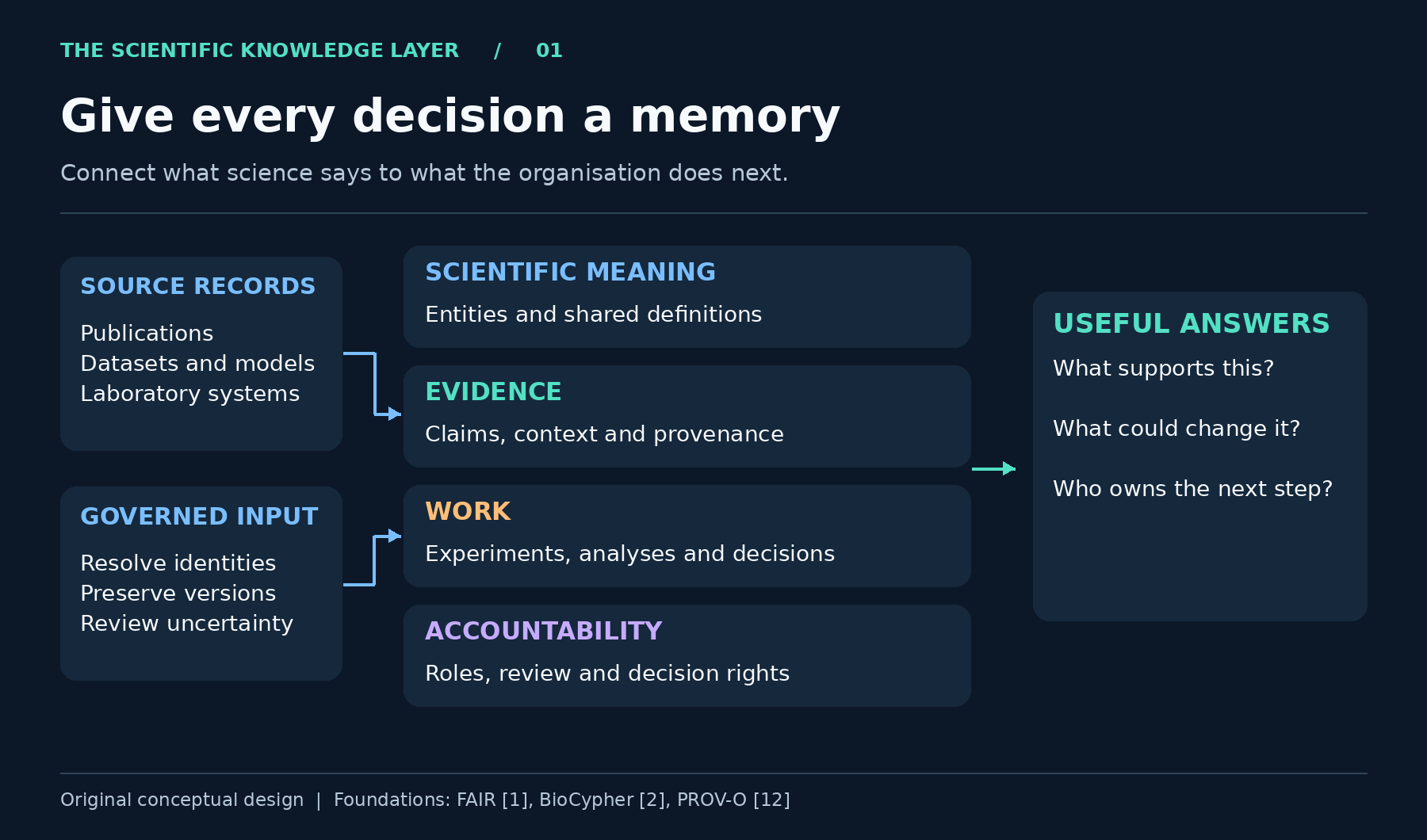 Figure 1. Proposed architecture. Existing repositories retain their records; the knowledge layer connects selected entities and evidence to work and responsibility. Original illustration; conceptual, not a measured result.
For example, an observation about a protein should be linked to the assay and biological context in which it was measured. A decision to investigate that protein should link to the observation, competing evidence and the programme role that accepted the next step. These links allow a new finding to trigger review of a specific decision rather than another broadcast email.
Give every claim an evidence passport
A paper is a container for many claims. Some are direct measurements; others are model outputs, interpretations or hypotheses. Storing only a paper-to-topic link loses these distinctions.
Represent important claims as records in their own right. Each should include the subject and relationship asserted, the object or measured value, units where relevant, and the experimental or computational context. Link it to the exact publication version and supporting figure, table, dataset or passage when available. Record extraction method, review status and the responsible reviewer.
An evidence passport also needs time. Preserve publication date, source version, ingestion date and review date. When a claim changes, retain the previous version and the reason for the revision. For responsibility assignments, record when the assignment applied; for later corrections, record when the system learned about the change. This permits both an account of a past decision and an updated interpretation today.
W3C PROV-O offers reusable concepts for entities, activities and agents, including derivation and attribution. These support a provenance model; the organisation still has to define scientific review and decision authority. [12]
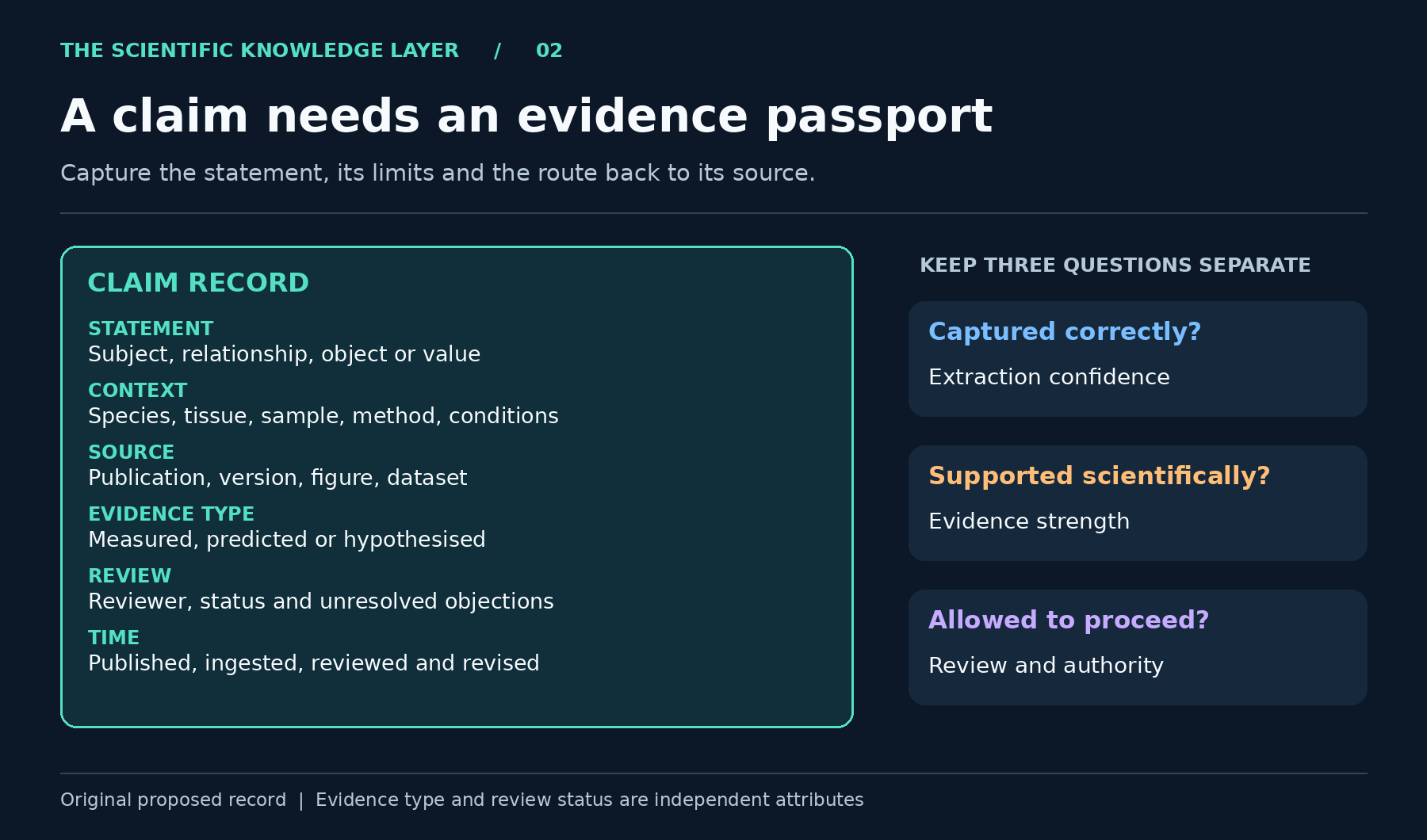 Figure 2. Proposed claim record. Extraction confidence, scientific strength and permission to act are separate attributes. A high extraction score means that a statement may have been captured correctly; it does not validate the statement.
Use separate fields for evidence type and review status. For instance, a computational prediction may be correctly extracted and expert reviewed while remaining untested experimentally. Allow contradictory claims to coexist with their conditions intact. The system should help a reviewer understand a disagreement before attempting to reconcile it.
Life sciences from cell states to a testable target
The decision. A pulmonary fibrosis programme wants to select a candidate mechanism for experimental investigation. The useful question is: which candidate has relevant human evidence, a plausible cellular context and a tractable experiment that could challenge the hypothesis?
The research foundation. Habermann and colleagues analysed 114,396 cells from 20 pulmonary fibrosis and 10 nonfibrotic control lungs, identifying 31 cell subsets or states. The study described disease-associated epithelial populations and distinct fibroblast contributions to matrix expansion. This demonstrates the value of preserving cell type and tissue context when interpreting disease-associated expression. It does not make every associated gene a validated therapeutic target. [3]
The Open Targets Platform provides a complementary foundation for evaluating therapeutic hypotheses by integrating target-disease evidence and information used in target prioritisation. Its 2025 publication describes support across evidence assessment, prioritisation and hypothesis generation. Such a resource can inform a programme's evidence review without replacing its experimental judgement. [4]
The proposed workflow. Begin with a bounded disease question and a versioned set of public studies and internal datasets. Connect disease subtype, donor cohort, tissue, cell state, gene, protein, pathway and observation. Keep a gene distinct from its encoded protein, and preserve mappings between alternative cell annotations rather than merging labels automatically.
A candidate review then combines human genetic support where available, expression in the relevant cells, functional observations and conflicting findings. Its output is a comparison with explicit evidence gaps. A highly expressed gene may be a marker of injury, a consequence of disease or part of a repair response. The graph should preserve those competing explanations.
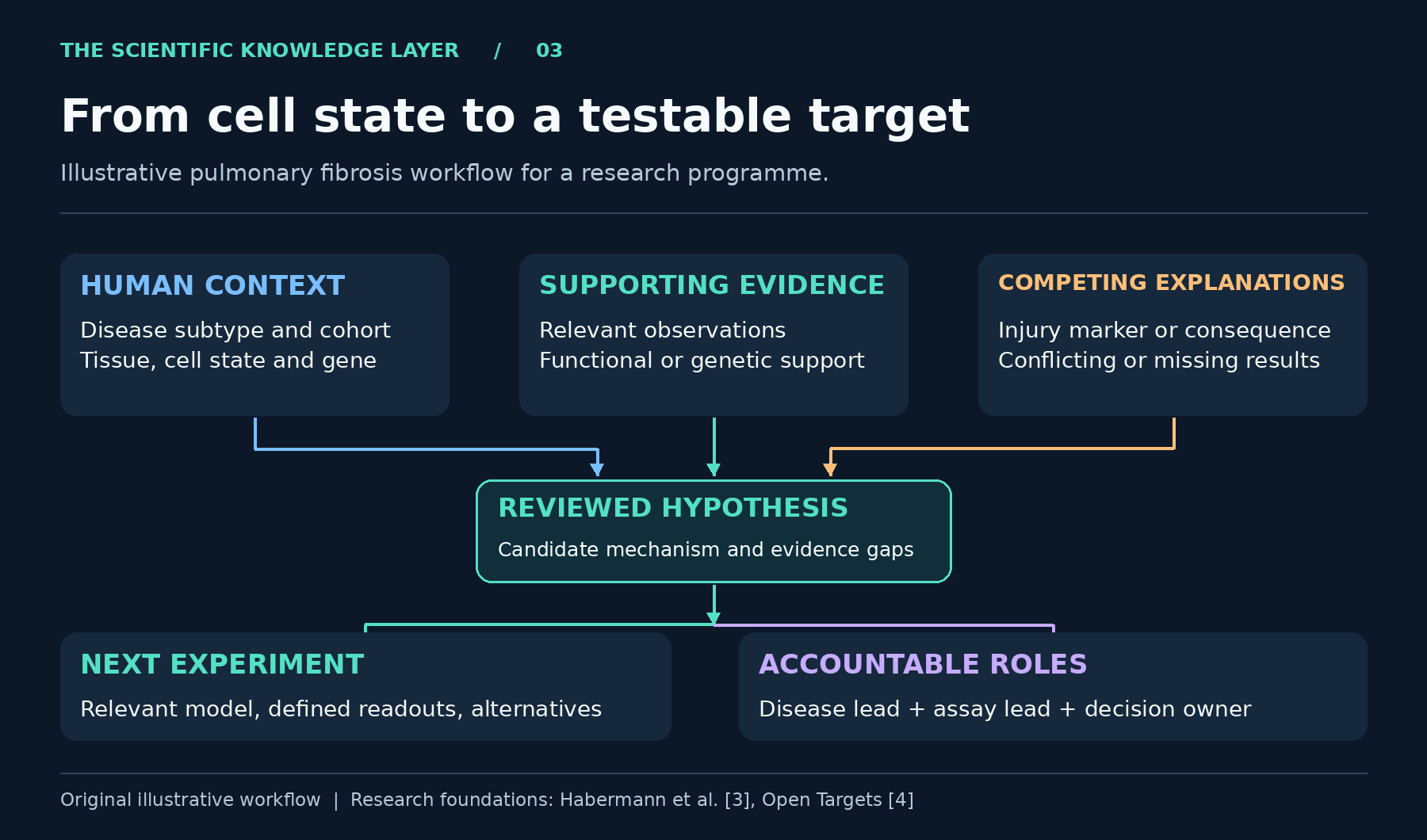 Figure 3. Illustrative pulmonary fibrosis workflow. The candidate mechanism is intentionally unspecified; the diagram makes no claim that a particular target is effective.
The programme next defines a falsifiable experiment. A proposed perturbation study might ask whether changing the candidate mechanism alters a predefined fibrosis-related readout while preserving cell viability in a relevant model. Record the model's limitations, comparison groups and interpretation criteria before viewing the result. This makes later reasoning easier to assess and reduces opportunities to reinterpret every outcome as support.
Connect the work to roles: a computational biology lead owns the analysis, a disease biology lead owns the mechanistic interpretation, and an assay lead owns the experimental design. A programme decision owner authorises the next stage. A quality reviewer verifies that the evidence package includes exclusions and contradictory findings.
The usable answer. A future assistant should return the hypothesis, source-linked observations, cellular context, unresolved alternatives and the assigned next experiment. It should identify missing evidence explicitly. The value to measure is the time required to assemble a reviewed hypothesis package, the share of claims traceable to source data, and the proportion of planned experiments with agreed interpretation criteria. These are proposed pilot measures, not outcomes established by the cited papers.
Materials from a promising formula to a reproducible sample
The decision. A battery team wants to prioritise solid-state electrolyte candidates for synthesis and characterisation. The screening question needs more than a composition and a conductivity value. It needs structure, processing history, measurement conditions and evidence about the sample actually tested.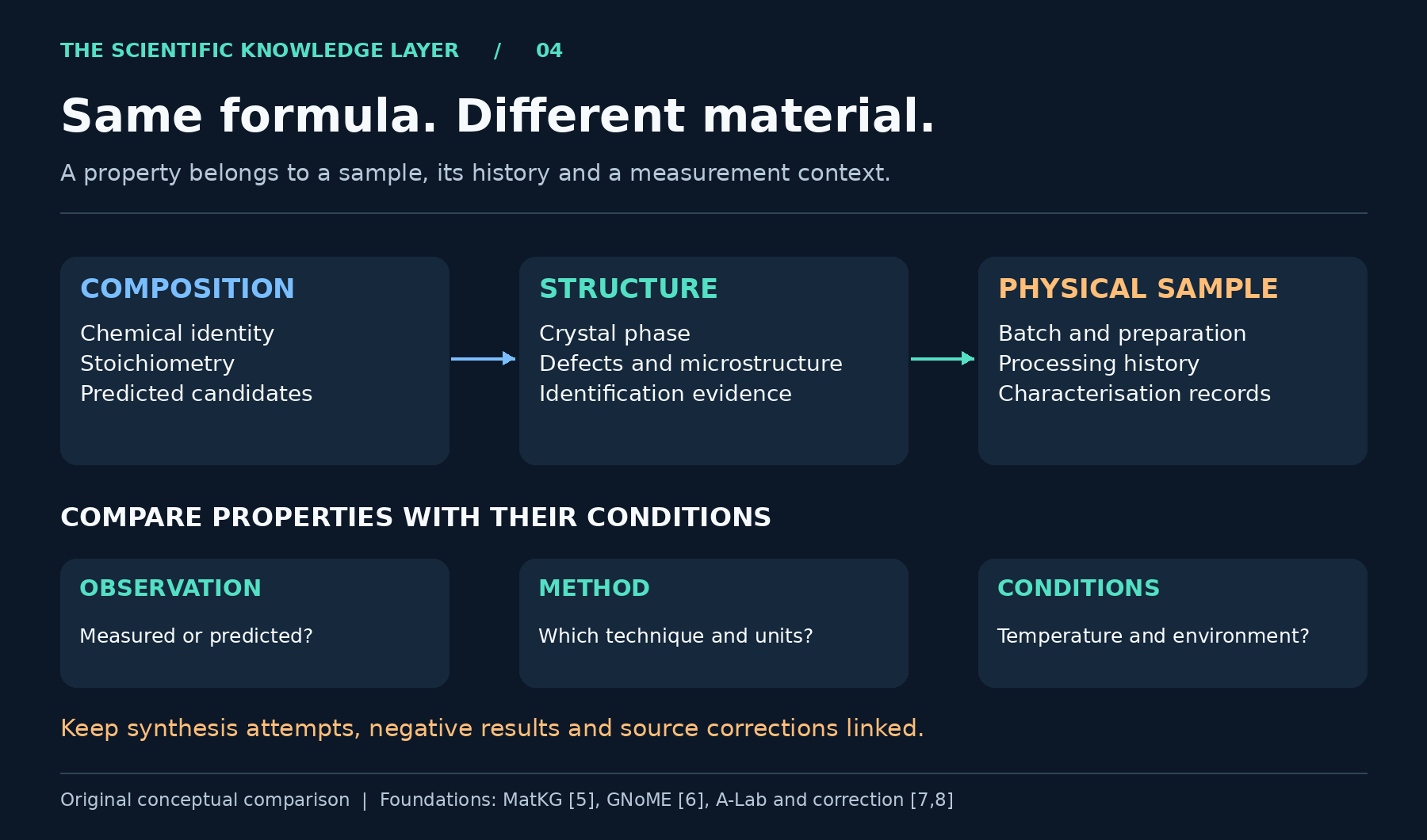
Figure 4. Illustrative materials comparison. A reported value belongs to a defined sample and measurement context. The diagram contains no performance data and implies no ranking between candidates.
The research foundation. MatKG extracted materials concepts from scientific literature and organised more than 70,000 entities and 5.4 million unique triples. Its relationships use statistical association, making it useful for navigation and candidate exploration. Such associations require further checking before being interpreted as measured properties or causal relationships. [5]
The GNoME study demonstrated large-scale graph-network screening of inorganic crystal structures, including exploration of solid-electrolyte candidates. Computational energetic stability is one screening signal; synthesis feasibility and application performance remain separate questions. A graph neural network used for prediction and an enterprise knowledge graph used to manage evidence also have different functions. [6]
The A-Lab study demonstrated an autonomous workflow for solid-state synthesis of inorganic powders. Its January 2026 correction addressed structural identification and clarified that the original novelty language referred to being new to the prediction platform, rather than necessarily new to science. That correction is directly relevant to how an enterprise should preserve publication versions and revise downstream claims. [7,8]
The proposed workflow. Represent a composition, a crystal structure and a physical sample as separate entities. Connect the sample to precursor identities, batch, processing sequence, atmosphere and characterisation records. Attach every property observation to that sample, with units, temperature, method and relevant uncertainty.
The team first assembles candidates from calculations, public literature and internal results. It then checks whether records are comparable. Bulk and grain-boundary conductivity, for example, should be distinguishable; a model estimate should remain identifiable as a prediction. Missing measurement conditions should create a review task rather than an apparently comparable row in a ranking.
Candidate selection can then consider several dimensions: predicted stability, available synthesis evidence, relevant transport measurements and compatibility with the intended application. Keep the scoring rule versioned and explain the effect of missing data. A candidate with sparse reporting should not gain an artificial advantage because its limitations were never measured.
The synthesis lead owns the proposed route, the characterisation lead owns phase identification, and an electrochemistry lead owns interpretation of transport measurements. The programme owner decides whether the combined evidence justifies further testing. Laboratory execution follows the team's established procedures and approvals; a graph relationship alone confers no authority to operate equipment.
Record unsuccessful attempts with the same care as successful ones. A failed preparation under one set of conditions is evidence about that attempt. Linking the conditions prevents the programme from generalising the failure to every possible route or repeatedly trying an unchanged experiment.
The usable answer. A candidate dossier should explain why the material was selected, which claims are computational, which observations belong to actual samples, what remains uncertain and who owns the next test. Measure traceability of property records, completeness of sample histories and repeated attempts undertaken without reference to prior results. Any improvement in synthesis success must be demonstrated prospectively in the team's own workflow.
Pharma from a ranked drug to an evidence review
The decision. A discovery team wants to decide which existing drug-disease hypotheses deserve preclinical investigation. A useful recommendation must connect mechanism, direction of action, disease relevance, exposure considerations and contrary evidence.
The research foundation. PrimeKG integrated 20 resources, representing 17,080 diseases through more than four million relationships. Its coverage includes biological processes, phenotypes, drugs and drug-disease relationships. It illustrates how heterogeneous biomedical information can be brought into a disease-centred representation. [9]
Hetionet earlier demonstrated systematic integration of biomedical knowledge for drug repurposing prioritisation. TxGNN subsequently used a medical knowledge graph to rank potential indications and contraindications, including settings with little existing treatment information, and supplied multi-hop explanations for expert inspection. These publications support graph-based hypothesis generation and prioritisation. Their computational evaluations do not establish prospective therapeutic efficacy for a newly proposed use. [10,11]
The proposed workflow. Start with a precisely defined disease and candidate compounds. Preserve the difference between a compound, salt or formulation, and link the relevant protein target and mechanism. Represent binding, inhibition and activation separately wherever the underlying evidence supports that distinction. A general drug-target connection should not silently determine the direction of a therapeutic hypothesis.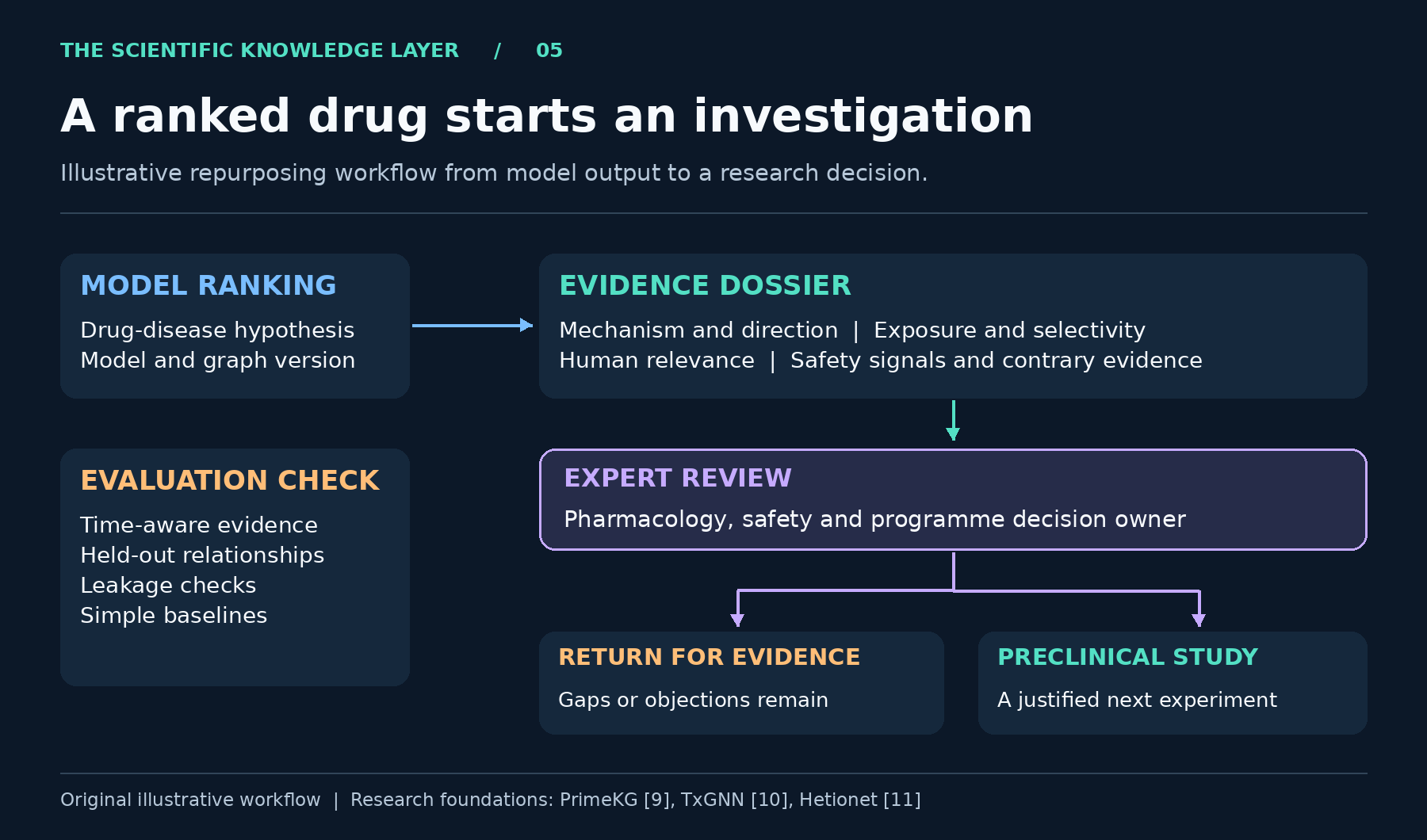
Figure 5. Illustrative repurposing workflow. A model ranking initiates investigation. Progression requires examination of mechanism, exposure, contrary evidence and experimental feasibility.
For each prediction, assemble a dossier linking the exact model version and graph snapshot to supporting paths. Add available evidence about human disease relevance, selectivity, tissue exposure and safety constraints. Existing approval for one indication does not establish suitability for another population, dose or route. Mark unavailable information as an evidence gap.
Preserve why a path appears plausible. A drug might inhibit a protein linked to a disease-associated pathway, yet its exposure in the relevant tissue may be insufficient. Another path might connect the same drug through an unrelated shared phenotype. The reviewer needs the underlying relationship types and sources to judge the explanation.
Evaluation should also challenge the model. Define which information would have been available at the prediction date, remove direct and inverse representations of held-out treatment links, and examine leakage through closely related diseases or duplicated sources. Compare against simple popularity and similarity baselines. These are proposed evaluation controls for a new implementation; they are not additional findings claimed for the cited studies.
A translational pharmacology role owns mechanistic review, a safety specialist owns the safety assessment, and the programme owner decides whether an experiment is justified. An assistant can assemble and update the dossier within its authorised scope. The decision record must identify the accountable human role and the evidence considered.
The usable answer. The output is a prioritised research hypothesis with reasons, objections, missing evidence and a named next action. Track reviewer acceptance of explanations, false-positive burden, time to complete a dossier and prospective experimental results. Retrospective ranking accuracy is useful, but it answers a narrower question than clinical benefit.
Build an operating structure scientists can use
The scientific graph becomes operational when a decision is connected to the roles that can review and advance it. Model the responsibility assignment explicitly, including programme scope, effective dates, required expertise and escalation path. Connect people to those assignments so staff changes do not erase the meaning of previous decisions.
|
Role |
Owns |
Example responsibility |
|
Domain scientific lead |
Scientific interpretation |
Review whether a claim applies to the programme context |
|
Data steward |
Identity and provenance quality |
Resolve ambiguous identifiers and missing source versions |
|
Experimental lead |
Study design and execution record |
Define readouts and attach results to the correct samples |
|
Model owner |
Model evaluation and release |
Document graph snapshots and performance limitations |
|
Programme decision owner |
Progression decision |
Record approval rationale and conditions for reassessment |
Roles can be scoped to a specific assay, indication or materials family. Some decisions need several reviews, with one explicit owner of the final progression decision. This avoids treating a generic reporting line as sufficient evidence of scientific competence or approval authority.
For software agents, record the permitted tasks, accessible data, policy version and supervising role. Enforce permissions in the systems that expose data and perform actions. Responsibility relationships help explain authority; enforcement requires application controls. An agent may draft an evidence package while a designated reviewer remains responsible for accepting it.
Connect the systems and preserve the uncertainty
Keep large datasets, raw instrument files and laboratory records in their appropriate repositories. The knowledge layer can hold identifiers, metadata and versioned links. Ingest a focused subset of public publications and internal systems, resolve entities, check the schema and route uncertain extractions to review.
Combine text retrieval with graph queries where each helps. Text retrieval can locate detailed passages; graph traversal can connect a claim to a sample, experiment, role or decision. Give the answering system the retrieved evidence, provenance and access context. Validate that citations support the generated statements and that a user can inspect the evidence allowed by their permissions.
An effective answer should include its scope and date. When the system cannot resolve an identifier, locate a source or find an authorised owner, it should report the gap. A graph can preserve errors as efficiently as accurate information, so curation and evaluation must be part of normal operations.
Publication updates need a defined workflow. A correction or retraction should flag affected claims, identify dependent analyses and decisions, and assign reassessment. Historical records should retain what was known at the time alongside the updated interpretation. The A-Lab correction illustrates why this capability matters in practice. [8]
Start with one decision and measure the result
A practical pilot can run in three phases. During the first month, choose one recurring decision, identify its users and review owners, and establish a baseline for evidence assembly. Select sources the organisation is entitled to use and define the minimum claim record.
During the second month, connect a bounded evidence set to one workflow. Include a historical decision that contains conflicting or revised evidence. Test whether a new reviewer can reconstruct its rationale and whether the system recognises missing context.
During the third month, compare the workflow with current practice on a predefined set of questions. Assess correctness, evidence completeness, source traceability, review time and cost. Where prospective experiments take longer, report those results later rather than substituting a retrieval metric.
|
Measure |
What to record |
|
Traceability |
Share of material claims with resolvable sources and versions |
|
Scientific completeness |
Share with the context required for the intended comparison |
|
Decision clarity |
Share of decisions with a current owner and recorded rationale |
|
Update responsiveness |
Time from a relevant source update to assigned reassessment |
|
Practical value |
Review time and total maintenance cost against the baseline |
These are proposed management measures. Set targets after observing the baseline. The cited literature does not establish a universal return on investment for this combined enterprise design.
For an R&D leader, the investment case is a repeatable ability to explain a scientific choice: the evidence supporting it, the conditions limiting it, the uncertainty remaining and the person responsible for the next step. That is the memory a growing research organisation needs to carry its discoveries forward.
References
The numbered sources below support the specific descriptions of published work. The workflows, operating structure and pilot recommendations are original synthesis. This is a selected-source article, not a systematic review. All five infographics are original conceptual illustrations.
- Wilkinson MD et al. The FAIR Guiding Principles for scientific data management and stewardship. Scientific Data 3, 160018 (2016). https://doi.org/10.1038/sdata.2016.18
- Lobentanzer S et al. Democratizing knowledge representation with BioCypher. Nature Biotechnology 41, 1056-1059 (2023). https://doi.org/10.1038/s41587-023-01848-y
- Habermann AC et al. Single-cell RNA sequencing reveals profibrotic roles of distinct epithelial and mesenchymal lineages in pulmonary fibrosis. Science Advances 6, eaba1972 (2020). https://doi.org/10.1126/sciadv.aba1972
- Buniello A et al. Open Targets Platform: facilitating therapeutic hypotheses building in drug discovery. Nucleic Acids Research 53, D1467-D1475 (2025). https://doi.org/10.1093/nar/gkae1128
- Venugopal V and Olivetti E. MatKG: An autonomously generated knowledge graph in Material Science. Scientific Data 11, 217 (2024). https://doi.org/10.1038/s41597-024-03039-z
- Merchant A et al. Scaling deep learning for materials discovery. Nature 624, 80-85 (2023). https://doi.org/10.1038/s41586-023-06735-9
- Szymanski NJ et al. An autonomous laboratory for the accelerated synthesis of inorganic materials. Nature 624, 86-91 (2023), corrected in 2026. https://doi.org/10.1038/s41586-023-06734-w
- Szymanski NJ et al. Author Correction: An autonomous laboratory for the accelerated synthesis of inorganic materials. Nature 650, E1 (2026). Published online 19 January 2026. https://doi.org/10.1038/s41586-025-09992-y
- Chandak P, Huang K and Zitnik M. Building a knowledge graph to enable precision medicine. Scientific Data 10, 67 (2023). https://doi.org/10.1038/s41597-023-01960-3
- Huang K et al. A foundation model for clinician-centered drug repurposing. Nature Medicine 30, 3601-3613 (2024). https://doi.org/10.1038/s41591-024-03233-x
- Himmelstein DS et al. Systematic integration of biomedical knowledge prioritizes drugs for repurposing. eLife 6, e26726 (2017). https://doi.org/10.7554/eLife.26726
- Lebo T, Sahoo S and McGuinness D, eds. PROV-O: The PROV Ontology. W3C Recommendation (2013). Technical standard. https://www.w3.org/TR/prov-o/
Conceptual inspiration. Morgan Senechal, The knowledge layer for enterprise AI: Operating Structure, Neo4j Developer Blog, 28 August 2026. https://medium.com/neo4j/the-enterprise-knowledge-layer-operating-structure-93f5a68f94cf. This article develops a separate scientific argument and does not reproduce the source article's prose, fictional case or illustrations.


