Thermodynamically stable hydride superconductors in GNoME database
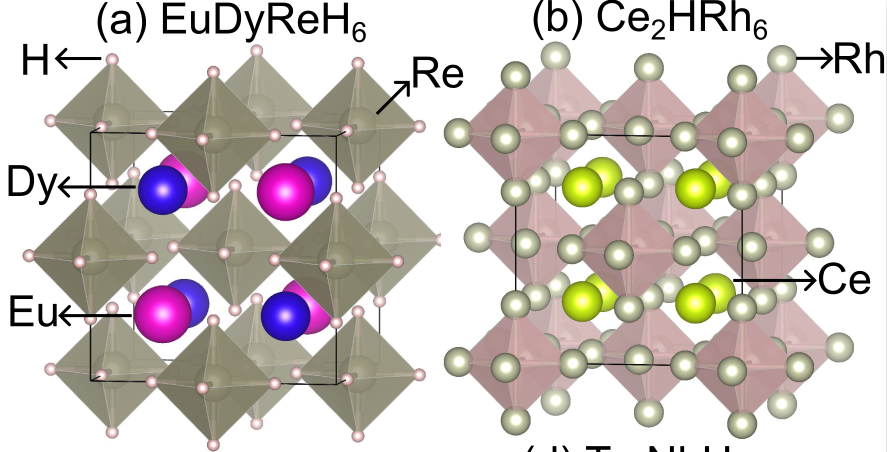


Hydrides are considered to be one of the most promising families of compounds for achieving high temperature superconductivity. However, there are very few experimental reports of ambient-pressure hydride superconductivity, and the superconducting critical temperatures (Tc) are typically less than 10 K. At the same time several hydrides have been predicted to exhibit superconductivity around 100 K at ambient pressure but in thermodynamically unfavorable phases. In this work we aim at assessing the superconducting properties of thermodynamically stable hydride superconductors at room pressure by investigating the GNoME material database, which has been recently released and includes thousands of hydrides thermodynamically stable at 0K. To scan this large material space we have adopted a multi stage approach which combines machine learning for a fast initial evaluation and cutting edge ab initio methods to obtain a reliable estimation of Tc.
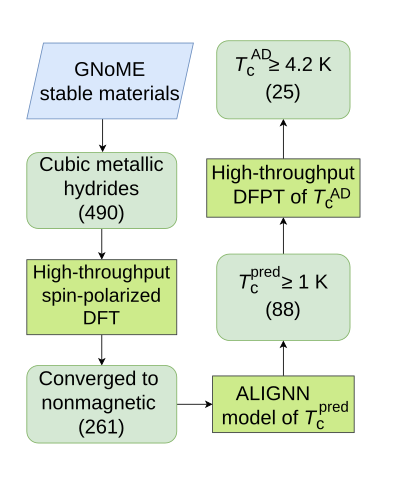
Our high-throughput calculations was able to identify 25 superconductors with Tc ranging from boiling point of liquid helium (4.2 K) to 23.5 K. For the highest-Tc compound, advanced ab initio methods refined Tc down to 17 K. While not extremely high, as compared to some of the other predictions which have appeared in literature, these stand out because of the extremely accurate estimation of thermodynamic stability at 0K (due to a more densely sampled 0K convex hull). At this stage, an experimental feedback that can validate both the crystal structures and superconductivity of these DFT-based candidates would greatly benefit the future search for superconductors.
The free fulltext PDF can be found at https://rdcu.be/e6eoH
Cite this article
Sanna, A., Cerqueira, T.F.T., Cubuk, E.D. et al. Search for thermodynamically stable ambient-pressure superconducting hydrides in the GNoME database. Commun Phys (2026). https://doi.org/10.1038/s42005-026-02552-4

author, reviewer and editor (associate editor of Physica B and an editorial board member of Springer Materials)
Follow the Topic
-
Communications Physics
An open access journal from Nature Portfolio publishing high-quality research, reviews and commentary in all areas of the physical sciences.

Related Collections
With Collections, you can get published faster and increase your visibility.
Nonlinear dynamics of living systems
Publishing Model: Open Access
Deadline: Nov 09, 2026
High-Energy Light Sources - From Tabletop to Large Facilities
Publishing Model: Open Access
Deadline: Sep 30, 2026