Atomic-scale ferroelectric tunnel junctions for future memories and computing devices
Published in Materials, Physics, and Computational Sciences
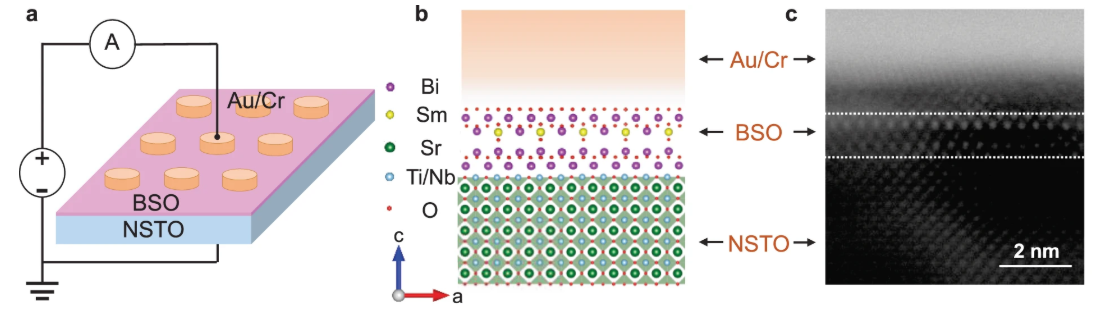
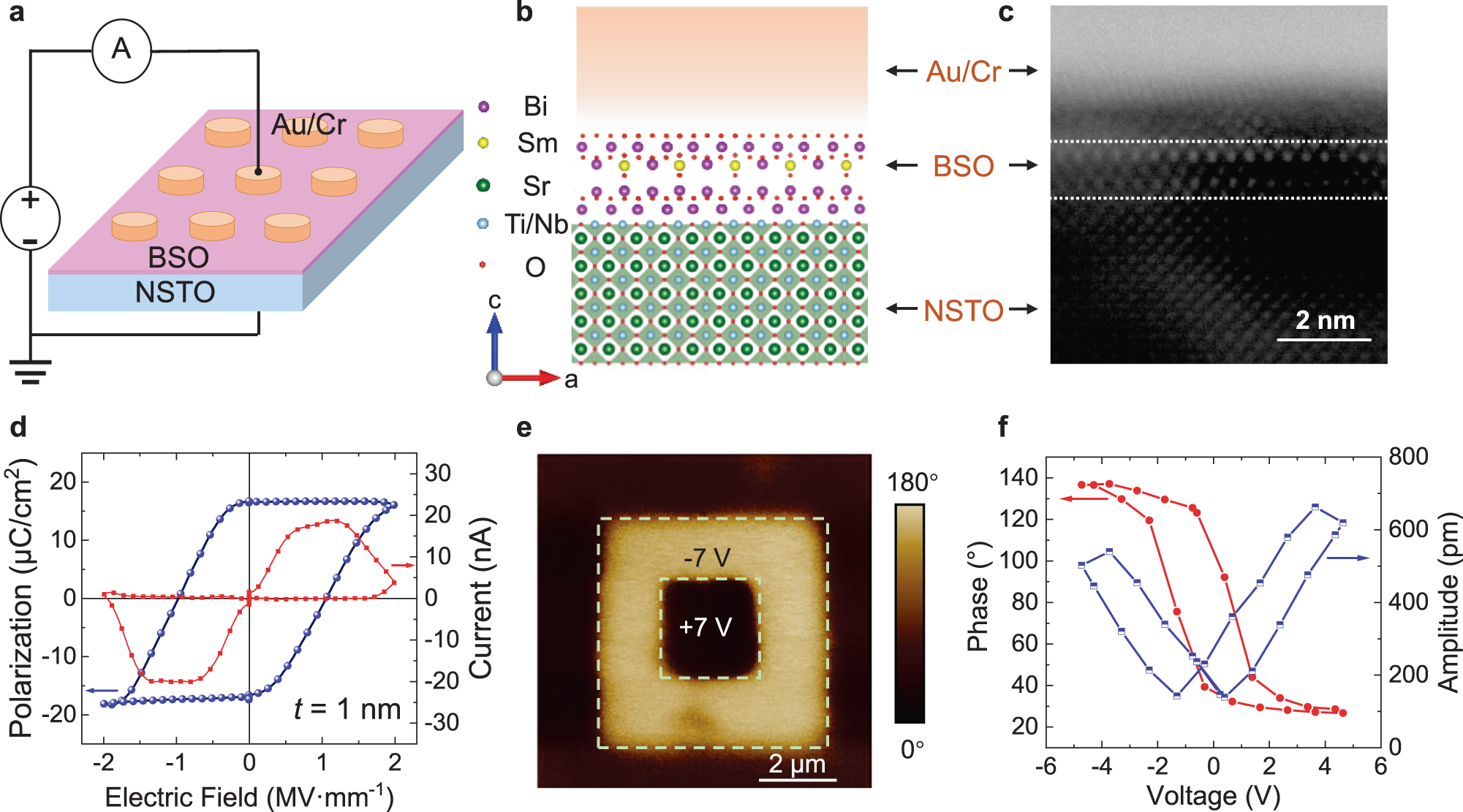
Ferroelectric tunnel junctions have emerged as pivotal components in the quest for faster, more reliable memory and computing solutions. In this latest research at Nature Communications (see freely open full text), a team led by Yue-Wen Fang of Spanish National Research Council at Centro de Física de Materiales (CSIC-UPV/EHU), Linxin Zhang at University of Science and Technology Beijing, and Rui Yang at Shanghai Jiaotong University has demonstrated the ability to maintain a high tunneling electroresistance of 7 × 10⁵ in FTJs utilizing a one-nanometer film of samarium-substituted bismuth oxide (see Fig. 1). This result marks a significant milestone, especially considering that previous attempts at achieving similar performance in ultra-thin ferroelectric films have struggled to cross the terahertz threshold of efficacy.
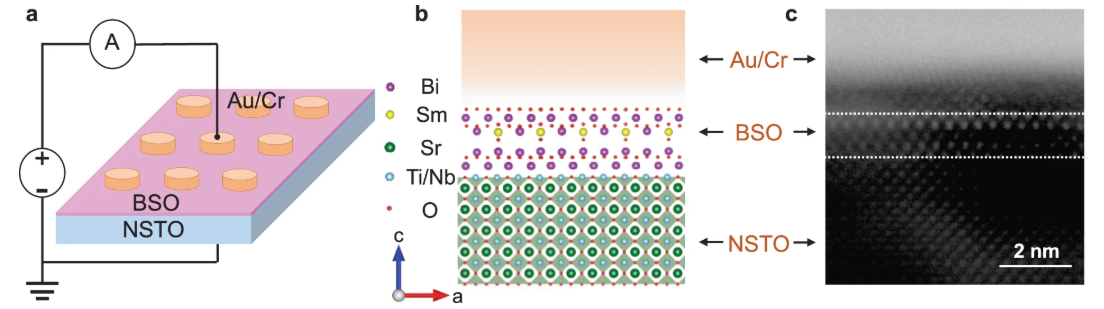
Fig. 1: a Schematic illustration of the FTJ structure. b Atomic-level diagram of the Au (60 nm)/Cr (15 nm)/BSO (1 nm)/NSTO FTJ structure. While the Sm atoms are distributed randomly in the structure, we provide one possible BSO structure obtained from a previous study at Science (https://doi.org/10.1126/science.abm5134). c The HAADF-STEM image of a BSO film grown on NSTO substrate, with the BSO thickness of 1 nm.
Traditionally, as the ferroelectric layer is reduced to atomic scales, challenges such as structural instability and depolarization fields have hindered performance in ferroelectricity. However, the strong out-of-plane ferroelectricity exhibited in layered bismuth oxide ensures stability even at significantly reduced thicknesses. The discovery that samarium substitution can sustain ferroelectric characteristics down to one nanometer opens up new avenues for leveraging ferroelectric properties in next-generation memory technology.
The implications of achieving such a high TER at ultra-thin scales are profound. By enabling up to 32 distinct resistance states without necessitating a write-verify cycle, these FTJs demonstrate a remarkable potential for multi-level data storage. Coupled with high endurance levels exceeding 5 × 10⁹ operations and an impressive retention time of 10 years, they pave the way for highly efficient and reliable non-volatile memories far beyond what is currently possible with existing technologies like commercial flash memory.
As we move into an era where the demand for compact and energy-efficient electronics continues to grow, the continued exploration and development of ferroelectric materials such as samarium-substituted layered bismuth oxide will be essential. This research not only builds a bridge towards advanced memory solutions but also reaffirms the significance of ferroelectric materials in the broader landscape of electronic and computational advancements.

author, reviewer and editor (associate editor of Physica B and an editorial board member of Springer Materials)
Follow the Topic
-
Nature Communications
An open access, multidisciplinary journal dedicated to publishing high-quality research in all areas of the biological, health, physical, chemical and Earth sciences.

Related Collections
With Collections, you can get published faster and increase your visibility.
Women's Health
Publishing Model: Hybrid
Deadline: Ongoing
Tumor Microenvironment Crosstalk and Therapeutic Implications
Publishing Model: Hybrid
Deadline: Nov 02, 2026