Topologically invariant Berry phase defined in nonlinear normal modes for general and strongly nonlinear dynamics
Published in Physics



Topological edge states lead to exotic boundary properties, including robust chiral edge propagations and polarized responses, that are immune to disorders and backscattering. These unconventional states are protected by integer numbers called topological invariants, which cannot be easily changed upon the variation of system parameters unless topological transitions cause these integer numbers to jump. Originally developed in quantum states, this modern concept is extended to classical structures that enable many pioneering applications.
However, most interactions in strongly nonlinear systems are beyond Kerr, such as electrical, acoustic, plasmonic, and biophysical systems. As there is no analytic solution of nonlinear normal modes, the topological invariants are hitherto undefined. Strong nonlinearities may destroy the topological nature of weakly nonlinear systems by breaking their intrinsic symmetries. Thus, existing linear and weakly nonlinear theories are not always correct to predict their strongly nonlinear topological attributes. Moreover, it is intriguing to ask what exotic physics arise when topology meets general strong nonlinearities. Thus, it is demanding to invoke the topological number that precisely describes the topological attributes of “beyond-Kerr” general strongly nonlinear dynamics.
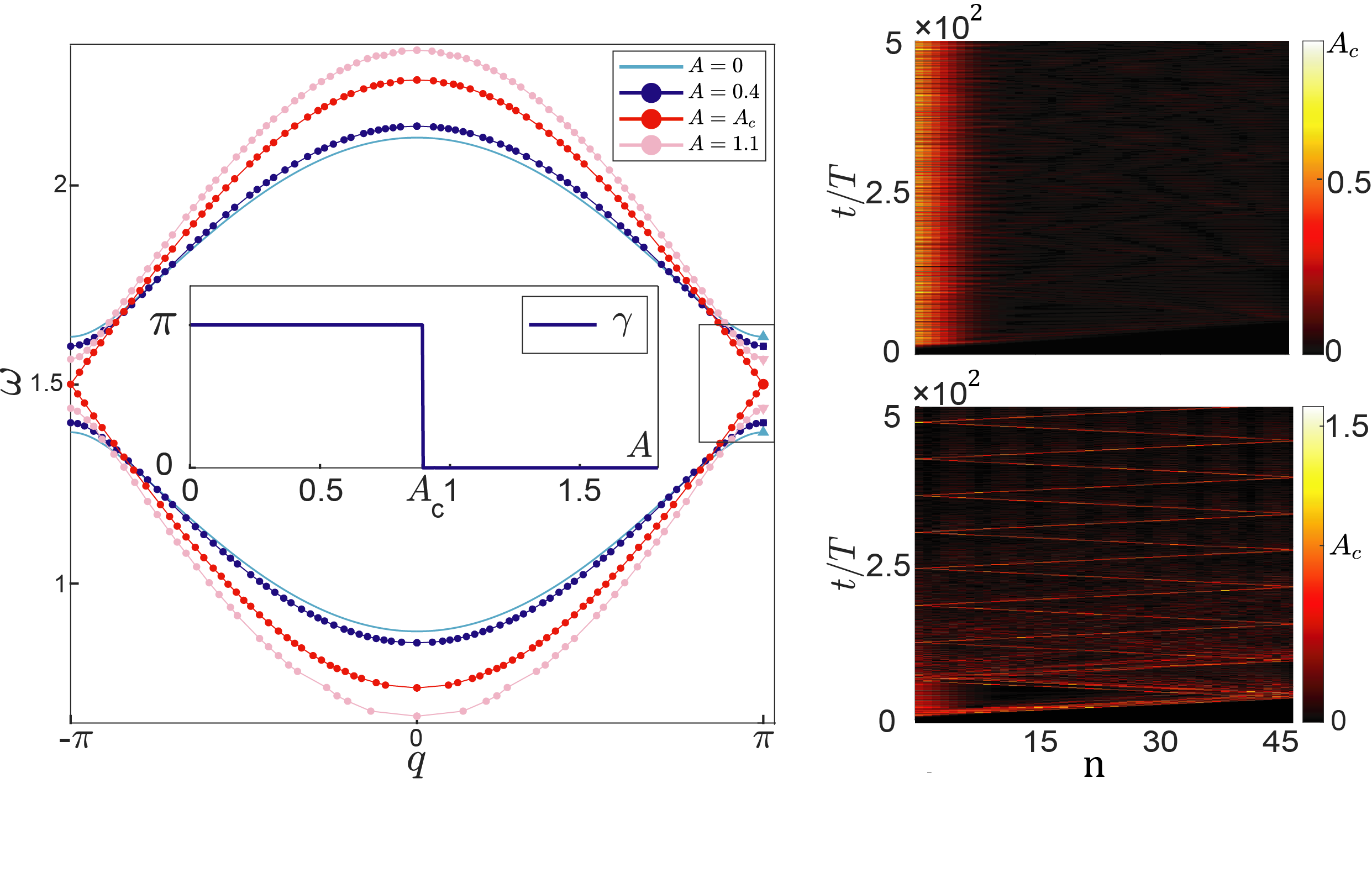
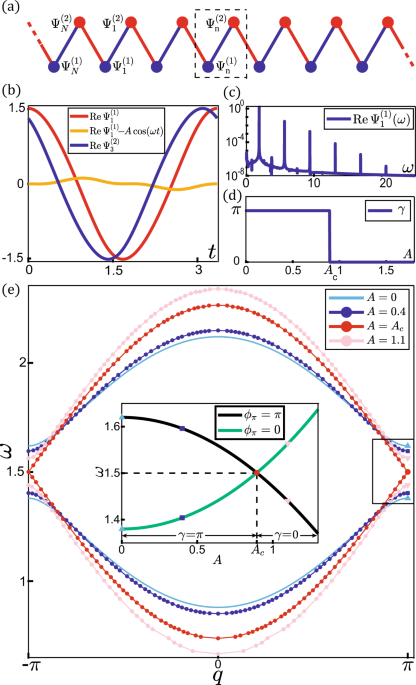
Our Work: We investigate the topological invariant and properties of one-dimensional generalized nonlinear Schrödinger equations. This theoretical framework describes a wide range of nonlinear physics, such as mechanically isostatic frames, electrical circuits, deep water waves, and biophysical processes. As the magnitudes are comparable between the nonlinear and linear parts of the interactions, the system is in the “strongly nonlinear regime”, where perturbation theory naturally breaks down. Consequently, nonlinear normal modes are remarkably distinct from sinusoidal waves. Remarkably, this work demonstrates that the notion of adiabatic geometric phase, namely nonlinear Berry phase, can still be analytically defined from these “non-sinusoidal” normal modes.
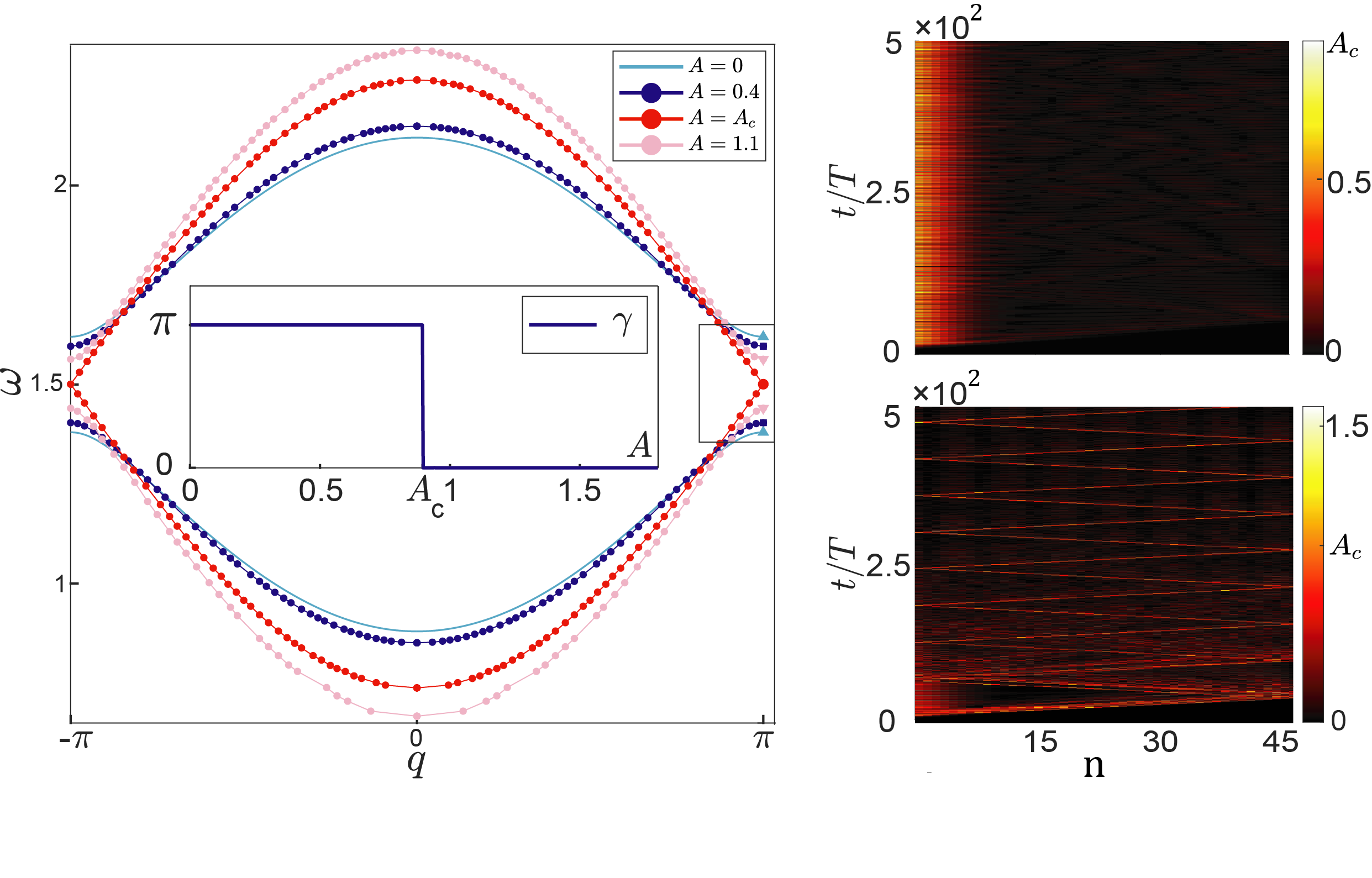
Without utilizing linear analysis, we establish a symmetry-based non-perturbative strategy, to show the quantization of nonlinear Berry phase under reflection symmetry. This integer-valued phase serves as the topological index of the nonlinear system, in which the emergence of nonlinear topological modes is assured by the non-trivial index. Analogous to the robustness of linear topological states, the integer invariant protects nonlinear topological normal modes from disorders.
In summary, our work reveals the universality of the notion of topological protection, even in strongly and general nonlinear motions. We hope that the geometric Berry phase derived from nonlinear normal modes, and the non-perturbative methodology established in this work, can help trigger future research interests in both topological physics and nonlinear dynamics.
For more information, please refer to our paper published in Nature Communications, “https://www.nature.com/articles/s41467-022-31084-y#citeas”.
Follow the Topic
-
Nature Communications
An open access, multidisciplinary journal dedicated to publishing high-quality research in all areas of the biological, health, physical, chemical and Earth sciences.

Related Collections
With Collections, you can get published faster and increase your visibility.
Women's Health
Publishing Model: Hybrid
Deadline: Ongoing
Tumor Microenvironment Crosstalk and Therapeutic Implications
Publishing Model: Hybrid
Deadline: Nov 02, 2026