The Chirality Surprise: How a “Faulty” Gyroscope Led to a New Way of Sensing Rotation
Published in Physics



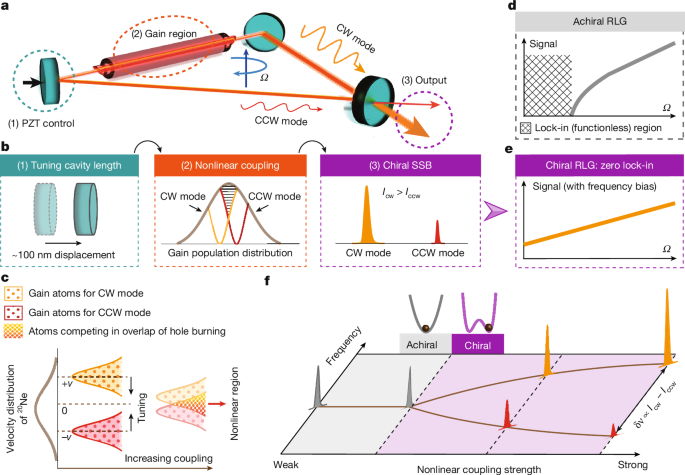

Every engineer who has worked with a high-precision ring laser gyroscope knows about its stubborn flaw: the “lock-in” effect. At very slow rotation rates, the gyroscope’s signal—the beat note between two laser beams—vanishes. It’s as if its internal compass gets stuck. For decades, the only fix has been to add external parts, like a dithering motor or magnetic crystals, to constantly nudge the system. I never imagined that the key to a simpler solution would come from a device that the production line had labelled as “faulty.”
The Puzzle from the Production Line
In late 2023, a colleague showed me the test data from a newly made gyroscope. The laser’s output power, which should have been smooth, was doing something strange. During a routine scan, it would suddenly jump—sometimes much brighter, sometimes much dimmer.
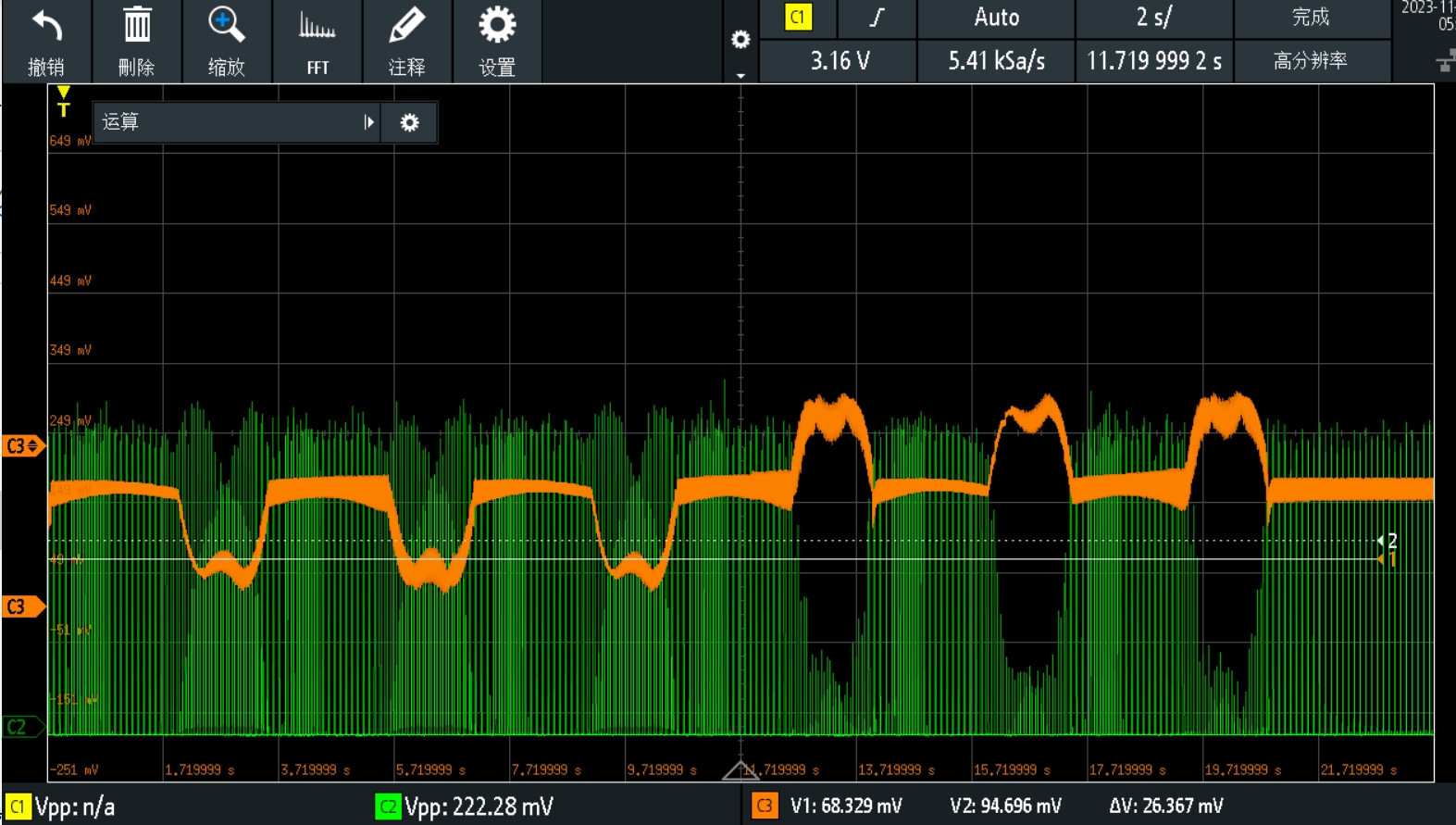
I had spent two years studying every detail of how these lasers behave, and a thought immediately clicked: this looks like mode competition. Inside the ring, the beam traveling clockwise and the one traveling counterclockwise were fighting for the same energy from the neon gas, and this fight was causing wild swings in power.
When I shared this idea, I faced skepticism. The textbook wisdom was clear: to avoid such messy competition, all commercial gyroscopes use a special two-isotope gas mixture. “This shouldn’t be happening,” was the consensus. Yet, the data was right there. We eventually traced the issue to a new batch of super-clean, ultra-low-loss mirrors. Ironically, by making the gyroscope cavity better, we had accidentally created the perfect conditions for this hidden battle. The factory’s solution was practical: they switched back to the old mirrors. Problem solved. Production moved on.
But I couldn’t let it go. I asked to keep two of the “faulty” units. What was really going on inside?
From a Hunch to a “Chiral” Idea
In my lab, I built a setup to watch this battle in detail. The power jumps weren’t random; they followed clear rules and depended on how hard we pumped the laser. It felt like the system was flipping between two distinct states—a phase transition. Discussions with theorists led me to a crucial test: to see if the two counter-propagating beams were truly fighting each other, I needed to force them to compete in a single, shared mode. This meant breaking the number one rule of gyroscope design: I had to use a single-isotope gas, reverting to a recipe the industry had abandoned long ago.
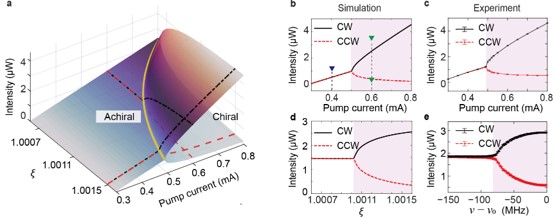
At the same time, I started working with Jipeng Xu, a theorist. Unburdened by decades of gyroscope dogma, he agreed with my gut feeling: this was a bistable phase transition. I began tinkering with the standard laser equations, adding a new term to describe how the beams could influence each other’s frequencies based on their intensity. The math showed something fascinating: after the laser first turned on, it could hit a plateau and then suddenly leap into a new state where one beam dominated the other. I called it a “laser of a laser.”
We took this to our advisor, Prof. Hui Jing. He looked at it and said, “This isn't just a ‘laser of a laser.’ This is a chiral gyroscope.”
That one word, “chiral”, changed everything. We weren’t just looking at a gyro glitch; we were seeing spontaneous symmetry breaking. The perfect left-right symmetry of the ring was breaking on its own, choosing a preferred “chirality.” This wasn’t a problem—it was a new principle waiting to be used.
The Heart-Stopping Experiment
An old, unsolved question nagged at me: why did the width of the troublesome “lock-in” zone sometimes change? Re-examining all my old data, I spotted a pattern: it always changed when the two laser beams had different brightnesses. A wild idea formed: What if that very imbalance—that chirality—created its own built-in frequency bias? Could it be strong enough to shove the gyroscope out of the lock-in zone forever?
I had built a custom gyroscope with pure single-isotope gas for exactly this kind of experiment. I asked my colleague Hongteng Ji to run it. The instruction was simple: rotate the gyro slowly and tune its operating point while recording everything—both the laser power and, critically, the beat frequency.
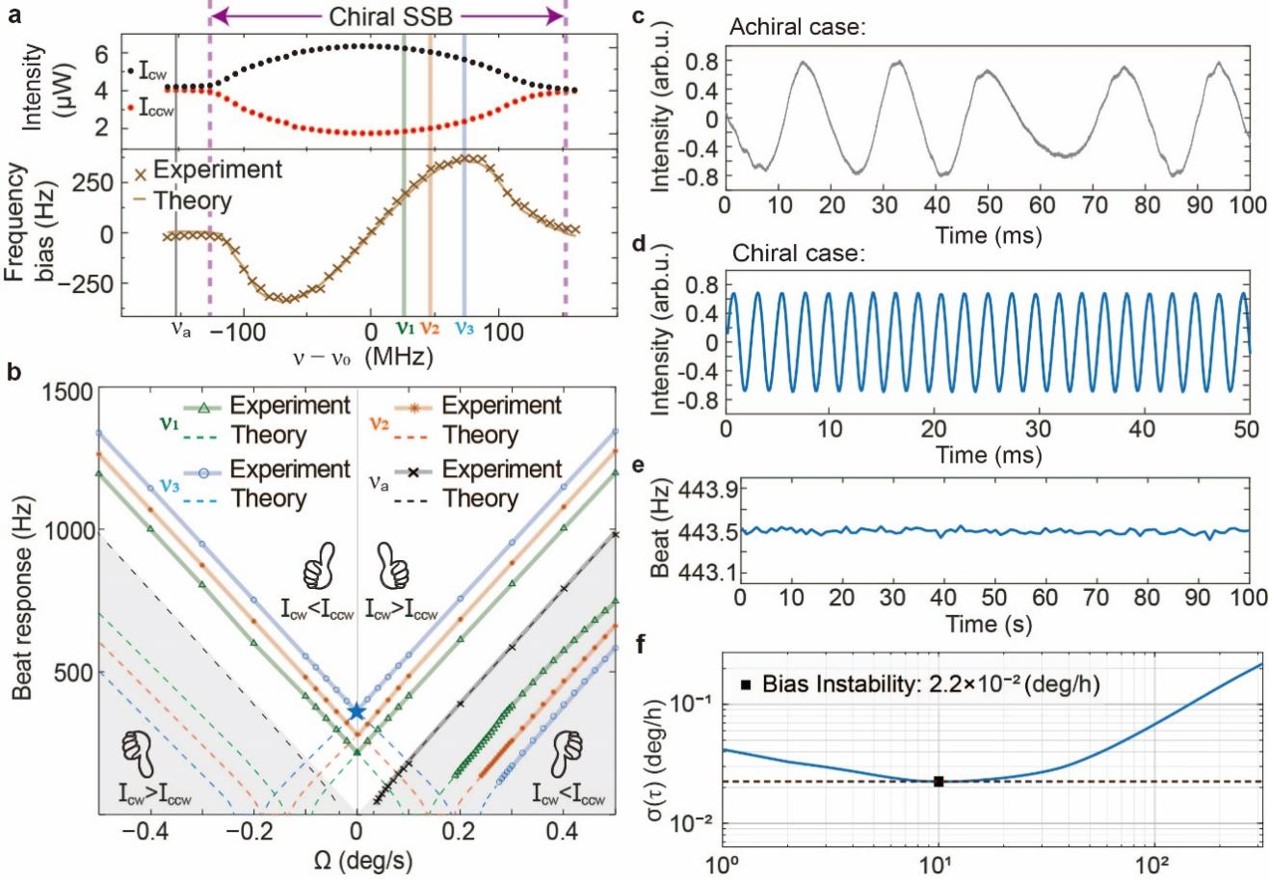
When the data arrived, it took my breath away. As the system entered the chiral state, the beat frequency traced a perfect, smooth S-shaped curve. The bias it created was huge—hundreds of Hertz. We then did the definitive test: we parked the gyro at its point of maximum self-bias and slowly rotated it down to zero speed.
We watched the oscilloscope. The rotation table stopped. The beat frequency signal—the steady tick-tick-tick that is the gyro’s heartbeat—did not. It kept pulsing, clean and strong. The lock-in zone, the fundamental flaw we had all learned to work around, was gone.
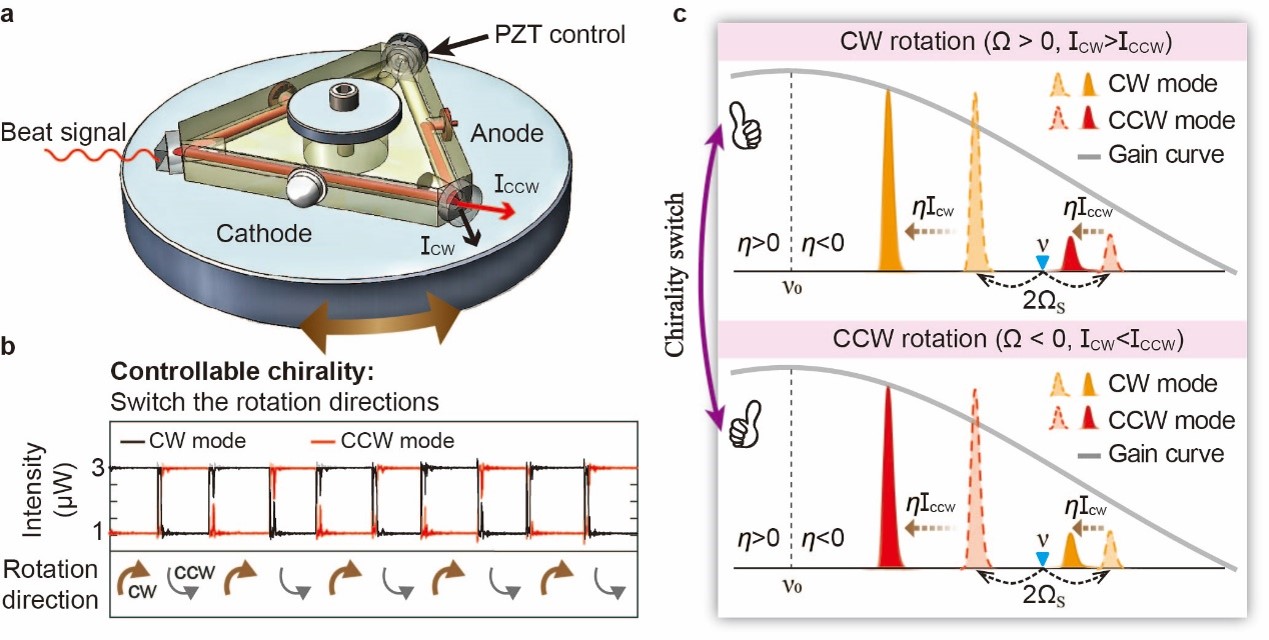
We even found that the preferred “chirality” could automatically flip when the rotation direction changed—a smart feature we called “chiral switching”. Inside the gyro, the two light beams compete so fiercely that the system must “choose” a winner, creating two stable states—one where the clockwise beam dominates, one where counterclockwise dominates. Rotation acts as a tiebreaker: the beam traveling with the rotation gets a microscopic head start due to the Sagnac effect. In this intense competition, that’s enough to push the system into the matching chiral state. The resulting intensity difference creates, via nonlinear frequency pulling, a built-in bias that keeps the gyro’s signal alive at any speed, permanently erasing the lock-in dead zone.
What Familiar Physics Still Has to Say
The most profound insight from this journey is not merely that we built a laser gyroscope without a lock-in dead zone. It is the realization that within a mature, well-charted technology, an entirely new physical principle was waiting to be heard.
Chiral laser gyroscopes may now represent a third foundational path, distinct from the established designs of mechanically dithered or four-frequency differential gyros. This path could be crucial for the future of high-reliability, miniaturized, and potentially chip-scale inertial sensing.
It began with a simple, practical question: why did a few gyroscopes fail a routine production test? The failure was real. The performance issue was undeniable. But under the right conditions, the same phenomenon became a signal, a theory, and a new design principle.
Perhaps that is the most enduring lesson from this work: mature systems are not closed systems. Sometimes, a field only appears quiet because few people have listened carefully enough to its anomalies.

Follow the Topic
-
Nature
A weekly international journal publishing the finest peer-reviewed research in all fields of science and technology on the basis of its originality, importance, interdisciplinary interest, timeliness, accessibility, elegance and surprising conclusions.

Related Collections
With Collections, you can get published faster and increase your visibility.
Carbon Dioxide Removal
Publishing Model: Hybrid
Deadline: Jan 16, 2027
Cancer Neuroscience: from mechanisms to therapy
Publishing Model: Hybrid
Deadline: Jan 30, 2027




Please sign in or register for FREE
If you are a registered user on Research Communities by Springer Nature, please sign in