The Missing Link Between Local Knowledge and Fisheries Management
Published in Earth & Environment, Ecology & Evolution, and Sustainability

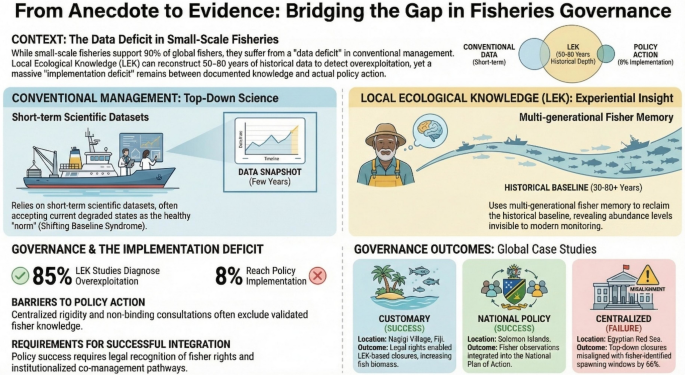

For many fisheries around the world, especially small-scale fisheries, long-term scientific datasets are scarce or entirely absent. Yet the people working on the water every day often hold detailed observations accumulated over decades. In a new review published in Reviews in Fish Biology and Fisheries, the authors examine what local ecological knowledge can contribute to understanding and managing overexploited fisheries. Drawing on 102 peer-reviewed studies published between 1999 and 2025, they assess both the strengths of this knowledge and the challenges involved in translating it into management action.
The review shows that local ecological knowledge can provide information that conventional monitoring programmes frequently miss. Fishers' observations have been used to reconstruct ecological baselines extending 50 to 80 years into the past, identify spawning and nursery habitats, document changes in species distributions, and detect declines in abundance. These insights are particularly valuable in regions where monitoring is limited or where ecological changes began long before systematic surveys were established.
Foreseeing explotation
A key contribution of the study is its attempt to quantify how often this knowledge helps identify signs of overexploitation. Across the reviewed literature, 85% of studies reported at least one indicator of overexploitation based on local ecological knowledge. The authors also describe how fishers can provide spatially detailed information on habitats and seasonal movements, and in some cases detect ecosystem changes before they become visible in formal datasets.
At the same time, demonstrating ecological value is only part of the story. While local ecological knowledge was frequently used to document environmental change, far fewer studies reported that it influenced management. Only 8% of the reviewed studies documented a formally implemented management action linked to this evidence. The authors suggest that the main obstacle is not the quality of the knowledge itself, but the institutional arrangements through which fisheries decisions are made.
Comparisons among case studies from Fiji, the Solomon Islands, Guyana, Egypt, and Canada point to a recurring pattern. Where local ecological knowledge was successfully incorporated into management, there were generally clear pathways connecting communities to decision-making processes and some form of recognized resource rights or governance authority. In contrast, several examples showed that well-documented local observations remained outside formal management systems despite being ecologically relevant.
Aware of limitations
The authors are careful not to present local ecological knowledge as a substitute for scientific research. They note that observations of declining catches, smaller fish, or changing distributions can have multiple causes, including habitat degradation and climate-related changes, and therefore benefit from validation against independent data whenever possible. They also acknowledge that the review is limited to English-language, peer-reviewed studies and may not fully capture experiences from regions where this knowledge is widely used but less frequently documented in the academic literature.
Even with these caveats, the article suggests that one of the most important questions facing fisheries governance today is no longer whether local ecological knowledge has value, but how institutions can make better use of evidence that is already available.
Author's note: I used Microsoft Copilot to assist in creating this post.
Image: By Bernard Gagnon - Own work, CC BY-SA 3.0

Follow the Topic
-
Reviews in Fish Biology and Fisheries
Reviews in Fish Biology and Fisheries is an international journal that publishes original and review articles on various aspects of fish biology, fisheries, and aquaculture.

Related Collections
With Collections, you can get published faster and increase your visibility.
Sustaining Life Below Water: Conserving, managing, and protecting our marine and freshwater resources
In support of the UN Sustainable Development Goal SDG14 we are calling for submissions for this new collection on Sustaining Life Below WaterPlastic waste, overfishing, ocean acidification, increasing eutrophication are some of the major threats endangering our oceans, rivers and lakes. With this collection we aim to create a cross-disciplinary home for research articles, perspectives, and emerging topics addressing the conservation and sustainability of the use of our marine and freshwater resources. By putting scholarship supporting this UN Goal in the spotlight we hope to increase the scientific knowledge and awareness of the targets and indicators set by the UN Goal such as reducing marine pollution, strengthening resilience, restoring coastal ecosystems, minimizing the impacts of ocean acidification, reducing destructive fishing practices, providing access for small-scale fishers to marine resources and markets and more.
We call for submissions on (but not limited to) the following topics:
•Biotelemetry and bio-logging
•Dam removal policy and development
•Economic benefits to Small Island developing States and least developed countries through sustainable management of fisheries, aquaculture and tourism
•Effects of reef degradation on ecosystem goods and services
•Environmental DNA and RNA
•Environmental flows
•Fish migration and passage
•Fisheries-induced evolution
•Floodplain management
•Hydropower mitigation
•Links between reef health and human health
•Methods and case studies and their scientific assessment, to manage, protect, and restore wetlands, to prevent and significantly reduce wetland pollution, in particular from land-based activities, including sedimentation from poor land-use, plastic and nutrient pollution
•Physiology and health of wild fish
•Preventing and reducing (plastic) pollution/waste in particular from land-based activities, including marine debris and nutrient pollution
•Policy development in river and lake management
•Reducing/minimizing ocean acidification
•Regulating harvesting, ending of overfishing and destructive fishing practices, and science-based management plans to restore fish stocks
•Restoration goals in lake management River and lake restoration
•Strengthening resilience and restoration of coastal ecosystem Understanding and improving sustainable use of coral reef resources.
How to submit? Please use the Submit to this journal link from the participating journals. These journals can be viewed in the right menu. During submission you will be asked if you would like your article to be included in a Topical Collection. Select ‘Yes’ and select the name of this collection from the drop down menu: TC: Sustaining Life Below WaterSubmissions to the collection may be original research articles, perspectives or review articles. Please read the submission guidelines for each journal before submitting. Each submission will undergo thorough and rigorous peer review according to each journal’s peer review editorial policy. Accepted articles will be published in their respective journal and will benefit from being cross-linked as well on the collection page.
The following journals are participating in this collection:
•Aquatic Ecology
•Aquaculture International
•Aquatic Sciences
•Coral Reefs
•Environmental Biology of Fishes
•Estuaries and Coasts
•Fish Physiology and Biochemistry
•Fisheries Science
•Hydrobiologia
•Journal of Applied Phycology
•Journal of Coastal Conservation
•Journal of Ocean University China
•Limnology
•Marine Biology
•Marine Biotechnology
•Maritime Studies
•Ocean Science Journal
•Reviews in Fish Biology and Fisheries
•Thalassas: An International Journal of Marine Sciences
•Wetlands Ecology and Management
Publishing Model: Hybrid
Deadline: Ongoing




Please sign in or register for FREE
If you are a registered user on Research Communities by Springer Nature, please sign in