Defect Chemistry: The Missing Physics of Electrocatalysis
Published in Ecology & Evolution, Materials, and Mechanical Engineering
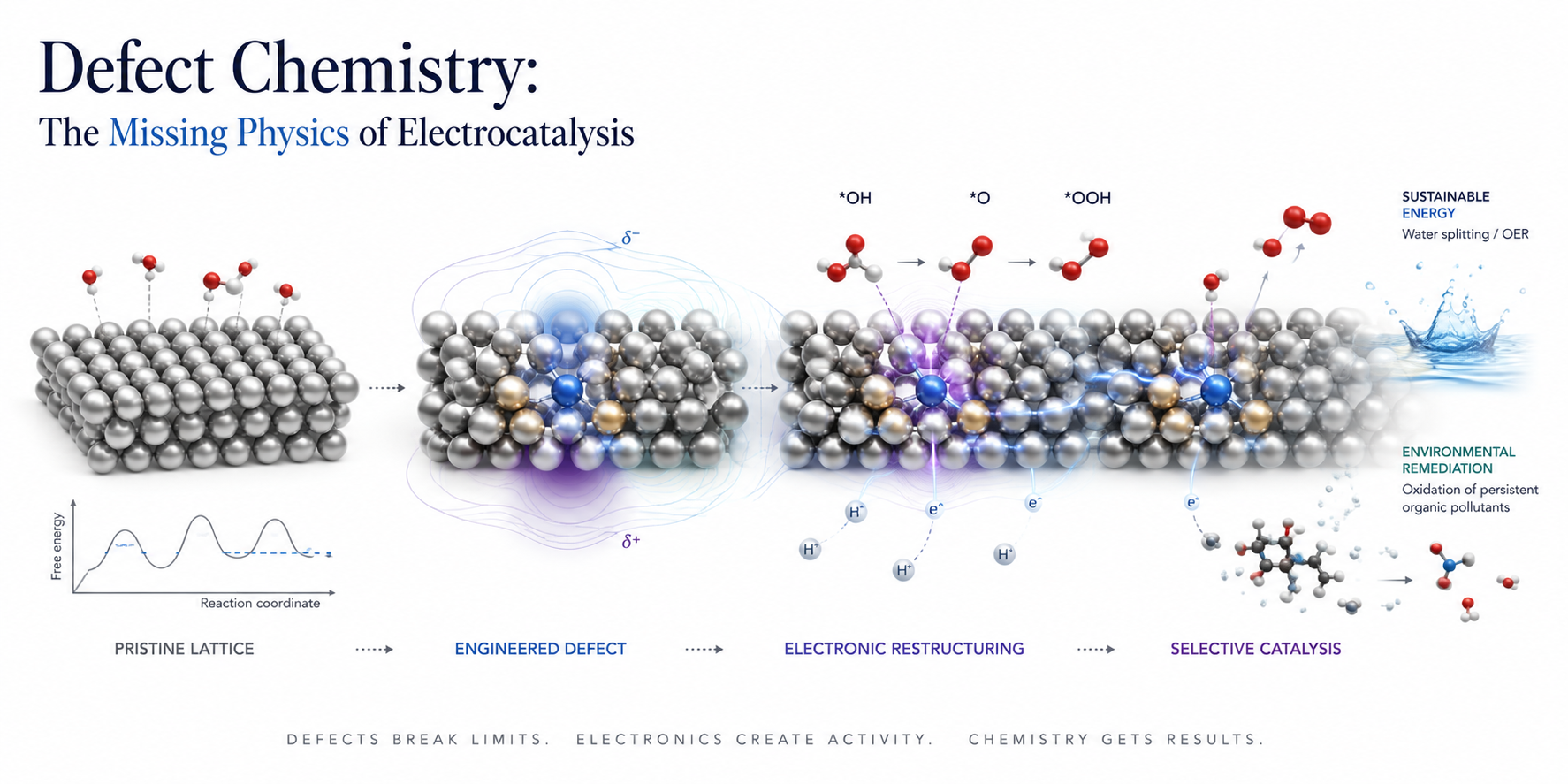

The Trap of the Perfect Lattice and the Sabatier Dead End
If you want to understand the bottleneck in modern sustainable energy technology, look no further than the Sabatier principle.
The rule is fundamental: a perfect catalyst must bind a reactant strongly enough to activate it, but weakly enough to release the final product. If we map this out, we get the famous "volcano plot." For complex, multi-step electrochemical reactions—such as the Oxygen Evolution Reaction (OER) in water splitting, or the Carbon Dioxide Reduction Reaction (CO2RR)—the intermediaries (*OH, *O, *OOH) share identical bonding geometries on pristine metal lattices.
This creates a rigid mathematical trap known as linear scaling relations.
If you design a pristine metal oxide crystal that binds *OH perfectly, the thermodynamics dictate that it will inherently bind *OOH too weakly. You are fundamentally locked into a theoretical overpotential penalty. No amount of brute-force nanostructuring or pristine crystal growth can break this mathematical wall.
A perfect, flawless crystal lattice is thermodynamically stable, but it is catalytically paralyzed. To break the scaling relations, we must break the symmetry of the lattice. We must introduce defects.
Oxygen Vacancies: The Engines of Energy Conversion
The most powerful tool in modern electrocatalysis is the oxygen vacancy (VO).
When we purposefully strip an oxygen atom out of a transition metal oxide lattice (such as a perovskite or a spinel ferrite), we create a localized atomic void. This void fundamentally rewrites the local electronic structure. The adjacent metal cations are forced into lower oxidation states, and the trapped electrons create new defect states directly within the bandgap.
From an electrocatalytic standpoint, this is revolutionary. According to the d-band center theory, the introduction of oxygen vacancies shifts the d-band center of the transition metals closer to the Fermi level. This dramatically enhances the hybridization between the metal d-orbitals and the oxygen p-orbitals of incoming reactants.
In water splitting (OER), oxygen vacancies act as preferential adsorption sites for water molecules, significantly lowering the activation energy barrier for the critical O-O bond formation step. In CO2 reduction, these defect sites stabilize the highly elusive *COOH intermediate, effectively steering the reaction pathway away from parasitic hydrogen evolution and toward high-value C2+ products like ethylene and ethanol.
The missing atom is the very thing doing the heavy lifting.
Single-Atom Catalysts: The Ultimate Defect
If a vacancy is a missing atom, what happens when we invert the concept? What if we engineer an isolated, lonely metal atom trapped within a foreign lattice matrix?
This is the frontier of Single-Atom Catalysts (SACs)—the extreme limit of defect chemistry. By anchoring individual transition metal atoms (like Fe, Co, or Ni) into the defective vacancies of a nitrogen-doped carbon matrix (M-N-C), we achieve 100% atom utilization.
But the true genius of SACs lies in their unsymmetrical coordination environment. Because the metal atom is atomically dispersed and highly unsaturated, it mimics the active sites of biological enzymes. In sustainable energy, SACs are entirely redefining the Oxygen Reduction Reaction (ORR) in hydrogen fuel cells, replacing exorbitant platinum with defective, iron-doped carbon networks. They are also paving the way for the electrochemical Nitrogen Reduction Reaction (NRR), forcing inert N2 gas to split at ambient conditions to produce green ammonia—a feat pristine transition metals consistently fail to achieve.
Environmental Remediation: Defects as Radical Factories
The power of defect electrocatalysis is not limited to clean energy generation; it is the ultimate weapon for environmental remediation and advanced wastewater treatment.
The global water supply is currently under siege by persistent, recalcitrant pollutants: pharmaceuticals, endocrine disruptors, and the notorious per- and polyfluoroalkyl substances (PFAS). Traditional physical filtration merely moves these pollutants to a landfill. To destroy them, we rely on Advanced Oxidation Processes (AOPs).
Here, defect-engineered electrocatalysts—such as sulfur-deficient Molybdenum Disulfide (MoS2-x) or oxygen-deficient Spinel Ferrites (MFe2O4-x)—act as localized radical factories.
When a low electrical bias is applied, these defect sites exhibit extraordinary electron-transfer kinetics. Instead of generating radicals passively in the bulk solution, the defects selectively bind oxidants like hydrogen peroxide (H2O2) or peroxymonosulfate (PMS) directly at the vacancy site. The trapped defect electrons trigger an immediate, localized cleavage of the O-O bond, flooding the solid-liquid interface with hydroxyl and sulfate radicals.
For forever chemicals like PFAS, which resist radical attack due to the immense strength of the C-F bond, defects offer an alternative route: Direct Electron Transfer (DET). The oxygen vacancies act as direct electronic bridges, physically binding the PFAS molecule and ripping electrons straight out of the fluorinated backbone, shattering the molecule without needing a radical intermediary.
The Stability Paradox: The Cost of Chaos
While the electrocatalytic prowess of defect chemistry is undeniable, we must confront the elephant in the room: The Stability Paradox.
Thermodynamics is a cruel master. The very reason defects are so catalytically active is because they are highly energized and metastable. When we subject heavily defective metal oxides to the extreme anodic potentials and highly oxidizing environments required for OER or wastewater mineralization, the lattice undergoes severe structural stress.
Over continuous operational cycles, oxygen vacancies can be annihilated (filled by oxygen from the water), or worse, the extreme local charge imbalances can trigger the dissolution of the transition metals into the electrolyte. This causes the catalyst to rapidly deactivate, turning our revolutionary defect site into a fatal structural vulnerability.
The next great leap in electrocatalysis will not be figuring out how to create more defects, but figuring out how to stabilize them.
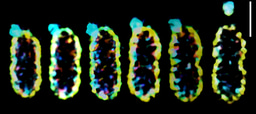
The integration of High-Entropy Alloys (HEAs) and High-Entropy Oxides (HEOs) is currently the most promising frontier. By utilizing extreme configurational entropy—mixing five or more disparate elements into a single lattice—we can create a severely distorted, highly defective interface that is thermodynamically locked in place. The chaos becomes the stabilizing force as shown in Figure 1 below:
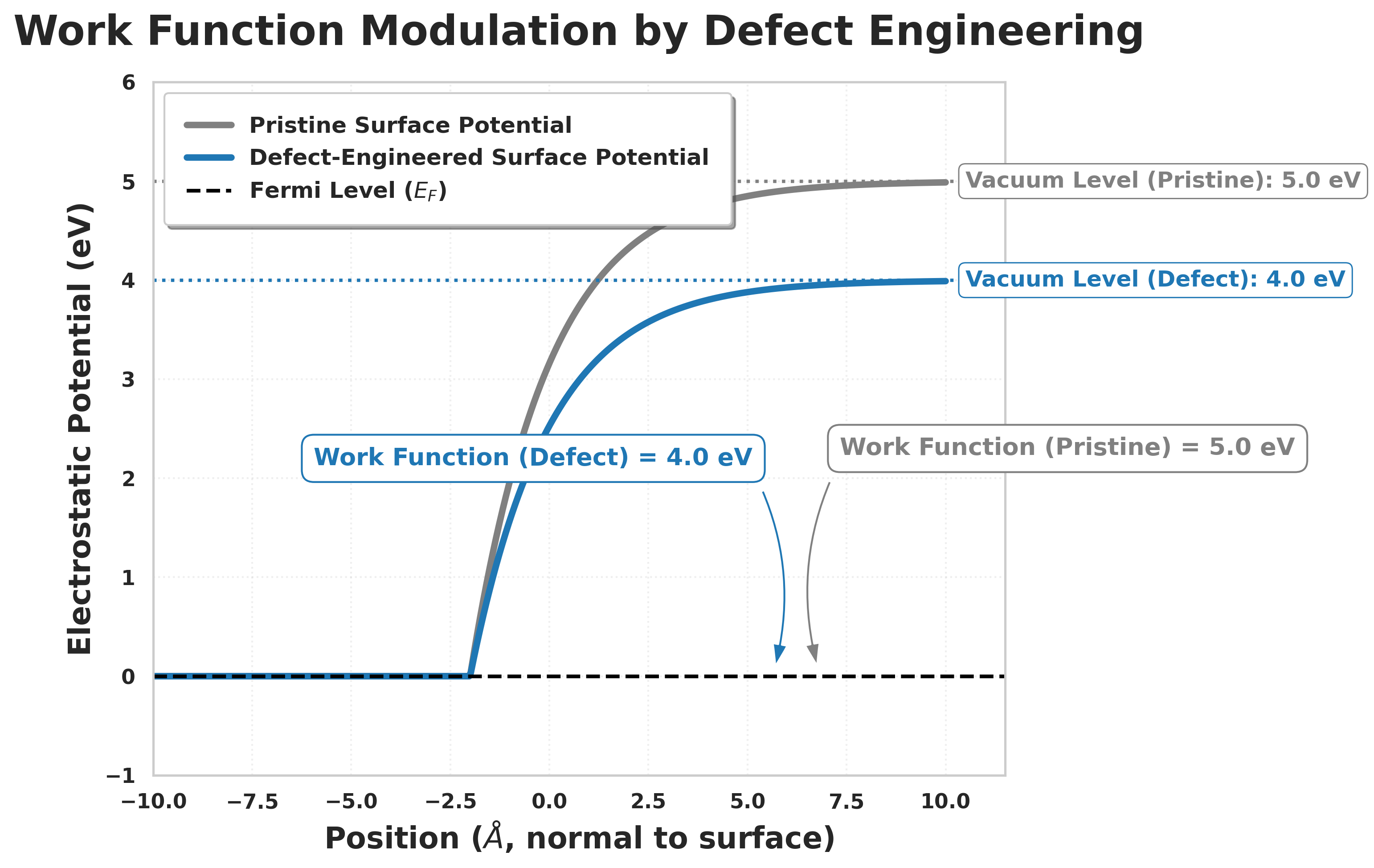
Figure 1: Work Function Modulation by Defect Engineering
Conclusion
Whether we are trying to split water for green hydrogen, reduce carbon emissions into usable fuels, or obliterate toxic forever chemicals in our aquifers, the solution lies in the intelligent application of atomic flaws.
Defect chemistry represents the ultimate convergence of materials science, quantum mechanics, and environmental engineering. We must abandon the pursuit of the pristine lattice and embrace the thermodynamic power of imperfection.
To my colleagues in electrocatalysis and materials science: What do you believe is the most viable strategy for overcoming the Stability Paradox? Can we engineer self-healing defect states under extreme anodic potentials, or is transition metal dissolution an inescapable tax we must pay for breaking the Sabatier limit?
#Electrocatalysis #DefectChemistry #SustainableEnergy #OxygenVacancies #WaterSplitting #EnvironmentalEngineering #PFAS #AdvancedMaterials #SingleAtomCatalysts #SpringerNature

Dr. Akeem Adeyemi Oladipo is a globally recognized Research Professor of Materials and Environmental Chemistry at Eastern Mediterranean University. Ranked among the world's Top 2% Scientists, his expertise bridges nanotechnology, renewable energy, and electro-analytical chemistry. He specializes in advanced materials synthesis for wastewater treatment, highly sensitive electrochemical biosensors, and solar energy conversion. By integrating machine learning and artificial neural networks, his research drives scalable deep-tech innovations in environmental sustainability and energy storage.



Please sign in or register for FREE
If you are a registered user on Research Communities by Springer Nature, please sign in