Breaking the Activity-Durability Trade-Off: Fe-Cr Dual-Atom Coupling Enables Highly Active and Long-Lived Oxygen Reduction Catalysts
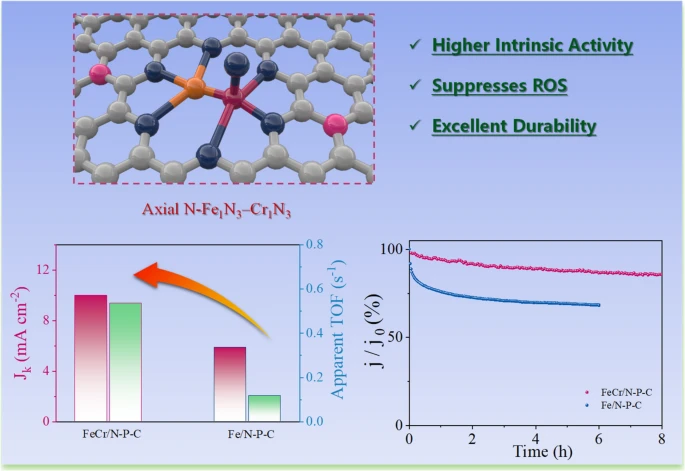
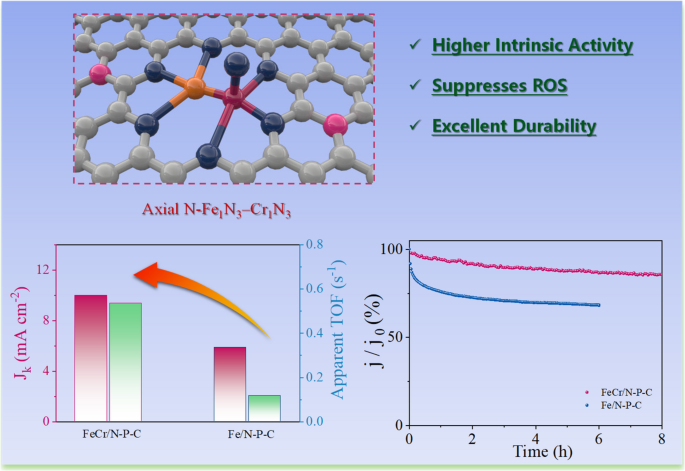

In this work, we developed a neighboring Fe-Cr dual-atom catalyst (FeCr/N-P-C) that addresses one of the most persistent challenges in Fe-based oxygen reduction reaction (ORR) catalysts: achieving high catalytic activity without sacrificing durability. By introducing atomically dispersed Cr adjacent to Fe active sites, we established strong Fe-Cr electronic coupling that simultaneously accelerates ORR kinetics and suppresses Fe-induced degradation. As a result, the catalyst delivers outstanding ORR performance and long-term stability, while also demonstrating excellent practical performance in rechargeable zinc-air batteries.
Key Insights
- Neighboring Fe-Cr dual sites enhance Fe activity through electronic coupling. Structural characterization confirms atomically dispersed Fe-Cr dual-atom sites embedded within an N,P-codoped carbon framework, enabling effective modulation of the Fe electronic structure.
- Intrinsic ORR activity is significantly improved. FeCr/N-P-C achieves a turnover frequency (TOF) of 0.534 s⁻¹ at 0.80 V, representing a 4.6-fold increase compared with the Fe single-atom catalyst.
- The catalyst exhibits excellent oxygen reduction performance. An onset potential of 1.01 V and half-wave potential of 0.845 V were achieved, surpassing monometallic Fe and Cr catalysts as well as commercial Pt/C under alkaline conditions.
- Cr promotes reaction kinetics while reducing degradation pathways. In situ studies reveal faster *OOH conversion together with suppressed peroxide accumulation, leading to more efficient ORR and reduced formation of harmful reactive oxygen species (ROS).
- Remarkable durability was demonstrated. The catalyst shows only a 21 mV half-wave potential loss after 30,000 cycles and retains 85% of its initial current after 8 hours of continuous operation.
- Excellent device-level performance was achieved. Rechargeable zinc-air batteries based on FeCr/N-P-C deliver a peak power density of 187 mW cm⁻² and stable cycling for more than 150 hours, outperforming benchmark Pt/C-based systems.
Significance of This Work
In this study, we demonstrate that neighboring Fe-Cr electronic coupling can simultaneously improve the intrinsic activity and operational durability of Fe-based ORR catalysts. The neighboring Cr atom not only promotes oxygen-intermediate conversion but also suppresses Fe-induced Fenton reactions and ROS generation, mitigating catalyst degradation at its source.
Our findings establish Fe-Cr dual-atom engineering as an effective strategy for overcoming the traditional activity-stability trade-off in non-precious-metal electrocatalysts, providing new opportunities for the development of durable, high-performance catalysts for fuel cells, zinc-air batteries, and other sustainable energy technologies.
Authors & Affiliations
Yingying Guo†, Junfeng Wei†, Xiaohong Tan, Yuhang Xiao, Siyun Du, Hao Cui, and Chengxin Wang**
† These authors contributed equally to this work.
School of Materials Science and Engineering, Sun Yat-sen University, Guangzhou 510275, China.
Corresponding Authors
Prof. Hao Cui ✉ cuihao3@mail.sysu.edu.cn
Prof. Chengxin Wang ✉ wchengx@mail.sysu.edu.cn
How to Cite This Article
Guo, Y. et al. (2026). Neighboring Fe-Cr electronic coupling simultaneously promotes intrinsic activity and suppresses Fe-induced degradation for oxygen reduction electrocatalysis. Catal, 2, 17. https://doi.org/10.1007/s44422-026-00031-z

Follow the Topic
-
Catal
Catal is an open access journal covering full spectrum of catalysis critical advances. From biocatalysts to heterogeneous catalysts, it integrates fundamental and applied sciences. Catal offers a primary platform for researchers and practitioners in the field.

Related Collections
With Collections, you can get published faster and increase your visibility.
National Catalysis Conference 2025
The 22nd National Catalysis Conference, held in December 2025 in Xiamen, China, stands as the largest national academic event in the field of catalysis, bringing together leading scientists from academia and industry to discuss frontier research and emerging technologies across catalytic science.
In collaboration with several internationally recognized researchers from Xiamen University - the main organizer of the conference - Catal will publish a Special Issue featuring selected contributions from the meeting. This joint effort ensures high academic standards and showcases the scientific breadth and excellence presented at the conference.
Potential topics include, but are not limited to:
• Catalytic materials
• Thermocatalysis
• Electrocatalysis
• Biomass and CO₂ conversion
• Industrial catalysis
• Theoretical and computational catalysis
Publishing Model: Open Access
Deadline: Dec 31, 2026
Porous Materials for Sustainable Green Catalysis
The advancement of our collective understanding in the field of porous materials for sustainable green catalysis is crucial as we face urgent environmental challenges and the need for sustainable energy solutions. The integration of porous materials into catalytic processes has opened new avenues for improving efficiency, selectivity and stability while minimizing waste. Significant advances have been made, including the development of zeolites, mesoporous materials, metal-organic frameworks (MOFs) and covalent organic frameworks (COFs), which have demonstrated remarkable catalytic performance in various reactions.
Future research holds immense potential, with speculations ranging from the design of novel porous materials with tailored properties to their application in industrial catalysis, biocatalysis, H2 production and carbon capture technologies. By continuing this research, we can drive progress toward achieving Sustainable Development Goals (SDGs), particularly in clean energy (SDG 7) and climate action (SDG 13), ultimately fostering a sustainable future for our planet.
We invite researchers to contribute to this special Collection by submitting research articles, brief communications, perspectives, reviews, and analyses.
Topics of interest include but are not limited to:
- Synthesis of porous materials
- Catalytic performance evaluation
- Green synthesis methods
- Application in environmental remediation
- CO2 conversion technologies
- Biocatalysis in porous matrices
- Design of multifunctional porous catalysts
- Mechanistic studies of catalysis
Publishing Model: Open Access
Deadline: Dec 31, 2026





Please sign in or register for FREE
If you are a registered user on Research Communities by Springer Nature, please sign in