Tri-Band Regulation and Split-Type Smart Photovoltaic Windows for Thermal Modulation of Energy-Saving Buildings in All-Season
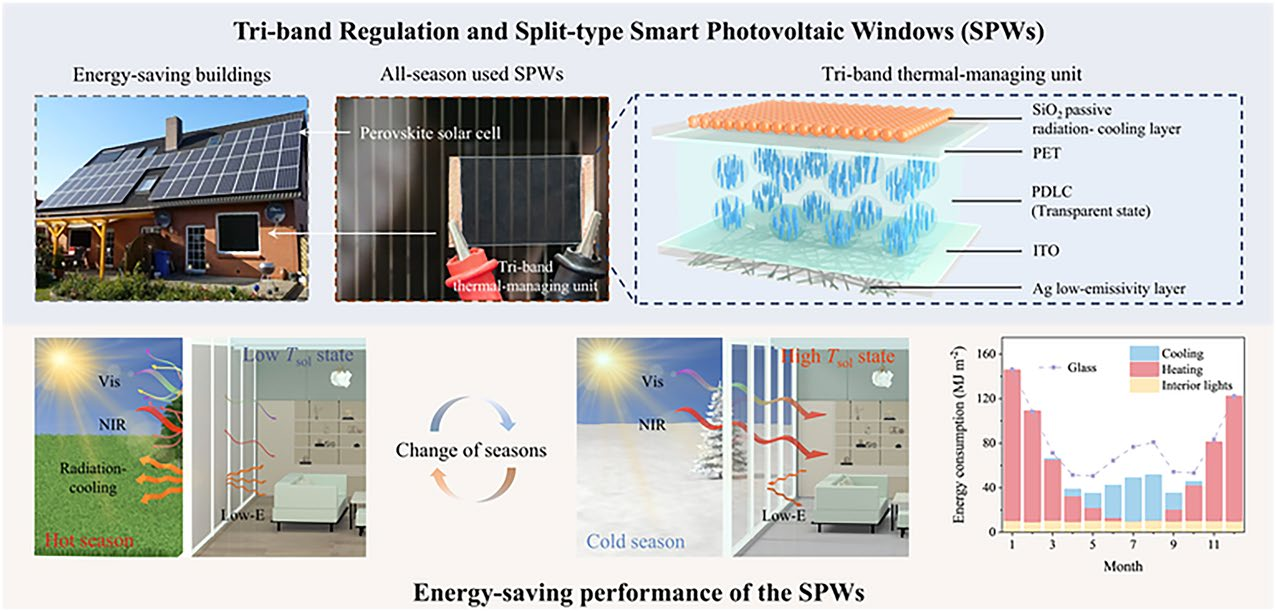
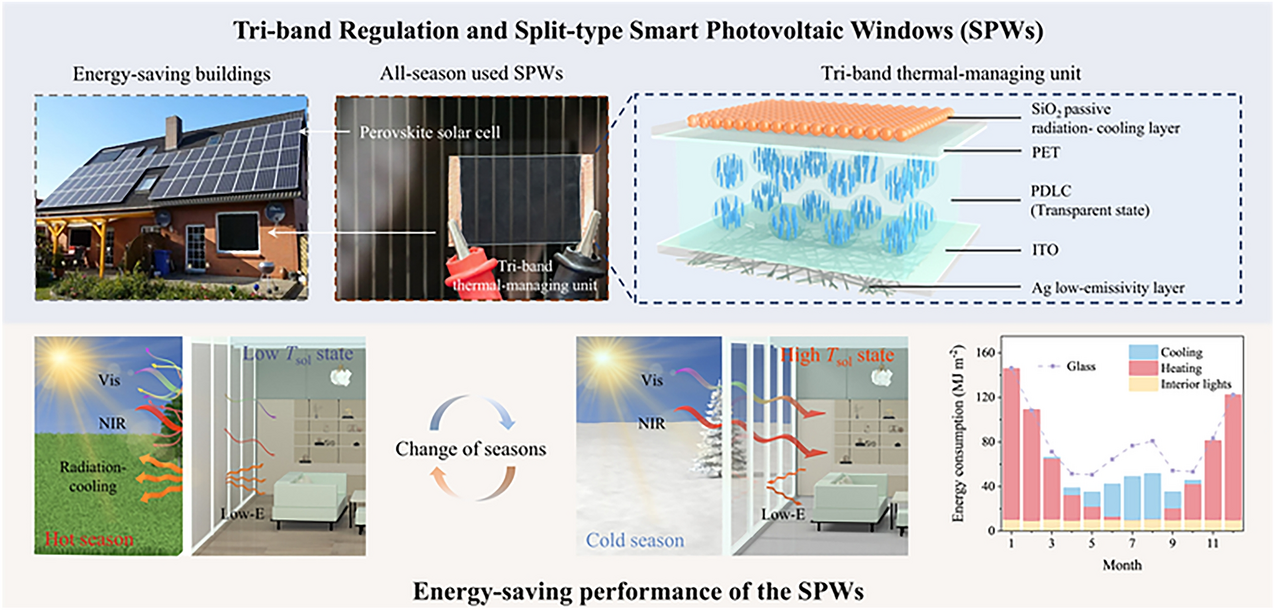

Energy-saving buildings (ESBs) are an emerging green technology that can significantly reduce building-associated cooling and heating energy consumption, catering to the desire for carbon neutrality and sustainable development of society. Smart photovoltaic windows (SPWs) offer a promising platform for designing ESBs because they present the capability to regulate and harness solar energy. With frequent outbreaks of extreme weather all over the world, the achievement of exceptional energy-saving effect under different weather conditions is an inevitable trend for the development of ESBs but is hardly achieved via existing SPWs. Here, we substantially reduce the driving voltage of polymer-dispersed liquid crystals (PDLCs) by 28.1 % via molecular engineering while maintaining their high solar transmittance (Tsol = 83.8 %, transparent state) and solar modulating ability (ΔTsol = 80.5 %). By the assembly of perovskite solar cell and a broadband thermal-managing unit encompassing the electrical-responsive PDLCs, transparent high-emissivity SiO2 passive radiation-cooling, and Ag low-emissivity layers possesses, we present a tri-band regulation and split-type SPW possessing superb energy-saving effect in all-season. The perovskite solar cell can produce the electric power to stimulate the electrical-responsive behavior of the PDLCs, endowing the SPWs zero-energy input solar energy regulating characteristic, and compensate the daily energy consumption needed for ESBs. Moreover, the scalable manufacturing technology holds a great potential for the real-world applications.

Editor of Nano-Micro Letters, which is an Open-Access, peer-reviewed journal reported papers that have at least one dimension ranging from a few sub-nanometers to a few hundreds of micrometers. The journal is published by Springer Nature and indexed by SCI, EI, SCOPUS, Pubmed, etc. The 2024 JCR Impact Factor is 36.3. The 2024 CiteScore is 53.1.
Follow the Topic
-
Nano-Micro Letters

Nano-Micro Letters is a peer-reviewed, international, interdisciplinary and open-access journal that focus on science, experiments, engineering, technologies and applications of nano- or microscale structure and system in physics, chemistry, biology, material science, and pharmacy.
Please sign in or register for FREE
If you are a registered user on Research Communities by Springer Nature, please sign in