Magnetic–Dielectric Synergy in One-Dimensional Metal Heterostructures for Enhanced Low-Frequency Microwave Absorption
Published in Electrical & Electronic Engineering and Materials
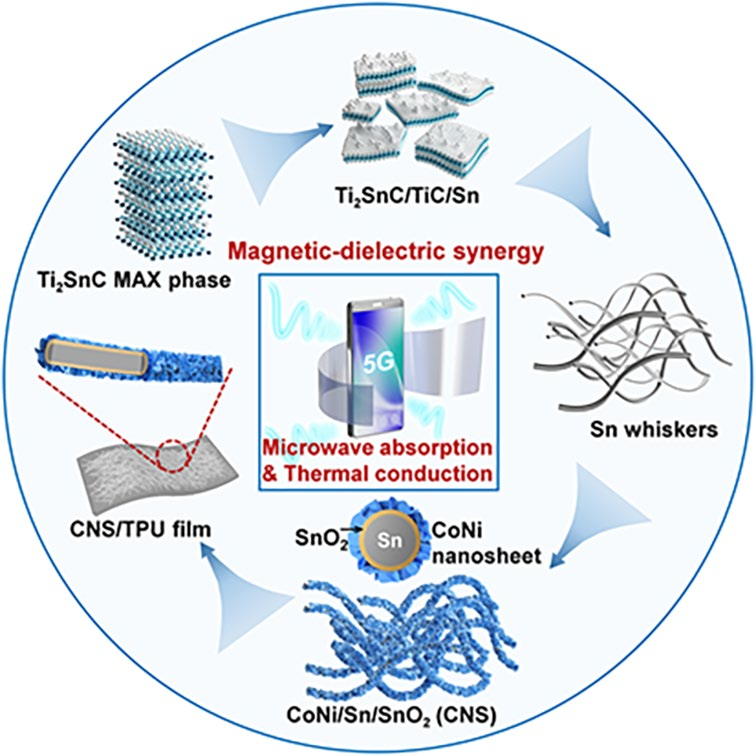
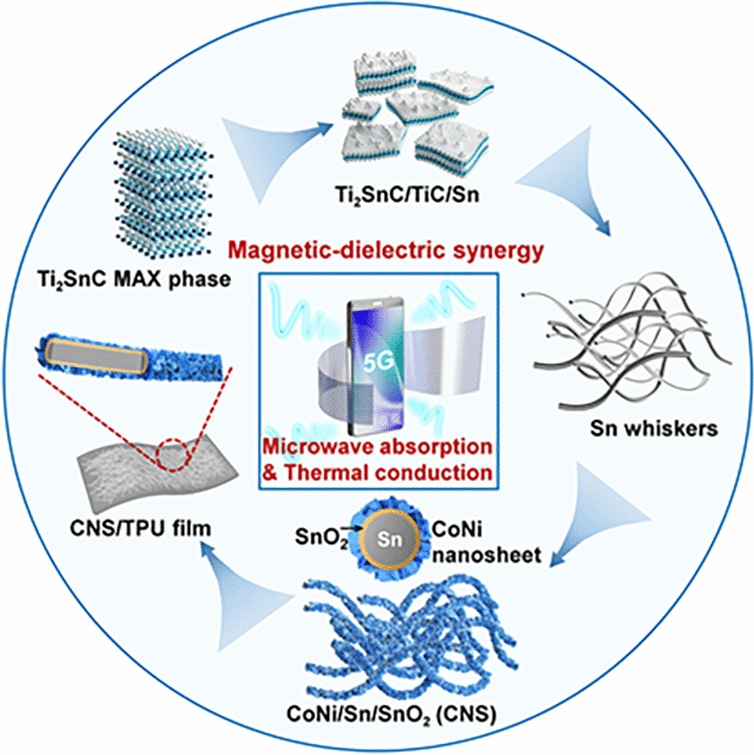

Microwave absorption (MA) materials often face poor synergy between impedance matching and attenuation in the low-frequency range. Balancing permittivity and permeability through magnetic–dielectric synergy is a promising strategy to address this issue. To realize the synergy, herein, Sn whiskers with an in situ oxide layer served as substrates for magnetic-loss-active CoNi nanosheet growth, forming a hierarchical CoNi@SnO2@Sn (CNS) heterostructure. The CNS absorber achieves a minimum reflection loss (RLmin) value of − 62.29 dB with an effective absorption bandwidth (EAB) of 2.2 GHz, covering the entire C-band with 70% absorption at only 2.61 mm thickness. The nanosheet design of CoNi enhances magnetic anisotropy to promote natural resonance, while the conductive Sn core and abundant Sn/SnO2 and CoNi/SnO2 heterointerfaces facilitate conduction loss and dielectric polarization. When composited into a thermoplastic polyurethane (TPU) matrix, the resulting CNS/TPU-2 film (20 wt% CNS) exhibits an RLmin value of -61.04 dB and a 2.5 GHz EAB. Its in-plane and through-plane thermal conductivities reach 2.41 and 0.51 W m−1 K−1, representing 4.1 and 2.6 times those of pure TPU films, respectively, facilitating heat dissipation from protected devices. This work provides valuable insights into magnetic–dielectric synergy for low-frequency MA of 1D metal-based materials, offering promising potential for 5G communications and flexible electronics.

Editor of Nano-Micro Letters, which is an Open-Access, peer-reviewed journal reported papers that have at least one dimension ranging from a few sub-nanometers to a few hundreds of micrometers. The journal is published by Springer Nature and indexed by SCI, EI, SCOPUS, Pubmed, etc. The 2025 JCR Impact Factor is 38.5. The 2025 CiteScore is 58.9.
Follow the Topic
-
Nano-Micro Letters
Nano-Micro Letters is a peer-reviewed, international, interdisciplinary and open-access journal that focus on science, experiments, engineering, technologies and applications of nano- or microscale structure and system in physics, chemistry, biology, material science, and pharmacy.