Turning Carbon into Fuel: Breakthroughs in Fe-Based Catalysts for Efficient CO₂-to-Higher Alcohol Conversion

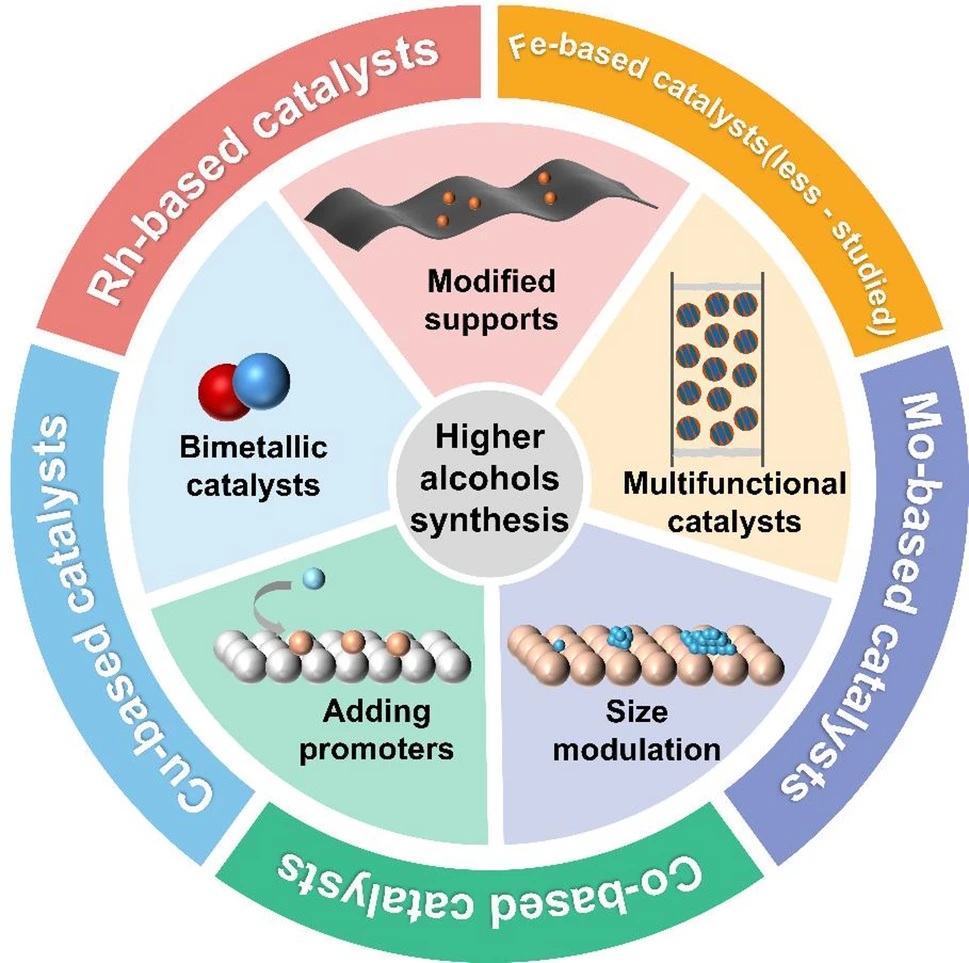
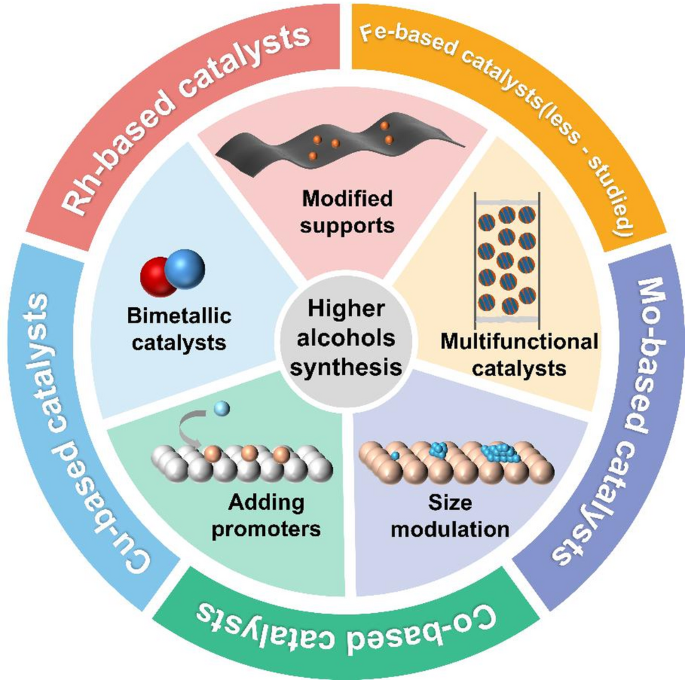

In this review, we provide a comprehensive overview of recent progress in Fe-based catalysts for the hydrogenation of CO₂ to higher alcohols (C₂+OH). As global efforts to reduce carbon emissions intensify, the catalytic conversion of CO₂ into value-added fuels and chemicals has emerged as a promising strategy for carbon utilization. Among various catalytic systems, Fe-based catalysts stand out because of their low cost, excellent CO₂ activation capability, and intrinsic ability to promote carbon-chain growth through the synergistic reverse water–gas shift (RWGS) and Fischer–Tropsch synthesis (FTS) pathways. Our analysis highlights how catalyst design, promoter engineering, and support modification can significantly improve higher-alcohol selectivity and catalytic stability.
Key Insights
- Fe-based catalysts are leading candidates for CO₂-to-alcohol conversion: Their strong CO₂ activation ability and unique capacity for C–C coupling make them highly attractive for higher alcohol synthesis.
- Bimetallic promotion is highly effective: The incorporation of Co, Pd, Cu, and other metals can regulate Fe active phases, optimize electronic structures, and improve intermediate conversion efficiency.
- Fe-Co alloy carbides demonstrated exceptional performance: Fe-Co catalysts achieved up to 51.1% CO₂ conversion and 49.1% higher alcohol selectivity, while maintaining stability for more than 1,000 hours.
- PdFe alloy–Fe₅C₂ interfaces create synergistic active sites: These interfaces facilitate CO generation, CO dissociation, and carbon-chain propagation, resulting in enhanced higher-alcohol production and catalyst durability.
- Alkali promoters play a key regulatory role: Na, K, and Cs modify the electronic properties of Fe active sites, balancing CO activation, hydrogenation, and C–C coupling to favor higher alcohol formation over hydrocarbons.
- Support engineering is equally important: Metal oxides, carbon materials, and zeolites can regulate active-site dispersion, electronic transfer, oxygen-vacancy formation, and reaction pathways.
- Carbon-based electron-buffer layers enhance ethanol synthesis: Optimized charge redistribution among ZnOx, Fe₅C₂, and Fe₃O₄ phases significantly increases ethanol productivity and catalyst stability.
- Zeolite-supported systems offer long-term opportunities: Their confinement effects and tunable acidity provide unique advantages, although metal-support interactions and promoter migration remain challenges.
Significance of This Work
In this review, we highlight how metal promoters, support materials, and active-phase engineering work together to enhance the performance of Fe-based catalysts for CO₂ hydrogenation to higher alcohols. We show that rational catalyst design can improve CO₂ activation, C–C coupling, product selectivity, and catalyst stability. [News in English | Word]
We also identify key challenges—including limited alcohol selectivity, catalyst deactivation, and incomplete mechanistic understanding—and outline future opportunities in promoter-support synergy and advanced catalyst design. These insights provide a roadmap for developing efficient technologies that convert captured CO₂ into sustainable fuels and value-added chemicals.
Authors & Affiliations
Zexiu Yu, Peng Wang*, Thachapan Atchimarungsri, Lizhi Wu, Fan Bo, Xingang Li*, Hua Yang, and Li Tan*
Affiliations
- State Key Laboratory of Green and Efficient Development of Phosphorus Resources, College of Chemistry, School of Future Technology, Fuzhou University, Fuzhou 350108, China.
- The International Joint Institute of Tianjin University, Tianjin University, Tianjin 300072, China.
- Chongqing Vocational Institute of Safety Technology, Chongqing 404020, China.
Corresponding Authors
Prof. Peng Wang
✉ p_wang@fzu.edu.cn
Prof. Xingang Li
✉ xingang_li@tju.edu.cn
Prof. Li Tan
✉ tan@fzu.edu.cn
How to Cite This Article
Yu, Z. et al. (2026). Advances in Fe-based catalysts for the hydrogenation of carbon dioxide toward higher alcohols. Catal, 2, 16.
https://doi.org/10.1007/s44422-026-00029-7
Follow the Topic
-
Catal
Catal is an open access journal covering full spectrum of catalysis critical advances. From biocatalysts to heterogeneous catalysts, it integrates fundamental and applied sciences. Catal offers a primary platform for researchers and practitioners in the field.

Related Collections
With Collections, you can get published faster and increase your visibility.
Porous Materials for Sustainable Green Catalysis
The advancement of our collective understanding in the field of porous materials for sustainable green catalysis is crucial as we face urgent environmental challenges and the need for sustainable energy solutions. The integration of porous materials into catalytic processes has opened new avenues for improving efficiency, selectivity and stability while minimizing waste. Significant advances have been made, including the development of zeolites, mesoporous materials, metal-organic frameworks (MOFs) and covalent organic frameworks (COFs), which have demonstrated remarkable catalytic performance in various reactions.
Future research holds immense potential, with speculations ranging from the design of novel porous materials with tailored properties to their application in industrial catalysis, biocatalysis, H2 production and carbon capture technologies. By continuing this research, we can drive progress toward achieving Sustainable Development Goals (SDGs), particularly in clean energy (SDG 7) and climate action (SDG 13), ultimately fostering a sustainable future for our planet.
We invite researchers to contribute to this special Collection by submitting research articles, brief communications, perspectives, reviews, and analyses.
Topics of interest include but are not limited to:
- Synthesis of porous materials
- Catalytic performance evaluation
- Green synthesis methods
- Application in environmental remediation
- CO2 conversion technologies
- Biocatalysis in porous matrices
- Design of multifunctional porous catalysts
- Mechanistic studies of catalysis
Publishing Model: Open Access
Deadline: Dec 31, 2026
National Catalysis Conference 2025
The 22nd National Catalysis Conference, held in December 2025 in Xiamen, China, stands as the largest national academic event in the field of catalysis, bringing together leading scientists from academia and industry to discuss frontier research and emerging technologies across catalytic science.
In collaboration with several internationally recognized researchers from Xiamen University - the main organizer of the conference - Catal will publish a Special Issue featuring selected contributions from the meeting. This joint effort ensures high academic standards and showcases the scientific breadth and excellence presented at the conference.
Potential topics include, but are not limited to:
• Catalytic materials
• Thermocatalysis
• Electrocatalysis
• Biomass and CO₂ conversion
• Industrial catalysis
• Theoretical and computational catalysis
Publishing Model: Open Access
Deadline: Dec 31, 2026