Unlocking Efficient Solar H₂O₂ Production via Donor–Acceptor Conjugated Polymers

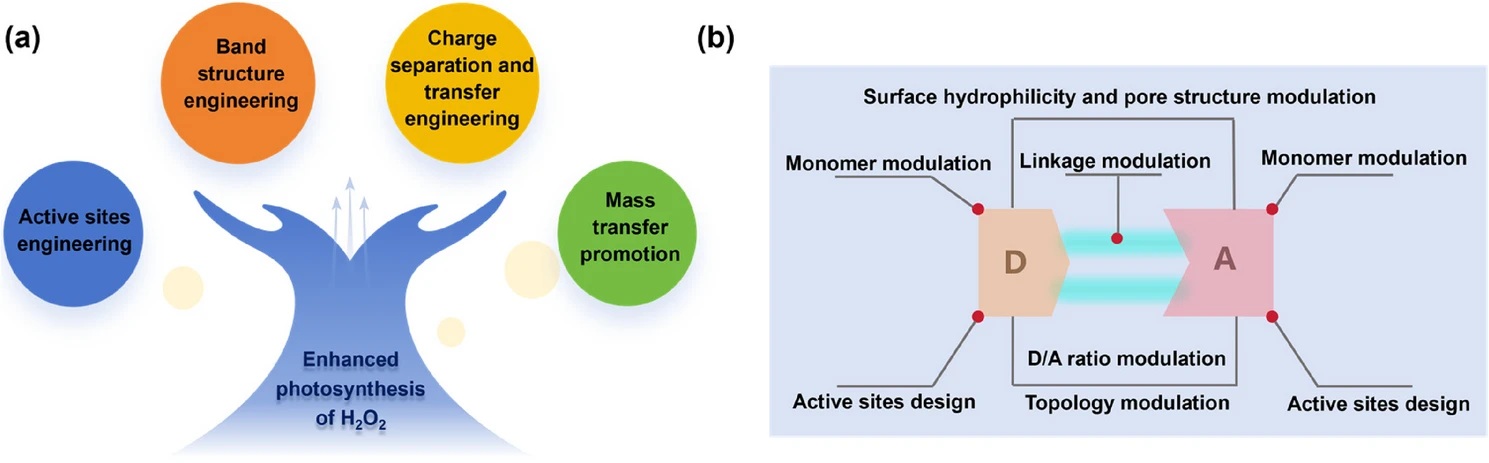
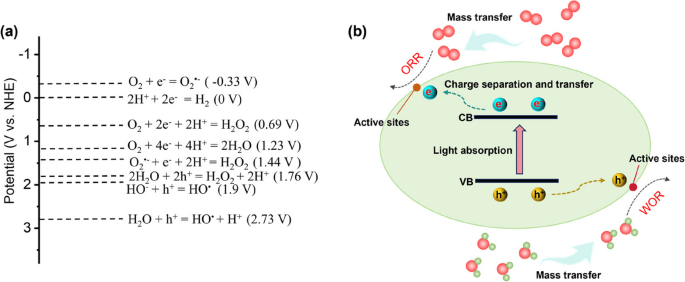

In this work, we provide a comprehensive overview of donor–acceptor (D–A) conjugated polymers as highly promising photocatalysts for the sustainable production of hydrogen peroxide (H₂O₂) in pure water. Conventional industrial synthesis via the anthraquinone process remains energy-intensive and environmentally burdensome. By contrast, solar-driven photocatalytic synthesis offers a green alternative, utilizing only water and oxygen under mild conditions.
Building on recent advances, we highlight how rational molecular engineering of D–A polymers significantly improves catalytic efficiency, selectivity, and stability, advancing the development of next-generation solar chemical technologies.
Key Insights
-
D–A polymers enable efficient photocatalysis
Their tunable band structures and strong charge separation enhance visible-light-driven H₂O₂ production. -
Molecular engineering boosts performance
Rational design has increased H₂O₂ production rates by up to two orders of magnitude. -
Linkage and topology control charge dynamics
Structural tuning improves exciton dissociation and charge transport efficiency. -
Active-site design improves selectivity
Engineered sites favor the 2e⁻ ORR pathway, enhancing H₂O₂ selectivity. -
Mass transfer optimization enhances efficiency
Porous and hydrophilic structures facilitate reactant diffusion and utilization. -
Performance gaps remain
Current systems still fall short of industrial efficiency and scalability targets.
Significance of This Work
This review demonstrates that D–A conjugated polymers provide a versatile and tunable platform for solar-driven H₂O₂ production. Through coordinated advances in molecular design, linkage engineering, topology modulation, and catalytic site optimization, substantial progress has been achieved in improving photocatalytic performance.
At the same time, we identify key challenges, including limited solar-to-chemical conversion efficiency, insufficient long-term stability, and the lack of clear structure–activity relationships. We emphasize that emerging approaches such as machine learning-guided design and advanced operando characterization will play a critical role in accelerating future breakthroughs.
Overall, we anticipate that continued interdisciplinary efforts will enable the development of efficient, durable, and scalable polymer photocatalysts, paving the way for decentralized and sustainable hydrogen peroxide production powered by sunlight.
Authors & Affiliations
Wang Wang; Jingzhao Cheng; Bei Cheng; Guoqiang Luo; Jingsan Xu; Shaowen Cao*
Affiliations:
State Key Laboratory of Advanced Technology for Materials Synthesis and Processing, Wuhan University of Technology, Wuhan, China
Hubei Technology Innovation Center for Advanced Composites, Wuhan University of Technology, China
Queensland University of Technology, Brisbane, Australia
Corresponding Author:
Shaowen Cao (swcao@whut.edu.cn)
How to Cite This Article
Wang, W.; Cheng, J.; Cheng, B.; Luo, G.; Xu, J.; Cao, S. (2026).
Donor–acceptor conjugated polymers for the photosynthesis of H₂O₂ in pure water.
Catal, 2, 13. https://doi.org/10.1007/s44422-026-00026-w
Follow the Topic
-
Catal
Catal is an open access journal covering full spectrum of catalysis critical advances. From biocatalysts to heterogeneous catalysts, it integrates fundamental and applied sciences. Catal offers a primary platform for researchers and practitioners in the field.

Related Collections
With Collections, you can get published faster and increase your visibility.
Porous Materials for Sustainable Green Catalysis
The advancement of our collective understanding in the field of porous materials for sustainable green catalysis is crucial as we face urgent environmental challenges and the need for sustainable energy solutions. The integration of porous materials into catalytic processes has opened new avenues for improving efficiency, selectivity and stability while minimizing waste. Significant advances have been made, including the development of zeolites, mesoporous materials, metal-organic frameworks (MOFs) and covalent organic frameworks (COFs), which have demonstrated remarkable catalytic performance in various reactions.
Future research holds immense potential, with speculations ranging from the design of novel porous materials with tailored properties to their application in industrial catalysis, biocatalysis, H2 production and carbon capture technologies. By continuing this research, we can drive progress toward achieving Sustainable Development Goals (SDGs), particularly in clean energy (SDG 7) and climate action (SDG 13), ultimately fostering a sustainable future for our planet.
We invite researchers to contribute to this special Collection by submitting research articles, brief communications, perspectives, reviews, and analyses.
Topics of interest include but are not limited to:
- Synthesis of porous materials
- Catalytic performance evaluation
- Green synthesis methods
- Application in environmental remediation
- CO2 conversion technologies
- Biocatalysis in porous matrices
- Design of multifunctional porous catalysts
- Mechanistic studies of catalysis
Publishing Model: Open Access
Deadline: Dec 31, 2026
National Catalysis Conference 2025
The 22nd National Catalysis Conference, held in December 2025 in Xiamen, China, stands as the largest national academic event in the field of catalysis, bringing together leading scientists from academia and industry to discuss frontier research and emerging technologies across catalytic science.
In collaboration with several internationally recognized researchers from Xiamen University - the main organizer of the conference - Catal will publish a Special Issue featuring selected contributions from the meeting. This joint effort ensures high academic standards and showcases the scientific breadth and excellence presented at the conference.
Potential topics include, but are not limited to:
• Catalytic materials
• Thermocatalysis
• Electrocatalysis
• Biomass and CO₂ conversion
• Industrial catalysis
• Theoretical and computational catalysis
Publishing Model: Open Access
Deadline: Dec 31, 2026