Ultra-Fast Synthesis of Non-Precious CoNiB₂ Catalysts for Water Oxidation

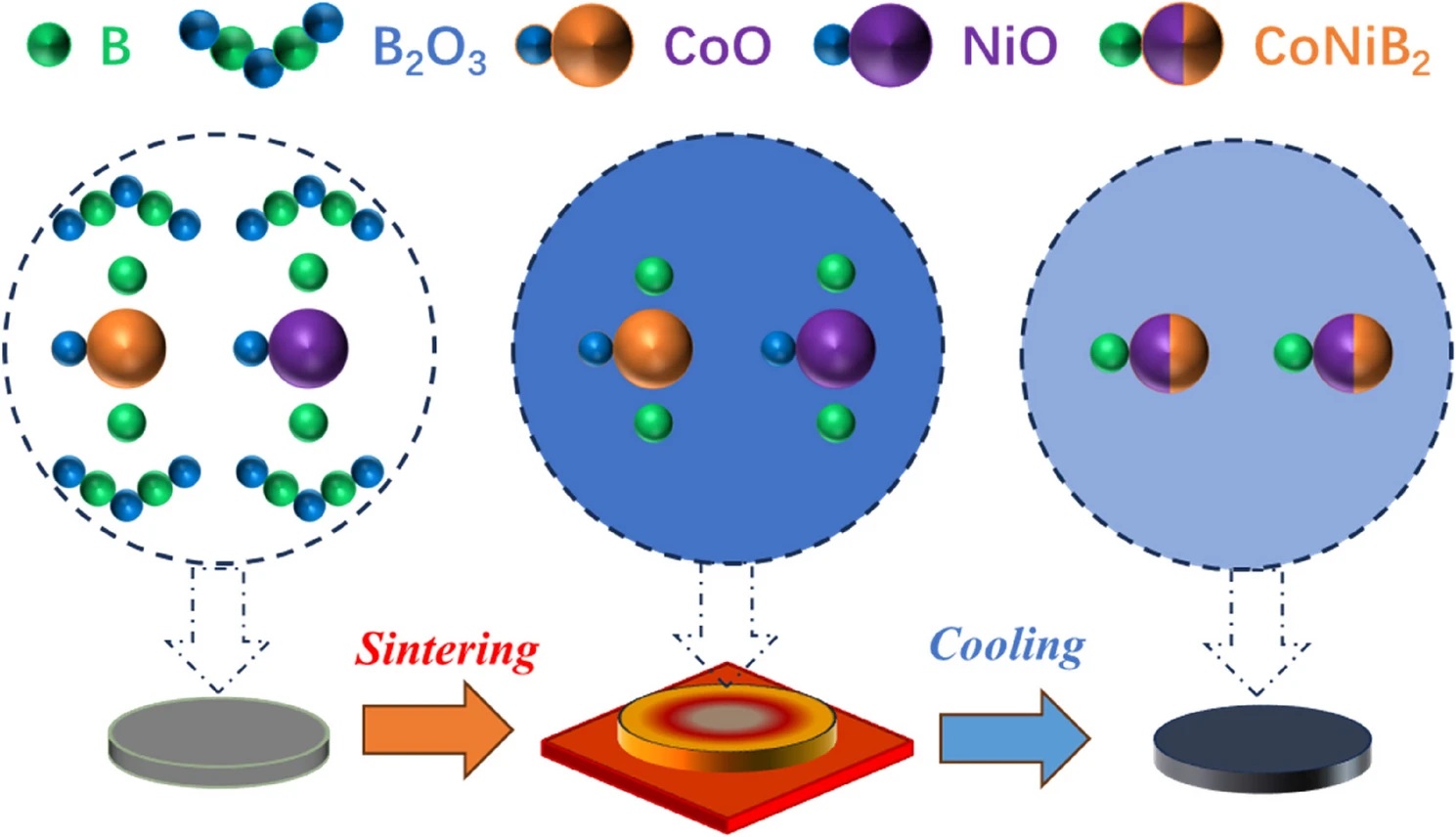
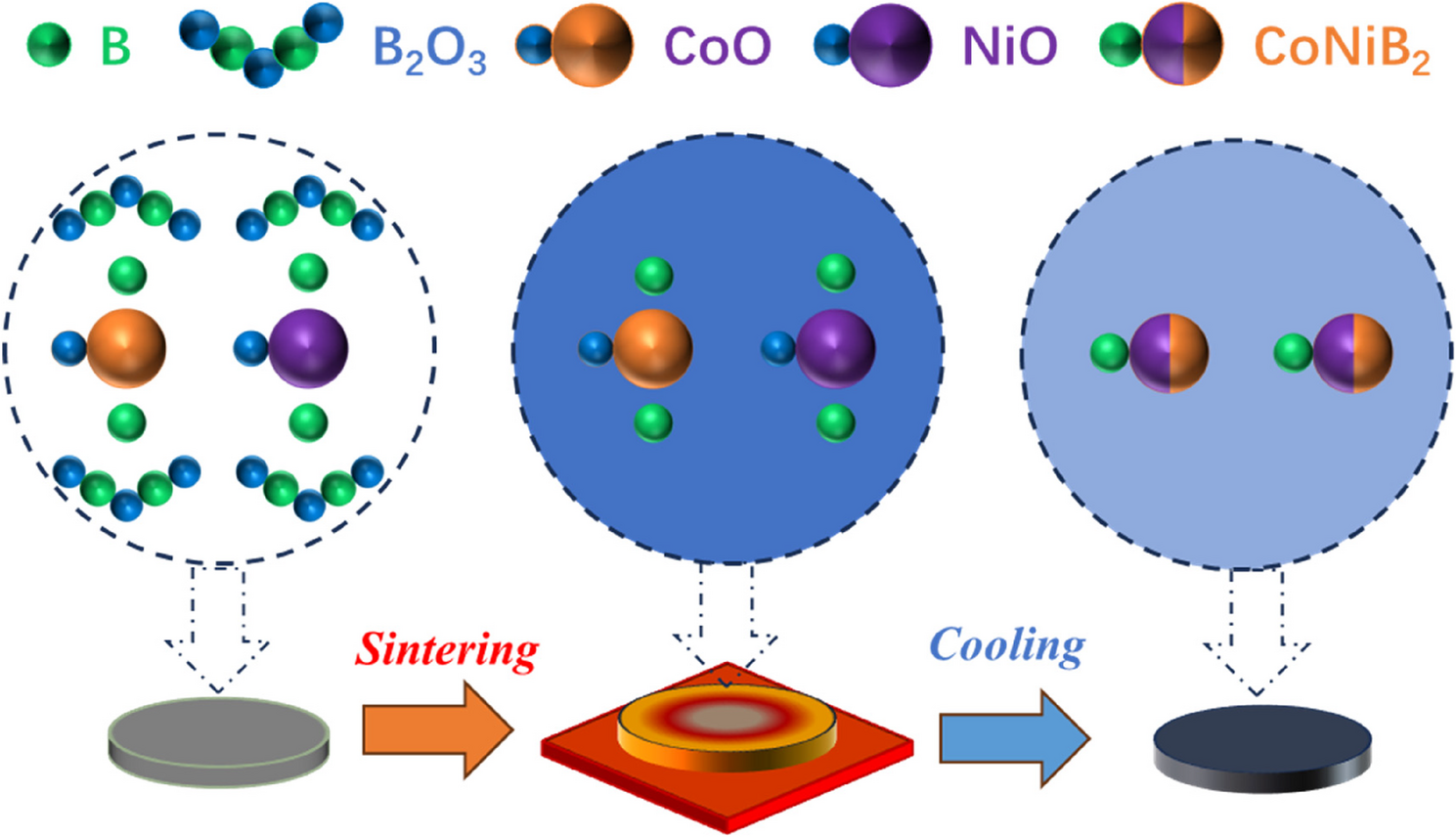

We present a rapid and scalable strategy for constructing a high-performance oxygen evolution reaction (OER) electrocatalyst based on cobalt–nickel boride (CoNiB₂). Using a liquid-phase soaking technology, crystalline CoNiB₂ nanoflowers can be synthesized within seconds from simple oxide precursors. This work demonstrates that efficient, durable and non-precious-metal OER catalysts can be produced through an ultra-fast and versatile synthesis route, offering new opportunities for green hydrogen production.
Key Insights
- Ultra-fast synthesis strategy: We developed a liquid-phase soaking technology that enables the synthesis of crystalline CoNiB₂ in just 20 seconds, showing that high-performance electrocatalysts can be obtained on an exceptionally short timescale.
- Liquid boron oxide as a transient reaction medium: Molten boron oxide acts as a temporary liquid phase that promotes rapid redox conversion of cobalt and nickel oxides into CoNiB₂ while limiting crystal overgrowth, yielding phase-pure products with controlled morphology.
- Nanoflower architecture with abundant active sites: The resulting CoNiB₂ forms nanoflowers composed of folded, edge-rich subunits, greatly increasing the electrochemically active surface area and facilitating efficient charge transfer during oxygen evolution.
- Outstanding oxygen evolution activity: In alkaline electrolyte, CoNiB₂ reaches 10 mA cm⁻² at an overpotential of only 271 mV, outperforming the benchmark RuO₂ catalyst at comparable loading.
- Fast reaction kinetics enabled by bimetallic synergy: A low Tafel slope of 67 mV dec⁻¹ indicates accelerated OER kinetics, arising from the synergistic electronic interaction between cobalt and nickel within the boride lattice.
- Excellent durability under high current density: The CoNiB₂ catalyst maintains stable performance during continuous operation at 100 mA cm⁻² for at least 25 hours, underscoring its robustness under industrially relevant conditions.
- Theoretical insight into performance enhancement: Density functional theory calculations reveal that CoNiB₂ exhibits a much lower energy barrier for the rate-determining step of OER than monometallic CoB, providing mechanistic insight into its superior catalytic activity.
Significance
This study shows that efficient and durable OER catalysts can be synthesized rapidly without relying on precious metals or complex processing routes. The ability to fabricate a high-performance bimetallic boride catalyst within seconds offers a practical pathway toward scalable catalyst production for alkaline water electrolysis and green hydrogen technologies.
More broadly, the liquid-phase soaking approach provides a general strategy for constructing nanoscale borides with tailored morphology and optimized electronic structure. This method can be extended to other boride systems, accelerating materials discovery in electrocatalysis and energy conversion.
Authors and Author Affiliations
Ruifeng Qi†, Junqi Liu†, Xiaohua Qiao, Tianyu Zhang, Qin Liu, Feng Gao, Qingsong Huang*
† These authors contributed equally to this work
School of Chemical Engineering, Sichuan University, Chengdu 610065, China
Tianfu Jiangxi Laboratory, Chengdu 610065, China
Corresponding Author: Qingsong Huang
Email: qshuang@scu.edu.cn
Follow the Topic
-
Catal
Catal is an open access journal covering full spectrum of catalysis critical advances. From biocatalysts to heterogeneous catalysts, it integrates fundamental and applied sciences. Catal offers a primary platform for researchers and practitioners in the field.

Related Collections
With Collections, you can get published faster and increase your visibility.
Porous Materials for Sustainable Green Catalysis
The advancement of our collective understanding in the field of porous materials for sustainable green catalysis is crucial as we face urgent environmental challenges and the need for sustainable energy solutions. The integration of porous materials into catalytic processes has opened new avenues for improving efficiency, selectivity and stability while minimizing waste. Significant advances have been made, including the development of zeolites, mesoporous materials, metal-organic frameworks (MOFs) and covalent organic frameworks (COFs), which have demonstrated remarkable catalytic performance in various reactions.
Future research holds immense potential, with speculations ranging from the design of novel porous materials with tailored properties to their application in industrial catalysis, biocatalysis, H2 production and carbon capture technologies. By continuing this research, we can drive progress toward achieving Sustainable Development Goals (SDGs), particularly in clean energy (SDG 7) and climate action (SDG 13), ultimately fostering a sustainable future for our planet.
We invite researchers to contribute to this special Collection by submitting research articles, brief communications, perspectives, reviews, and analyses.
Topics of interest include but are not limited to:
- Synthesis of porous materials
- Catalytic performance evaluation
- Green synthesis methods
- Application in environmental remediation
- CO2 conversion technologies
- Biocatalysis in porous matrices
- Design of multifunctional porous catalysts
- Mechanistic studies of catalysis
Publishing Model: Open Access
Deadline: Dec 31, 2026
National Catalysis Conference 2025
The 22nd National Catalysis Conference, held in December 2025 in Xiamen, China, stands as the largest national academic event in the field of catalysis, bringing together leading scientists from academia and industry to discuss frontier research and emerging technologies across catalytic science.
In collaboration with several internationally recognized researchers from Xiamen University - the main organizer of the conference - Catal will publish a Special Issue featuring selected contributions from the meeting. This joint effort ensures high academic standards and showcases the scientific breadth and excellence presented at the conference.
Potential topics include, but are not limited to:
• Catalytic materials
• Thermocatalysis
• Electrocatalysis
• Biomass and CO₂ conversion
• Industrial catalysis
• Theoretical and computational catalysis
Publishing Model: Open Access
Deadline: Dec 31, 2026