Ultralow-density rigid network hydrogels for high-throughput solar freshwater production
Published in Sustainability
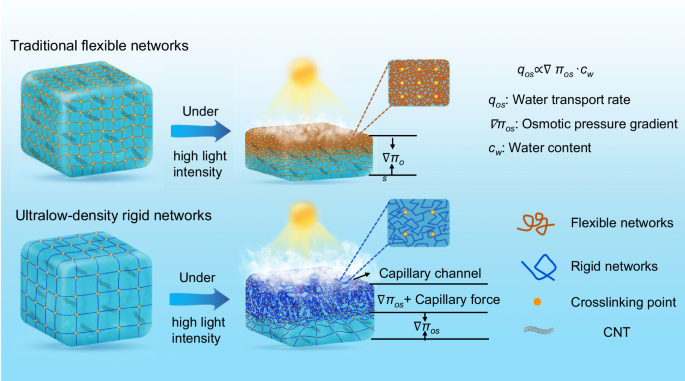

Freshwater scarcity has become one of the most pressing global challenges, with billions of people still facing limited access to clean water, particularly in regions lacking reliable energy and infrastructure. Solar water purification (SWP) offers a sustainable pathway by using abundant sunlight to evaporate and separate clean water from seawater or contaminated sources. Among various solar evaporator materials, hydrogels have emerged as an attractive platform because they can localize solar heat at the evaporation interface, continuously supply water, and show fast evaporation rates under one-sun illumination. However, when we think about practical water production, one-sun evaporation is still far from enough. Producing meaningful amounts of freshwater for individuals, families, or small communities requires not only high efficiency but also large and rapid daily water output. This led us to a key question: if one sun is not enough, can we push hydrogel evaporators to work under concentrated sunlight?
Concentrated sunlight provides a direct route to increasing evaporation rates and freshwater production. By increasing the solar intensity, the evaporation rate and freshwater production could be greatly increased. However, this strategy also introduces a more demanding materials challenge: can a soft, water-rich hydrogel maintain stable operation when evaporation becomes extremely rapid under multi-sun irradiation? Conventional hydrogels are usually good at storing water, but their soft and flexible polymer networks are not designed for the intense water loss caused by concentrated sunlight. Under high-intensity irradiation, water must be rapidly transported from the interior of the hydrogel to the heated evaporation surface. If water delivery cannot keep up with evaporation, the surface begins to dry. Meanwhile, the hydrogel network may shrink, collapse, or lose effective transport pathways, which further slows water replenishment (Fig. 1a). As a result, a hydrogel that performs well under one sun may become unstable under multi-sun conditions. The central question, therefore, is what kind of hydrogel network structure can remain water-rich, structurally stable, and capable of continuously supplying water under concentrated sunlight.
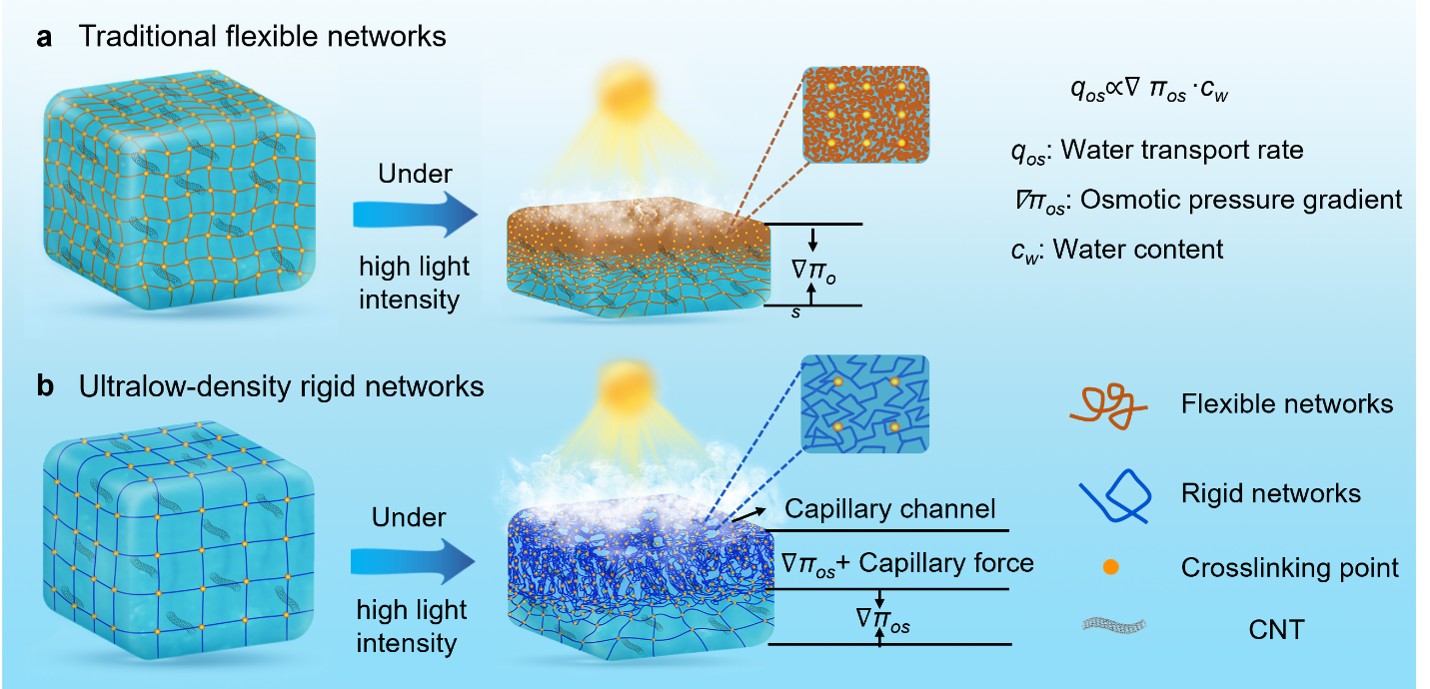
Fig 1. Schematic illustration of the water transport mechanisms in hydrogel-based solar evaporators featuring conventional flexible networks versus ULR networks during evaporation.
To address this challenge, we developed an ultralow-density rigid-network (ULR) hydrogel to address this fundamental transport limitation. Instead of focusing only on light absorption or thermal management, we targeted the internal water transport process that governs evaporation stability. The hydrogel combines an ultralow polymer density to retain high water content with a rigid, anti-shrinkage framework that preserves porous transport pathways during evaporation (Fig. 1b). This design allows the material to simultaneously maintain sufficient water availability and effective transport channels, even under strong irradiation. The system enables a dual water-transport mechanism, where osmotic pressure drives water from the interior while capillary pathways accelerate water delivery near the evaporation surface. By overcoming the conventional trade-off between water content and transport driving force, the hydrogel achieves stable and efficient operation under demanding conditions.
The ULR hydrogel-based evaporators translate this material design into high and practical freshwater production. The ULR evaporator reaches 25.57 kg m⁻² h⁻¹ under 10 suns (Fig. 2a), and in outdoor tests, a simple, low-cost module produces 12.42 L of freshwater per day, corresponding to 138 L m⁻² day⁻¹, with water quality meeting drinking standards (Fig 2b-d). Techno-economic analysis further suggests that, in high-solar regions, the system can approach the cost of bottled water within a very short time frame, with payback periods on the order of days to weeks depending on local conditions (Fig. 2e). Beyond performance metrics, this points to a broader impact: such systems could enable decentralized, low-cost water production without reliance on grid electricity or large-scale infrastructure. Overall, this work demonstrates that controlling internal water transport is critical for SWP into practical solutions. By enabling stable operation under high-intensity sunlight, the ULR hydrogel provides a scalable pathway toward affordable freshwater production, with potential implications for improving water accessibility, reducing dependence on centralized systems, and supporting sustainable development in water-stressed regions.
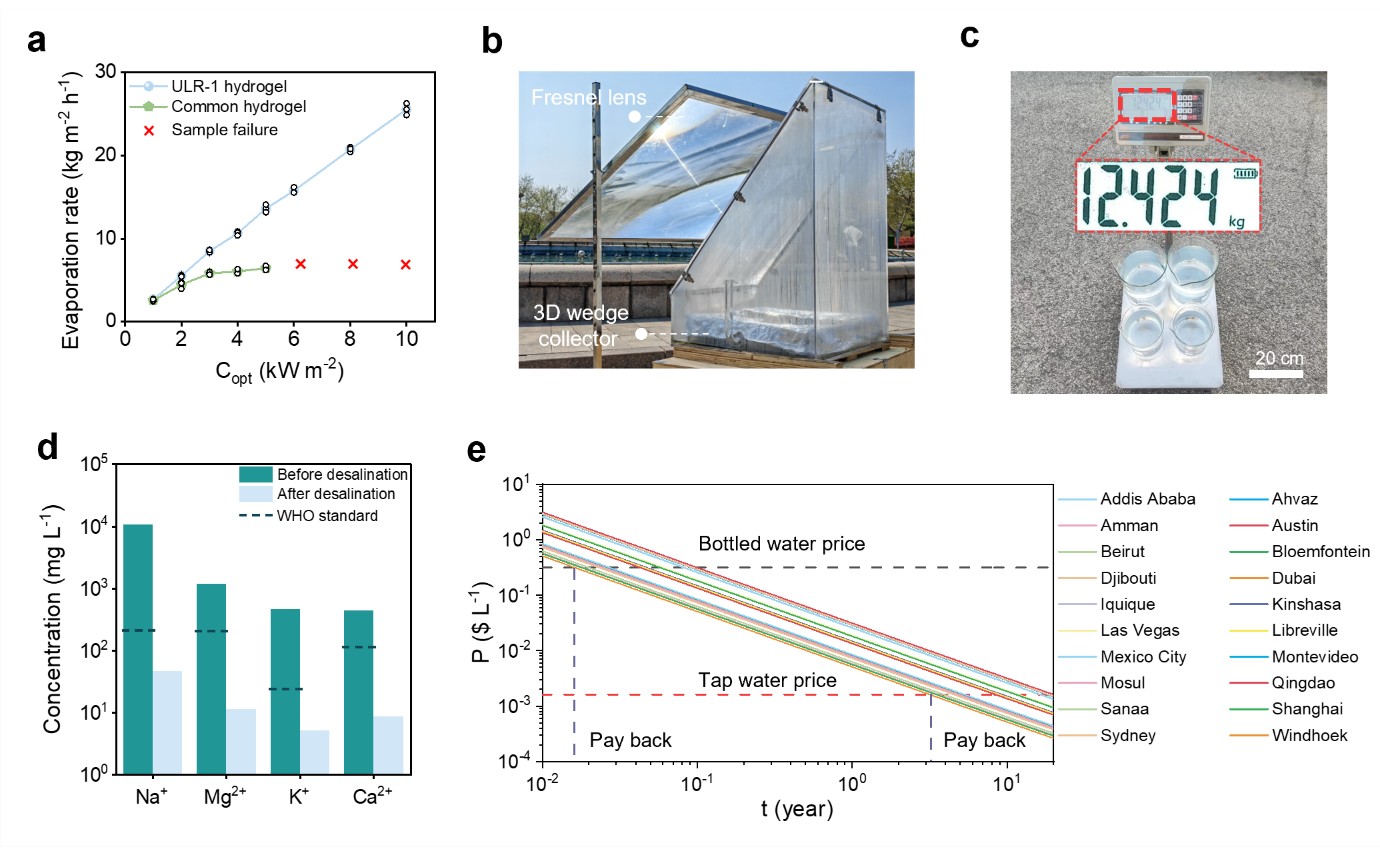
Fig. 2. (a) Evaporation rates of the ULR hydrogel-based evaporator and common hydrogel-based evaporators under different solar intensities. (b) Photograph of experimental set-up for SWP. (c) A photograph showing the total freshwater was collected in one day. (d) Measured concentrations of four primary ions in seawater and the as-purified water after desalination under 10 suns irradiation. (e) A techno-economic analysis of our system reveals the relationship between water pricing and operational duration across different regions worldwide.

Follow the Topic
-
Nature Communications
An open access, multidisciplinary journal dedicated to publishing high-quality research in all areas of the biological, health, physical, chemical and Earth sciences.

What are SDG Topics?
An introduction to Sustainable Development Goals (SDGs) Topics and their role in highlighting sustainable development research.
Continue reading announcementRelated Collections
With Collections, you can get published faster and increase your visibility.
Women's Health
Publishing Model: Hybrid
Deadline: Ongoing
Tumor Microenvironment Crosstalk and Therapeutic Implications
Publishing Model: Hybrid
Deadline: Nov 02, 2026