Understanding Spectral Heterogeneity: How Solvent Selection Influences Supramolecular Nanostructures in Thin Films
Published in Chemistry, Earth & Environment, and Materials

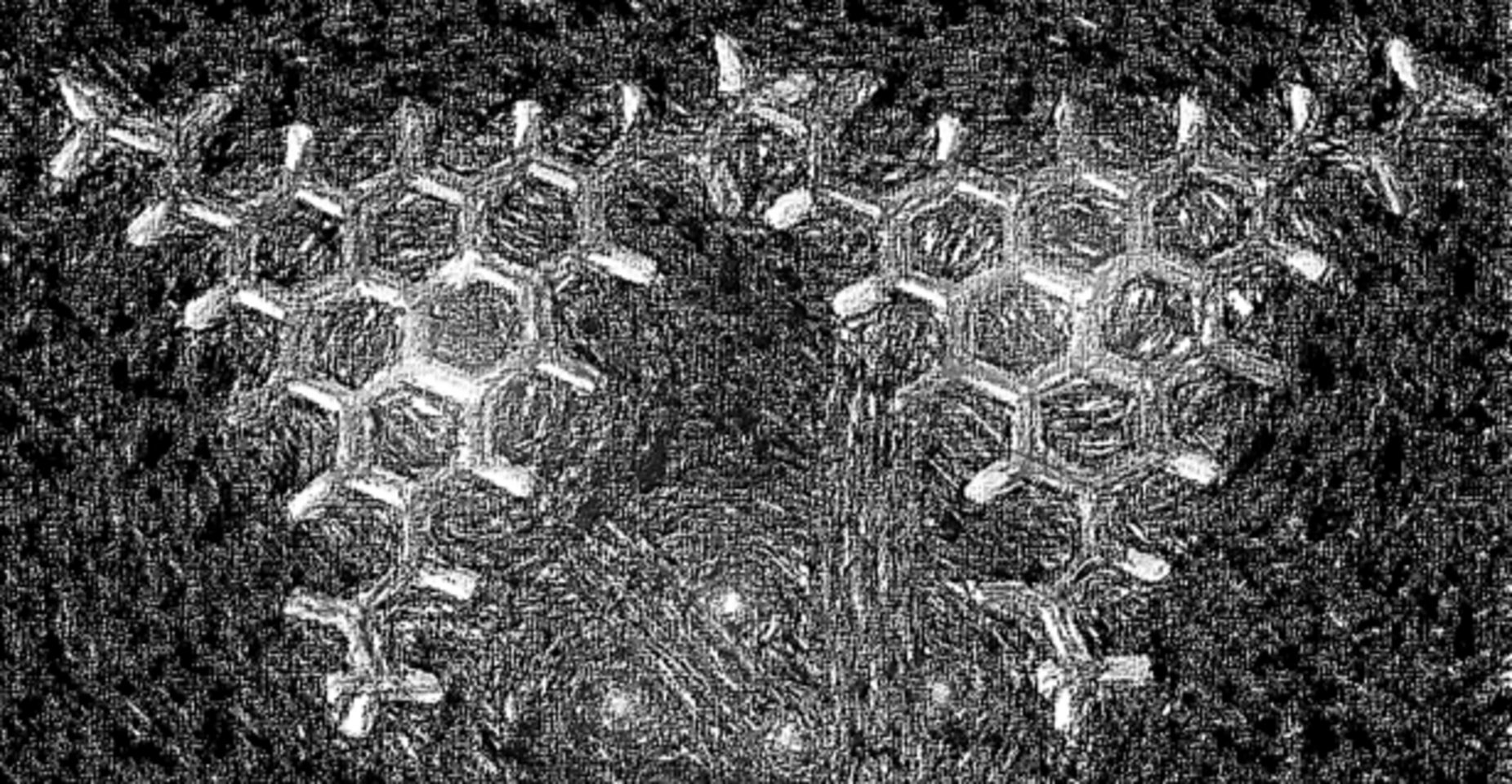
We investigated how the choice of solvent affects the molecular organization and optical properties of supramolecular thin films at a single-nanostructure level.
The Challenge of Transitioning from Solution to Solid Films
Supramolecular nanostructures are formed from solution when organic molecules self-assemble under specific conditions through non-covalent interactions. In recent years, researchers have learned a lot about how to control this self-assembly process in dilute liquid solutions, where it is possible to obtain defined and highly ordered structures. Such supramolecular nanostructures feature electronic and optical properties, which are not present in the individual molecules or poorly ordered (bulk) materials (a supramolecular object is more than the sum of its molecules).
Thus, these supramolecular materials are very interesting for the development of improved organic electronic devices, such as organic solar cells and transistors. However, electronic devices are seldomly used in the liquid state. To make a functional device, these nanostructures must be deposited onto solid substrates to form thin films. During this transition from the liquid phase to the solid phase, the original molecular order often changes. The nanostructures can aggregate irregularly, creating structural disorder and a heterogeneous energetic landscape. These energetic variations can trap electronic excitations (excitons) and charge carriers instead of allowing them to move efficiently through the material for optimal device performance.
Studying Materials at the Single-Nanostructure Level
Investigating this disorder at the nanoscale can be a quite complex task. Usually, optical spectroscopy techniques are applied, which, however, often measure the average signal of millions of nanostructures simultaneously. Because of this statistical averaging, the local variations of optical spectra, known as spectral heterogeneity, within and between individual nanostructures remain hidden.
To go beyond this statistical averaging, we used high-resolution optical microscopy combined with photoluminescence (PL) spectroscopy and excited-state lifetime measurements on thin films of supramolecular nanostructures. For our investigations we have chosen nanostructures based on a carbonyl-bridged triarylamine (s-CBT) trisamide. This system is interesting because we found in a previous study that the morphology of the aggregates strongly depends on the solvent used during its preparation: in n-dodecane, the molecules form individual supramolecular nanofibers, while in anisole, the nanofibers tend to aggregate into large bundles of nanofibers. We also complemented our study with numerical simulations of the PL spectra, which allowed us to theoretically parameterize the system and demonstrate the essential role of energetic disorder in its photophysics. Additionally, to have visual evidence, we performed scanning electron microscopy (SEM) where the different morphologies can be observed.
Observations from our Laboratory Work
Using the thin films prepared from solutions in anisole and n-dodecane, we analyzed thousands of individual microscopic positions on a substrate. During our measurements, we observed that different positions of the same sample exhibited significantly different PL spectra and lifetime decays.
Instead of treating these spatial variations as simple experimental errors, we focused on analyzing them systematically. We realized that this spectral heterogeneity provides direct information about how the molecules are organized inside the structures as well as how their local electronic properties change after the solvent evaporates. Despite the strong variations of PL spectra within the same film samples, we found that the overall optoelectronic properties of the dry thin film are still surprisingly closely related to those established in the liquid phase before deposition, despite the local differences observed between structures.
How the Solvent Influences the Final Thin Film
When the s-CBT molecules were self-assembled in n-dodecane, they formed single, well-isolated supramolecular nanofibers. After depositing these fibers onto glass, we observed that, although they exhibit spectral heterogeneity due to variations in the local environment, the energies of neighboring molecules within a nanofiber are correlated. Therefore, the electronic excitations (excitons) are delocalized, meaning that the energy can easily spread over neighboring molecules in a wave-like fashion along a fiber. To use a geographical analogy, this energetic landscape is as flat as the terrain of the Netherlands; because the energy levels are aligned, the energy wave moves smoothly and efficiently without encountering obstacles.
In contrast, when using anisole, the s-CBT building blocks self-assemble into individual nanofibers with properties similar to those deposited from n-dodecane, as well as into bundles where electronic disorder breaks energy correlations. In the solid film, this disorder causes the excitons to remain localized on only one or two molecules, generating numerous energy "traps" and with shifted spectra. This crowded bundle environment transforms the energy landscape into something resembling the rugged peaks and valleys of the Alps. The energy moves like water flowing over irregular steps, it easily drops into the low points (the energy traps) but becomes stuck there, unable to climb back up. As with water, such traps stop the overall flow of energy.
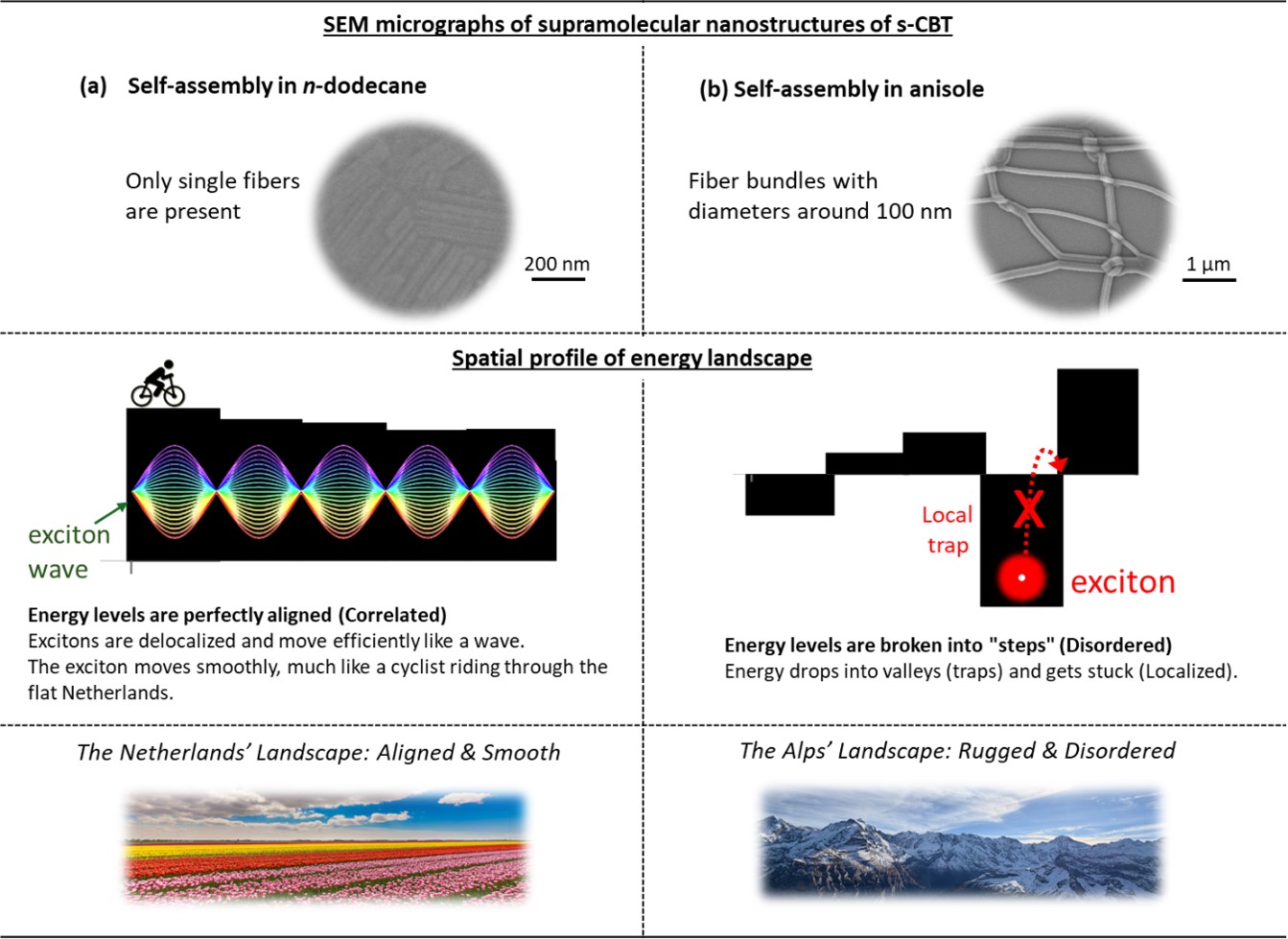 Note: The two landscape images at the bottom of the summary diagram are adapted from Pexels.
Conclusions and Future Research
Our results show that we can tune whether excitons are delocalized or localized at the nanoscale just by choosing the appropriate solvent for the self-assembly process. The supramolecular architectures formed and their photophysics are overall preserved when the samples dry, yet, substantial disorder is introduced during formation of the solid film. Understanding the connection between solution processing and this nanoscale variability is a key step toward optimizing organic materials and developing more efficient organic electronic devices. As we continue to study these supramolecular systems, these insights will help our laboratories to design more predictable and efficient carbon-based components for future electronic technologies.
References & Links:
Parra-Palacios, A., Kreger, K., Schmidt, H. W., & Hildner, R. Probing the Spectral Heterogeneity in Thin Films of Supramolecular Nanostructures Based on Heterotriangulenes. The Journal of Physical Chemistry C (2026). DOI: https://doi.org/10.1021/acs.jpcc.6c01008