Understanding Students’ Perceptions of AI-Driven Adaptive Learning in Nigerian Universities: Insights from a Multi-Institutional Study
Published in Computational Sciences, Behavioural Sciences & Psychology, and Education

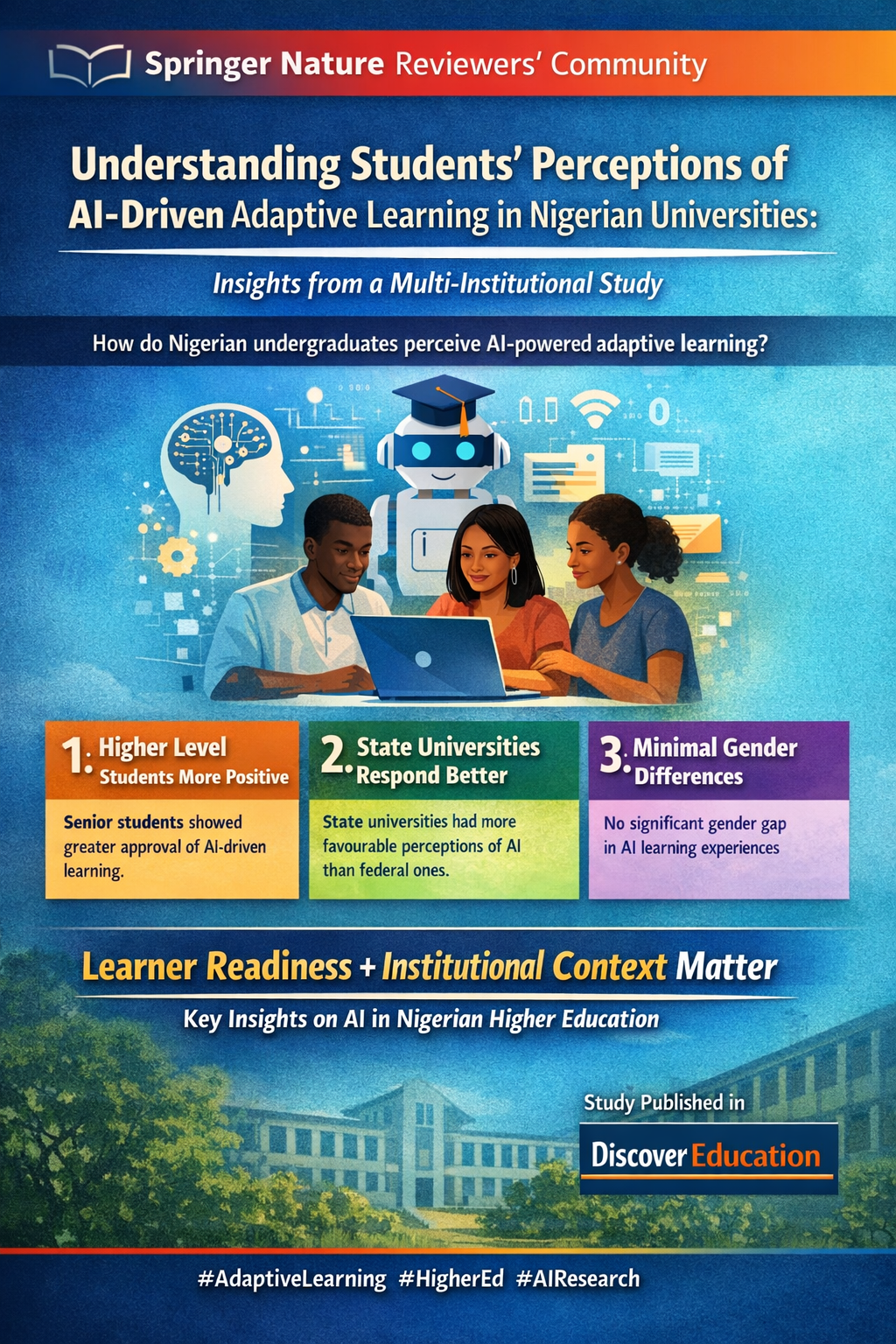




This study investigated the perceptions of 552 undergraduate science students drawn from six government-owned universities in South-Western Nigeria, using a descriptive survey design and non-parametric statistical analyses.
Our findings reveal three key insights:
- Academic progression strongly shapes perception: Students at higher levels of study (particularly 400–500 level) reported significantly more positive perceptions of AI-driven adaptive learning compared to lower-level students. This suggests that academic maturity and cumulative exposure enhance students’ ability to engage with and benefit from AI-supported learning systems
- Institutional context matters more than expected: Contrary to common assumptions, students from state universities demonstrated significantly more positive perceptions than those from federal universities, with a large effect size. This highlights how institutional conditions, such as instructional practices, resource pressures, and flexibility in innovation, may influence how AI is experienced.
- Gender differences are minimal in structured AI environments: While slight variations were observed, gender did not emerge as a strong determinant of perception when AI tools are embedded within formal instructional contexts. This supports the growing argument that equitable instructional design can mitigate demographic disparities in AI engagement.
The study reinforces that students’ perceptions of AI are not determined by the technology alone, but by the interaction between learner readiness, institutional context, and pedagogical integration. For reviewers and researchers, these findings indicate the importance of evaluating AI in education beyond performance outcomes. Understanding how students experience and interpret AI systems is critical for explaining why similar technologies produce different outcomes across different institutions.
The study also contributes to ongoing discussions around equity, instructional design, and context-sensitive AI adoption in higher education, particularly within resource-constrained systems.
Follow the Topic
-
Discover Education
An international, peer-reviewed open access journal that publishes original work in all areas of education, serving the community as a broad-scope journal for academic trends and future developments in the field.

Related Collections
With Collections, you can get published faster and increase your visibility.
Advancing Teaching & Learning: Integrating AI, Emerging Technologies, and Pedagogical Innovation
Collection "Advancing Teaching & Learning: AI, Emerging Technologies and Pedagogical Innovation" addresses a major challenge in education today. There is a lack of resources that bring advanced technologies and innovative teaching together. AI, digital tools and emerging technologies are transforming classrooms. Yet many teachers and education leaders struggle to use these tools effectively. This Collection fills that gap. It offers expert insights, practical strategies and real-world examples for modern teaching and learning.
The Collection is linked to the United Nations Sustainable Development Goal 4 on quality education. It shows how to make learning more accessible, inclusive and effective for all. AI, adaptive learning platforms and immersive technologies can personalise instruction. They can engage students and support diverse needs. At the same time, the human element of teaching remains central.
Readers will find practical guidance on curriculum design, digital literacy and evidence-based teaching methods. The approaches can be applied in classroom, blended and online learning. Beyond tools, the Collection inspires educators to rethink traditional methods. It encourages them to embrace innovation while keeping learning meaningful and student-focused.
By addressing the lack of comprehensive resources on advanced technologies, Advancing Teaching & Learning helps teachers, school leaders and instructional designers navigate the digital age. It equips them to create engaging, future-ready learning experiences. Students are prepared for a connected, digital world. Educators gain the confidence to unlock the full potential of every learner.
This Collection supports and amplifies research related to the United Nations Sustainable Development Goal 4 on quality education. It shows how to make learning more accessible, inclusive and effective for all. AI, adaptive learning platforms and immersive technologies can personalise instruction. They can engage students and support diverse needs. At the same time, the human element of teaching remains central.
Keywords: Teaching and Learning; AI in Education; Emerging Technologies; Digital Tools in Classrooms; Pedagogical Innovation; Adaptive Learning Platforms; Immersive Technologies; Quality Education (SDG 4); Classroom Innovation; Blended and Online Learning; Student Engagement; Teacher Professional Development; Future-Ready Learning; Instructional Design; Educational Technology Integration.
Publishing Model: Open Access
Deadline: Apr 15, 2027
Advancing Health Professions Education: Innovations, Strategies, and Global Perspectives
Health Professions Education (HPE) plays an important role in preparing competent, ethical, and compassionate healthcare professionals capable of responding to the complex demands of contemporary healthcare systems. In recent years, the field of HPE has witnessed a paradigm shift towards learner-centred, competency-based, and interprofessional education models that prioritize not only clinical expertise but also communication, professionalism, teamwork, and leadership skills.
This Collection invites original research, systematic or scoping reviews, case studies and brief reports and that critically examine the evolving landscape of HPE across medicine, dentistry, nursing, pharmacy, and other allied health disciplines. Key areas of interest include curriculum design and reform, innovative teaching and assessment methods, integration of digital and blended learning technologies, interprofessional education (IPE), faculty development, educational management, student support and well-being, and strategies to promote equity, diversity, and inclusivity in HPE.
We also welcome contributions that explore challenges and best practices in clinical training, rural and underserved community placements, global health education, policy development, accreditation, and institutional leadership in health education. Studies from low- and middle-income countries are strongly encouraged to enhance global representation and to promote scholarly exchange on scalable and contextually relevant innovations.
By consolidating scholarly work in this Collection, we aim to advance the discourse on high-quality, evidence-informed HPE that supports the achievement of Sustainable Development Goals (SDG 3 and SDG 4) and ultimately contributes to improved healthcare outcomes worldwide.
Publishing Model: Open Access
Deadline: Nov 30, 2026