What Triggers Structural Change Across Countries? Machine Learning Evidence from Long-Term Dynamics
Published in Social Sciences, Mathematics, and Statistics
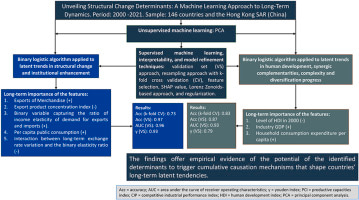
This article was published in the October 2025 issue of the journal Socio-Economic Planning Sciences (Salinas & Zhang, 2025) and continues the more comprehensive research examining structural change patterns by estimating dynamic latent factors, as described in Salinas (2025).
The study applied a novel combination of unsupervised and supervised machine learning techniques. Unsupervised learning techniques were pivotal in estimating two binary target variables based on two latent structures capturing countries’ long-term tendencies toward systemic structural change or constraints. The binary target variables are structural change and institutional enhancement (SCI) and human development, synergic complementarities, diversification, and complexity progress (HDSCD). The values indicate the extent to which countries fall above (1) or below (0) the average of the examined sample.
We used supervised learning techniques to identify the most salient features for predicting countries' systemic dynamics toward structural change or constraints. Furthermore, machine learning helped assess the generalizability of two binary logistic algorithms that predict countries' long-term latent tendencies.
Consequently, the research examined the factors influencing structural change between 2000 and 2021 by addressing a machine learning classification problem. The findings demonstrate the empirical relevance of the structural change system approach and the predictors' potential to trigger cumulative causation mechanisms that drive systemic transformations and predict countries' long-term trends toward an SC process or stagnation and decline.
How are structural change determinants unveiled?
The binary target variables encapsulate the relevant domains of the countries’ systemic dynamics and the extent to which they fall above (1) or below (0) the average of the examined sample (Salinas, 2025; Salinas & Zhang, 2025).
The HDSCD is a binary variable that captures the dynamics of social, productive, and synergistic factors that shape developmental trajectories.
In contrast, the SCI reflects countries’ manufacturing progress, including domestic production and international trade. It also reflects manufacturing activity dynamics in terms of sophistication, productivity, international competitiveness, and shifts in institutional governance.
Machine learning techniques demonstrated the generalizability of the features and the performance of the logistic models in predicting countries’ systemic dynamics toward structural change or constraints, in line with Salinas & Zhang (2026). Consequently, the study identified the most relevant predictors. The system approach to structural change supports their role in triggering cumulative causation effects that drive systemic transformation.
What does the evidence demonstrate about the determinants of structural change across countries?
The most relevant predictors per latent dimension are shown in the figure below:
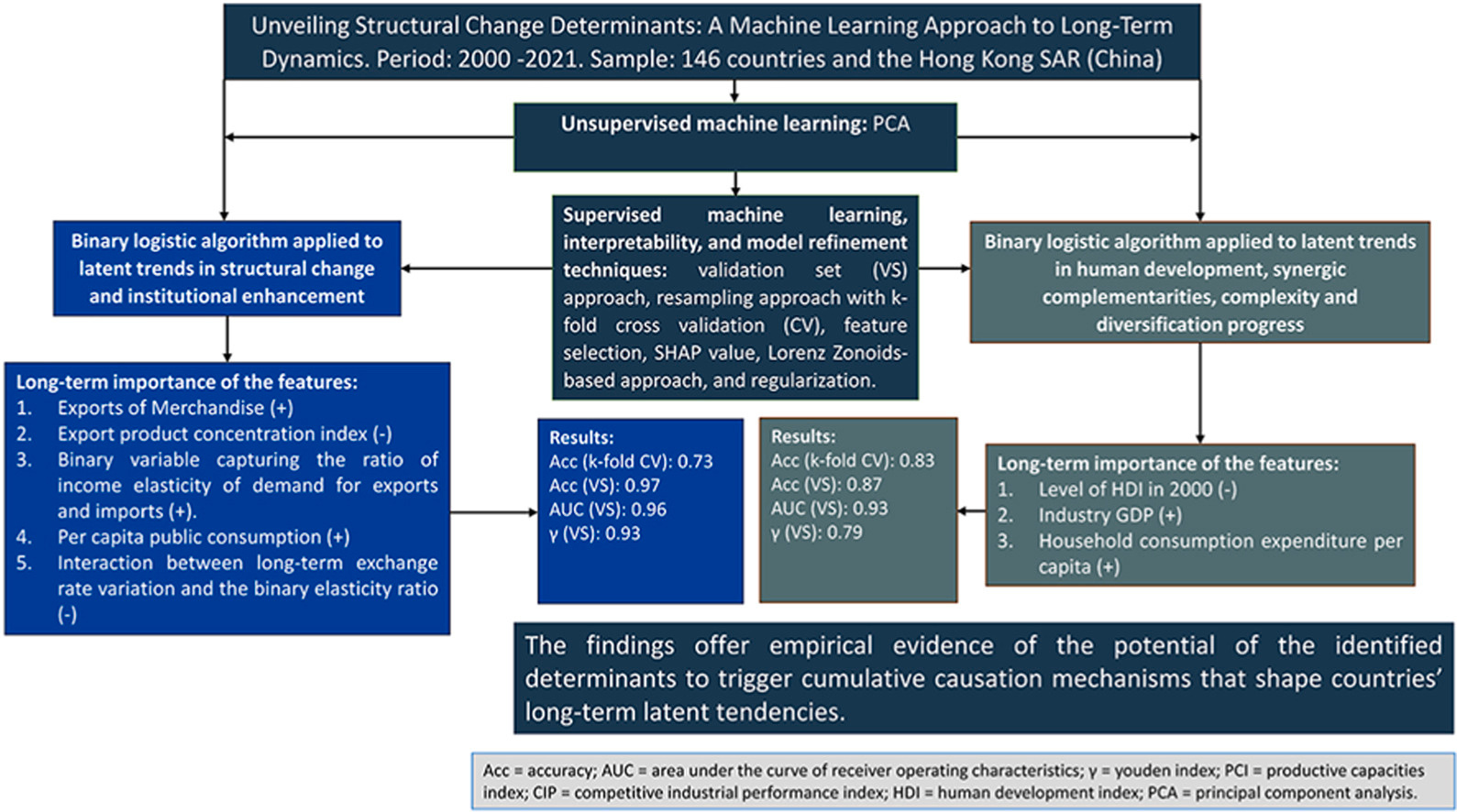
The SCI Elastic Net Logistic Model shows how predictors can trigger a virtuous tendency toward structural change in a country, fostered by the coevolution of sectors with Schumpeterian and Keynesian efficiency. This tendency helps countries overcome balance-of-payments constraints and promotes long-term economic growth.
The HDSCD logistic model is particularly relevant for developing countries, indicating that those with lower initial HDI levels are more likely to exhibit a positive HDSCD tendency. Furthermore, long-term growth in industrial GDP and household consumption expenditure per capita are crucial for predicting long-term HDSCD trends.
Metrics show that logistic algorithms and identified determinants accurately classify countries' long-term trends in both latent dimensions.
The system approach supports the interplay of determinants that trigger cumulative effects, shaping countries' trends toward structural change or constraint. Therefore, structural change policies require a holistic approach.
Article’s highlights:
- Shows the relevance of the system approach to structural change in underpinning triggers of long-term trends.
- Combines unsupervised and supervised machine learning to unveil potential triggers of structural change.
- Identifies determinants as key policy targets across distinct development stages.
- Machine learning improved the models’ generalizability, yielding a reliable tool for socio-economic planning.
- Showcases SHAP values’ applicability to parametric models, offering insights into feature performance in real-world predictions.
Salinas, J. (2025). Unveiling structural change patterns: An unsupervised machine learning approach to long-term dynamics. Humanities and Social Sciences Communications, 12(1). https://doi.org/10.1057/s41599-025-05128-9
Salinas, J., & Zhang, J. (2025). Unveiling Structural Change Determinants: A Machine Learning Approach to Long-Term Dynamics. Socio-Economic Planning Sciences, 101, 102290. https://doi.org/10.1016/j.seps.2025.102290
Salinas, J., & Zhang, J. (2026). Unveiling the Determinants of Competitive Industrial Performance Index (CIP) Evolution: A Machine Learning Approach to Midterm Dynamics. Computational Economics. https://doi.org/10.1007/s10614-025-11246-y

I hold a Ph.D. in Economics from Huazhong University of Science and Technology and a Magister Scientiae in Economic Policy from the International Center of Economic Policy (National University, Costa Rica). Additionally, I earned a Bachelor of Science in Economics from the University of El Salvador.
My research interests focus on applied economics, including development economics, structural change, international economics, economic policy, and machine learning, with articles published in high‑impact journals (SSCI-Q1/Q2). Currently, I serve as Head of the Doctoral Program in Economic Sciences at the University of El Salvador, where I have also taught a range of undergraduate and graduate courses in economics, economic policy, and international trade.
My career in El Salvador has included senior government positions such as Deputy Minister of Economy for Foreign Trade, economic advisor to the Salvadoran Parliament, and specialist in economic policy areas, including drug price regulation, fiscal policy, and social policy.