Using Nonthermal Plasma to Clean Diesel Exhaust for Ultra-clean Marine Power
Published in Earth & Environment, Physics, and Mechanical Engineering





I am pleased to share the story behind our recent paper, “Nonthermal Plasma Aftertreatment for Low-emission Diesel Engines To Achieve Ultra-clean Power Generation,” published in Plasma Chemistry and Plasma Processing. This work was accomplished through international collaboration with Dr. Apeksha Madhukar at the Indian Institute of Technology Goa, and it reflects our shared interest in applying nonthermal plasma science to one of today’s most important environmental challenges: how to make combustion-based power systems significantly cleaner.
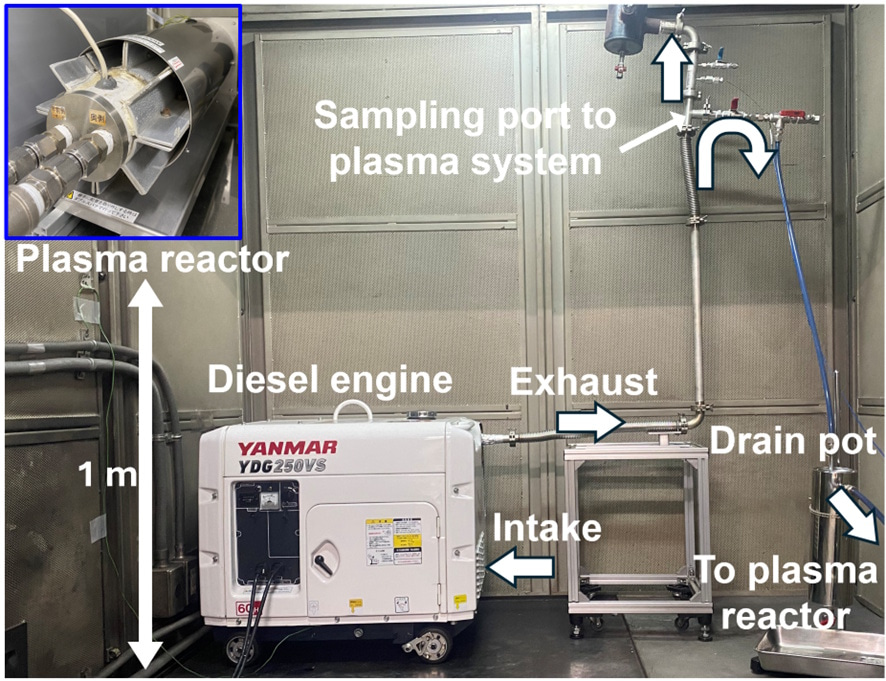
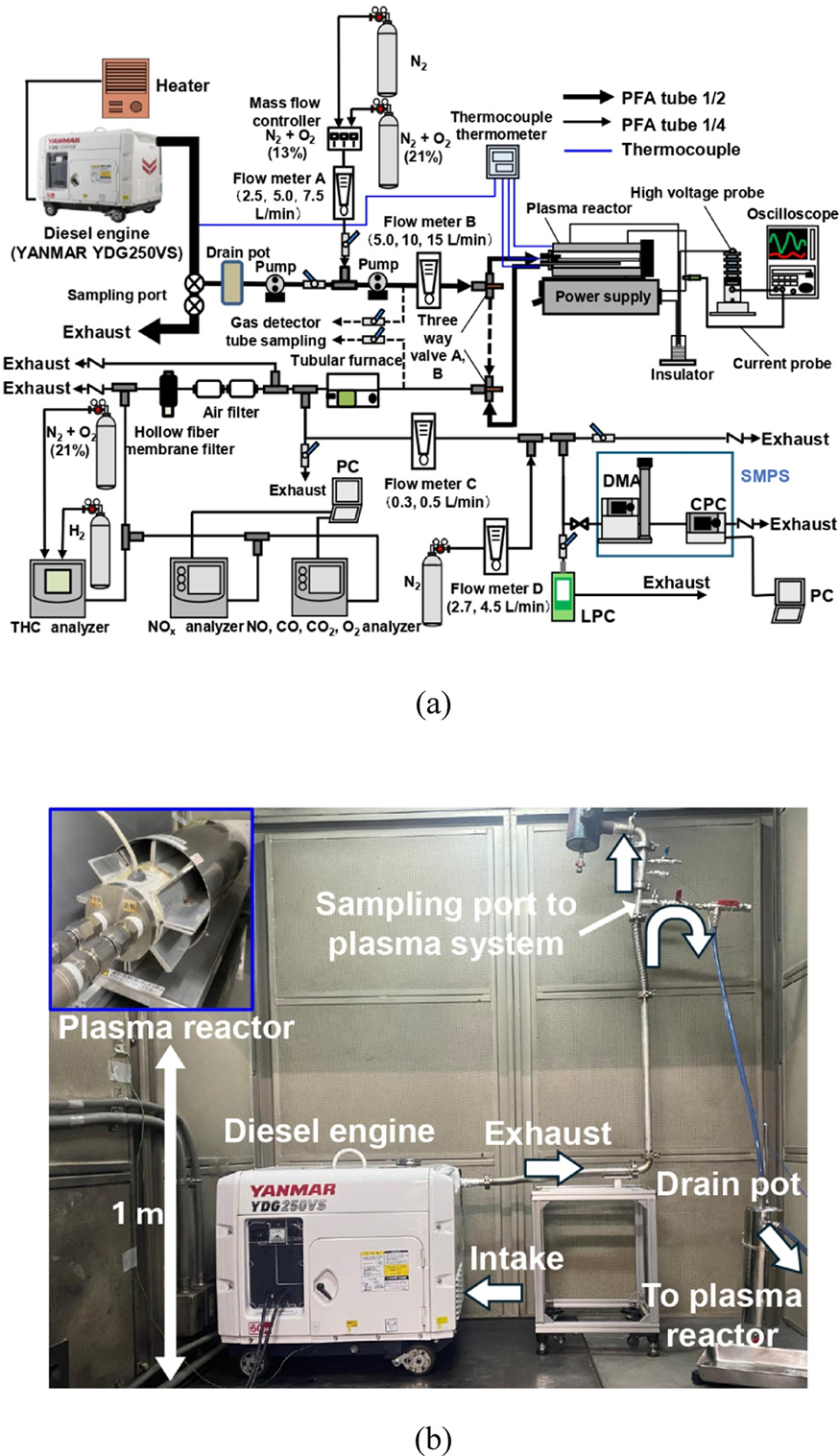
Experimental setup used to investigate nonthermal plasma aftertreatment of low-emission diesel exhaust.
In recent years, the transition from conventional combustion engines to electric powertrains has accelerated in the automotive sector. Battery electric vehicles and hybrid electric vehicles are becoming increasingly common, and many people view electrification as the natural pathway toward a cleaner future. However, the situation is very different in the marine sector. Ships still rely heavily on diesel engines and other combustion-based power sources for propulsion and onboard power generation. In fact, marine transportation remains one of the sectors where a full shift to battery-based systems is not yet practical, especially for long-distance voyages. Batteries are still limited by weight, energy density, charging infrastructure, and operational constraints. As a result, diesel engines continue to play an essential role in global logistics and power generation.
This raises an important issue. If diesel engines will remain indispensable for the foreseeable future, then improving their environmental performance becomes critically important. Even low-emission diesel engines fueled with non-sulfur gas oil or light oil still emit pollutants such as nitrogen oxides (NOx), particulate matter (PM), and unburned hydrocarbons (HCs). These emissions contribute to air pollution and environmental damage, and they must be reduced if diesel-powered systems are to remain socially and technologically acceptable in a low-emission future.
This challenge motivated our study. We asked a simple but important question: can nonthermal plasma help create ultraclean diesel exhaust without relying on chemical additives such as urea? This question is both scientific and practical. Scientifically, plasma creates highly reactive species that can trigger chemical transformations under relatively mild conditions. Practically, a system that avoids additives may be simpler and more attractive for implementation in marine or distributed power applications.
Nonthermal plasma is often described as the fourth state of matter, but unlike very hot thermal plasmas, nonthermal plasma can generate energetic electrons and chemically active species without heating the whole gas to extremely high temperatures. This makes it especially attractive for pollution control. Instead of relying only on heat, it uses plasma-generated radicals, excited species, and oxidants to promote reactions that break down or convert pollutants. In the field of environmental engineering, this opens the door to new treatment methods for exhaust gas purification.
In this work, we proposed and investigated an aftertreatment technology based on surface discharge-induced plasma. Diesel engine exhaust gas was passed through a plasma reactor, where reactive plasma species interacted with the exhaust components. One of the major advantages of this approach is its simplicity: it does not require an additional reagent such as urea, which is commonly used in selective catalytic reduction systems. Reducing system complexity can be an important benefit, particularly in applications where maintenance, storage, or operational flexibility matters.
A key part of our research was not only to measure pollutant removal, but also to better understand the chemistry occurring inside the plasma reactor. To do this, we measured the concentrations of many exhaust gas components before and after plasma treatment, including NO, NOx, CO, CO2, total hydrocarbons, O2, H2O, O3, and HNO3. By examining these species together, we were able to gain deeper insight into the reaction pathways responsible for emission reduction.
The results were encouraging. We successfully removed both NOx and hydrocarbons from diesel exhaust gas, even at relatively high exhaust gas flow rates. At a specific energy of 143 J/L, the removal efficiencies reached 67% for NOx and 76% for hydrocarbons. These are meaningful results because diesel exhaust is a chemically complex system, and achieving simultaneous removal of multiple pollutants is not easy. Different pollutants respond differently to plasma, and multiple competing reactions may occur at the same time. Nevertheless, the surface discharge plasma reactor showed clear potential for effective aftertreatment.
Our analysis suggests that the chemistry inside the reactor involves both oxidation and reduction pathways. PM-related components and hydrocarbons are removed mainly through oxidation by atomic oxygen species generated from plasma-produced ozone and nitrogen dioxide. At the same time, NOx reduction appears to occur through reactions with reducing components already present in the exhaust, such as carbon monoxide and hydrocarbons. In other words, the plasma does not simply destroy pollutants in one universal way. Rather, it creates a chemically active environment in which different pollutants can be transformed through different but interconnected mechanisms.
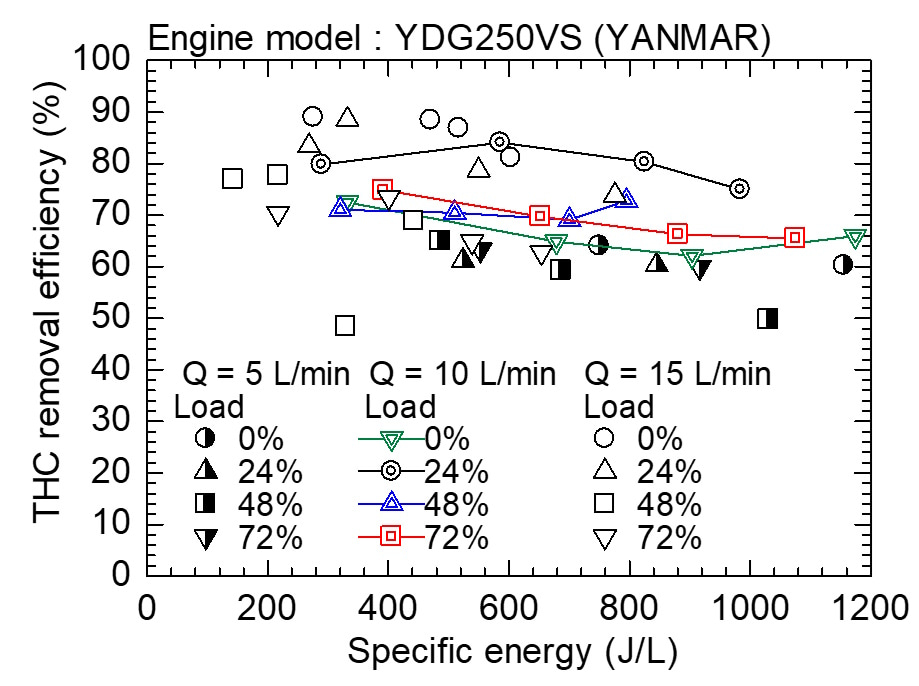
Removal efficiencies of hydrocarbons obtained under different plasma operating conditions.
One of the most interesting findings of the study was that higher plasma power is not always better. At first glance, one might expect that increasing the plasma input energy would automatically improve pollutant removal. However, our experiments showed that to improve the removal efficiencies of NOx and hydrocarbons, it is actually important to operate the plasma reactor under low specific energy or low plasma power conditions. This suggests that reactor operation must be carefully optimized so that the plasma chemistry favors effective removal rather than inefficient energy consumption or undesired side reactions.
This insight is particularly important for real-world applications. For plasma aftertreatment technology to be practical, it must not only work, but also operate efficiently. Marine engines, stationary diesel generators, and other combustion systems require robust and energy-conscious solutions. A plasma system that achieves substantial emission reduction under relatively low energy input is much more promising than one that depends on excessive power. Therefore, our findings contribute not only to plasma chemistry, but also to the engineering design of realistic clean-exhaust systems.
More broadly, this study is part of an ongoing effort to bridge the gap between advanced plasma science and practical environmental technology. While electrification is progressing, many sectors will continue to depend on combustion systems for years to come. In those sectors, cleaner aftertreatment technologies can play a major role in reducing environmental impact during the transition to future energy systems. Marine transportation is a particularly important case, because it supports global trade and cannot easily be electrified on the same timescale as passenger vehicles.
This work was also rewarding because it brought together fundamental science, environmental engineering, and international collaboration. Working with Dr. Apeksha Madhukar at the Indian Institute of Technology Goa strengthened the study and made it possible to approach the problem with a broader scientific perspective. Collaborative research is especially valuable when tackling complex challenges such as emission control, because it allows ideas, expertise, and methods to cross institutional and national boundaries.
Ultimately, we hope this paper will encourage further research on nonthermal plasma for emission control, especially in diesel engines, marine propulsion systems, and distributed power sources where ultraclean operation is increasingly required. Even in a future shaped by electrification and renewable energy, there remains an urgent need to reduce emissions from the combustion-based systems the world still depends on today. Plasma-assisted aftertreatment may offer one promising pathway toward that goal.
If you are interested in the full details of the study, please read our article: “Nonthermal Plasma Aftertreatment for Low-emission Diesel Engines To Achieve Ultra-clean Power Generation,” Plasma Chemistry and Plasma Processing (2026) 46:42. We hope this work helps stimulate further discussion on how plasma science can contribute to cleaner engines, cleaner air, and more sustainable power generation.

My research area is Mechanical Engineering with environmental nonthemal plasma.
Follow the Topic
-
Plasma Chemistry and Plasma Processing
The journal is an international journal focusing on fundamental research and new developments in plasma chemistry and plasma processing.