Using WhatsApp chats to understand a new approach to HIV testing in children.
Published in Healthcare & Nursing


Improving HIV testing for children and adolescents is vitally important, because children and adolescents experience a disproportionate amount of HIV-related illness and death compared to adults. Although children and adolescents aged up to 19 years old were only 7% of the global population living with HIV in 2021, they represented 17% of HIV-related deaths. This is due, in part, to late diagnosis of HIV.

A new approach to finding undiagnosed children living with HIV, known as index-linked testing, has been recommended by the World Health Organisation to improve diagnosis rates. Index-linked testing involves targeting of HIV testing to children of people living with HIV (known as indexes). This focused approach has the potential to find more children living with HIV and be more cost-effective than blanket testing approaches.
The “Bridging the Gap in HIV Testing and Care for Children in Zimbabwe” (B-GAP) study evaluated index-linked HIV testing for children aged between two and 18 years old at nine primary care clinics, covering both rural and urban areas. People living with HIV in a household with one or more children of unknown HIV status, or with a known HIV negative result more than 6 months ago, were eligible to take part in the study. Those who consented to have children tested could choose either a test at the clinic, a test at home delivered by a community healthcare worker (HCW), or a test at home delivered by a caregiver using an oral HIV self-test. B-GAP provided an opportunity to examine implementation in-depth, so lessons could be learned for future roll-out.
The B-GAP team kept in touch via two long-running WhatsApp chats, one for the whole field team, and the other for the rural areas only. We used those WhatsApp chats, as well as field team logs, meeting minutes, and incident reports, to identify barriers and facilitators to scale-up of index-linked testing. Data from each source was analysed thematically.

The WhatsApp chats deepened our understanding of implementation. In the chats, the team often offered more comprehensive opinions on successes and challenges than in other sources. For example, one chat had detailed discussion on difficulties coordinating with partner organisations who were delivering HIV testing of children in the community. This clarified the underlying reasons why these challenges were occurring, such as differences in aims between the partner organisations and the research team, as well as resource constraints faced by partner organisations. The chats also provided a real-time and dynamic account of events, such as stock-outs of HIV test kits, over time.
However, WhatsApp chats required more effort to analyse than the other sources. As the chats were an informal record, sometimes it was challenging to work out what researchers were referring to in their messages. Unlike with the other sources, the team presumed readers had prior knowledge of what was being discussed, making it difficult for an outsider to follow the conversation. Moreover, sometimes researchers met face-to-face or communicated using other technology, which led to sudden jumps in the topics being covered in the chats.
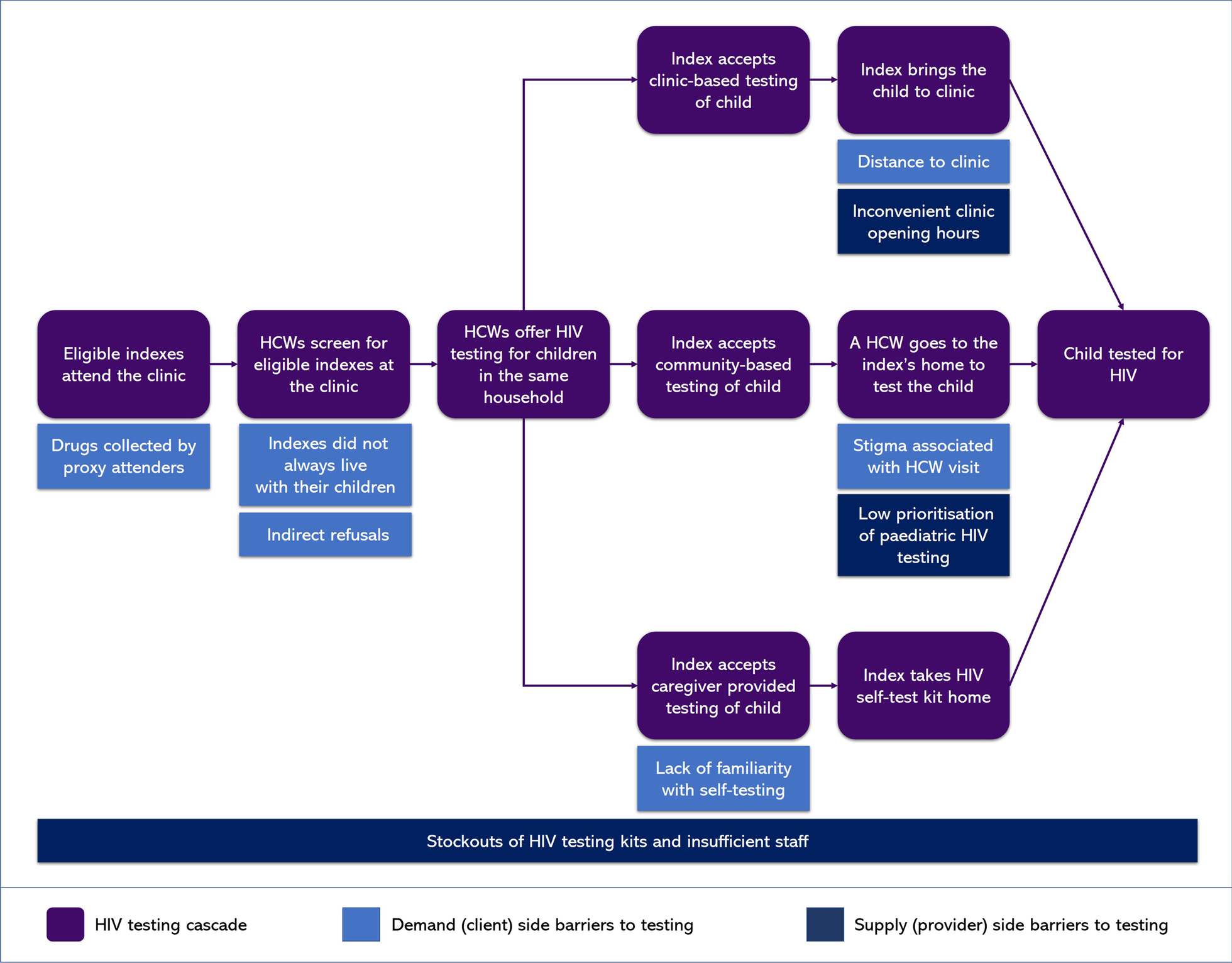
Nonetheless, through analysing the WhatsApp chats and other sources, we identified a range of challenges to index-linked testing for children. These are illustrated in the flow diagram to the right. Some challenges were recognised barriers to provision of many forms of HIV testing, such as stock-outs of HIV test kits, difficulties reaching clinics, and stigma around HIV. However, we also identified some unexpected challenges, such as indexes sending someone else to the clinic on their behalf, and a lack of familiarity with oral HIV testing, which resulted in low uptake. As index-linked HIV testing for children is used more widely it will be critical to find ways to ensure these challenges can be overcome.
The WhatsApp chats gave us valuable insight into the barriers and facilitators of index-linked HIV testing. It is important to consider newer technologies and social media alongside traditional sources of data to fully capture the complexity of implementation of public health interventions. By doing so, we can more effectively address barriers to delivery of interventions and ultimately improve health outcomes.
Read more about the B-GAP study and its findings in the following publications:
- Delivery of index-linked HIV testing for children: learnings from a qualitative process evaluation of the B-GAP study in Zimbabwe
- Comparison of index-linked HIV testing for children and adolescents in health facility and community settings in Zimbabwe: findings from the interventional B-GAP study
- Addressing the challenges and relational aspects of index-linked HIV testing for children and adolescents: insights from the B-GAP study in Zimbabwe
- Feasibility and Accuracy of HIV Testing of Children by Caregivers Using Oral Mucosal Transudate HIV Tests

Katherine is a PhD student at Imperial College London. Her PhD focuses on the links between HIV, mental health, and quality of life in sub-Saharan Africa.
Follow the Topic
-
BMC Infectious Diseases
This journal is an open access, peer-reviewed journal that considers articles on all aspects of the prevention, diagnosis and management of infectious and sexually transmitted diseases in humans, as well as related molecular genetics, pathophysiology, and epidemiology.

Related Collections
With Collections, you can get published faster and increase your visibility.
Personalized medicine in infectious diseases
BMC Infectious Diseases invites submissions for a Collection on Personalized medicine in infectious diseases.
The field of personalized medicine is rapidly advancing, particularly among infectious diseases, where the traditional ‘one-size-fits-all’ treatment approaches are increasingly inadequate. As our understanding of the genetic, environmental, and lifestyle factors influencing disease susceptibility and treatment response grows, this Collection aims to explore innovative strategies and technologies that can enhance the application of personalized medicine in combating infections.
Recent advancements in genomics, pharmacogenomics, and bioinformatics are transforming the application of personalized approaches for infectious diseases. These developments have enabled the identification of specific biomarkers that inform individualized treatment strategies, improving patient outcomes and minimizing adverse effects. In parallel, advances in molecular diagnostics and tailored antimicrobial therapies offer new opportunities to address the escalating challenge of antimicrobial resistance.
Improved understanding of host-pathogen interactions and the genetic determinants of infections may support the development of targeted antiviral and antimicrobial strategies that enhance their effectiveness, while limiting the emergence of resistance. Research in this area may also enable personalized antimicrobial dosing and optimized treatment guidelines that balance individual patient benefits with broader public health considerations.
This Collection welcomes original research articles on topics including but not limited to:
- Tailored antimicrobial therapy in infectious diseases
- Patient-specific interventions to improve clinical outcomes
- Personalized strategies to address antimicrobial resistance
- Precision medicine approaches in antiviral therapy
- Novel methodologies for disease modelling and therapeutic targeting
- Precision diagnostics, including biomarker validation and metagenomic sequencing
- Model-informed personalized dosing in infectious diseases
- Therapeutic drug monitoring in anti-infective therapy
This Collection supports and amplifies research related to SDG 3 (Good Health and Well-being).
All manuscripts submitted to this journal, including those submitted to collections and special issues, are assessed in line with our editorial policies and the journal’s peer review process. Reviewers and editors are required to declare competing interests and can be excluded from the peer review process if a competing interest exists.
Publishing Model: Open Access
Deadline: Dec 16, 2026
Tuberculosis and co-infections: diagnostics, management, and treatment
BMC Infectious Diseases invites submissions for a Collection on Tuberculosis and co-infections: diagnostics, management, and treatment.
Tuberculosis (TB) remains a leading cause of morbidity and mortality worldwide, particularly in regions with high prevalence rates and co-infections. The interplay between TB and various co-infections (including bacterial, viral, parasitic and fungal), complicates diagnosis and treatment strategies. Advances in molecular diagnostics and imaging techniques have improved our understanding of how these co-morbidities affect TB pathogenesis and treatment outcomes. However, the challenge of managing drug-resistant TB adds an additional layer of complexity, necessitating a comprehensive approach that integrates the latest research findings with clinical practice.
Research into TB of all stages and its co-infections is crucial for addressing the rising incidence of drug resistance and improving patient outcomes. Recent studies have identified critical biomarkers for early detection and prognosis, highlighting the role of rapid diagnostic tools in the clinical setting. Additionally, understanding the mechanisms of co-infections has led to tailored treatment regimens that maximize efficacy while minimizing adverse effects. Nonetheless, gaps remain in our knowledge of optimal management strategies for these complex cases, emphasizing the need for ongoing research in this field.
Future research endeavors should focus on the development of more effective diagnostic techniques and treatment protocols that consider the multifaceted interactions between TB and its co-infections. Innovations in personalized medicine may lead to targeted therapies that address specific pathogen interactions, ultimately enhancing patient recovery rates. Moreover, collaborative efforts between public health entities and research organizations could pave the way for comprehensive TB surveillance systems, fostering the identification of emerging trends in co-infection patterns.
This Collection welcomes original research articles on topics including but not limited to:
- Diagnostic innovations for Tuberculosis and co-infections
- Management strategies for drug-resistant Tuberculosis
- Interaction between Tuberculosis and HIV
- Tuberculosis and diabetes comorbidity
- Tuberculosis in the context of viral hepatitis and COVID-19
This Collection supports and amplifies research related to SDG 3 (Good Health and Well-being).
All manuscripts submitted to this journal, including those submitted to collections and special issues, are assessed in line with our editorial policies and the journal’s peer review process. Reviewers and editors are required to declare competing interests and can be excluded from the peer review process if a competing interest exists.
Publishing Model: Open Access
Deadline: Jan 27, 2027