Valleytronics in 2D Candidate Phase Change Materials
Published in Electrical & Electronic Engineering
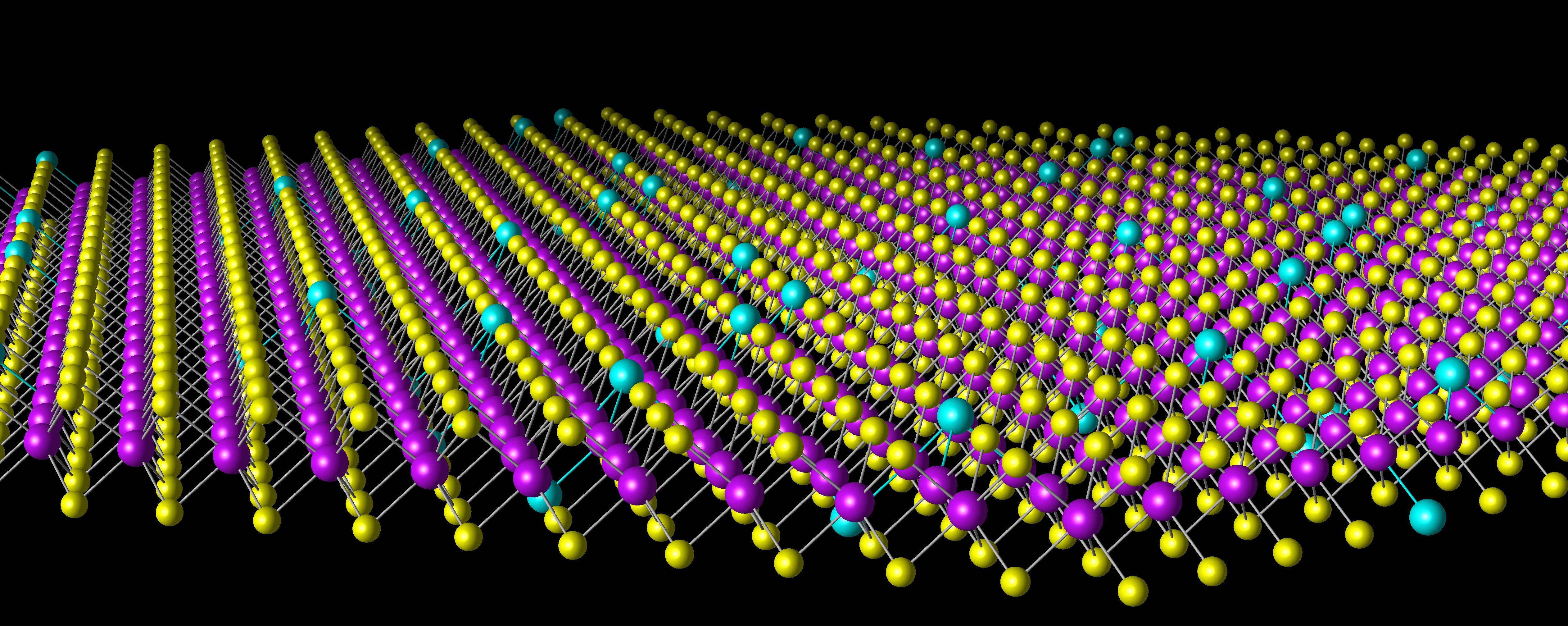




Silicon-based computing technologies are now reaching fundamental nanofabrication limits to keep up with the downscaling trend of modern electronics. Heat dissipation, memory endurance and retention, and energy efficiency are key challenges that have led scientists and engineers to explore new computing platforms beyond the highly successful von Neumann architecture.
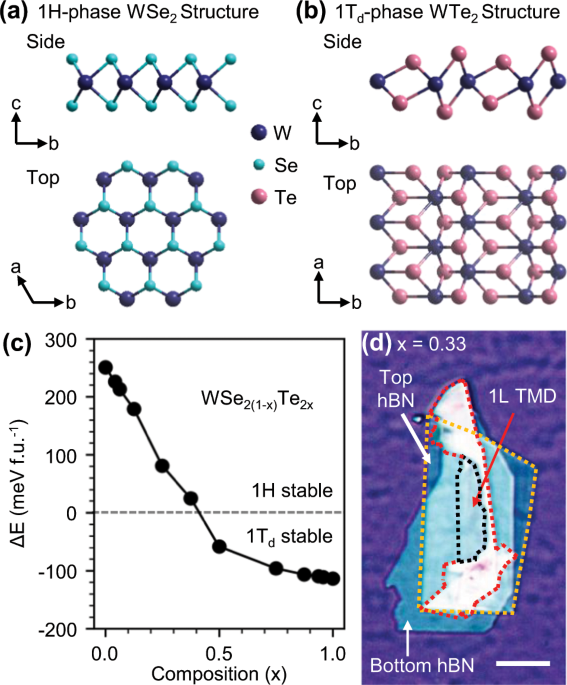
Valleytronics and neuromorphic computing are under heavy investigation as next-generation information processing technologies. In valleytronics (Figure 1), information is stored and manipulated by moving carriers between energy band extrema (i.e., valleys) in momentum-space. Achieving this requires a material where carriers can be selectively populated in individual valleys and manipulated on demand. Neuromorphic computing takes a different approach by relying on a network of phase change memory cells that can individually mimic neuronal behaviors. In phase change memories, information is stored in the structural, electronic, or magnetic phase of the material. Read/write operations are achieved by switching the material between phases and may offer a faster and more energy efficient alternative to some of the most common non-volatile memories in consumer electronics. In addition, the stimulus required to trigger a phase change can in some cases reduce with repeated operation, thus emulating the strengthening of biological synapses upon repeated stimulation.
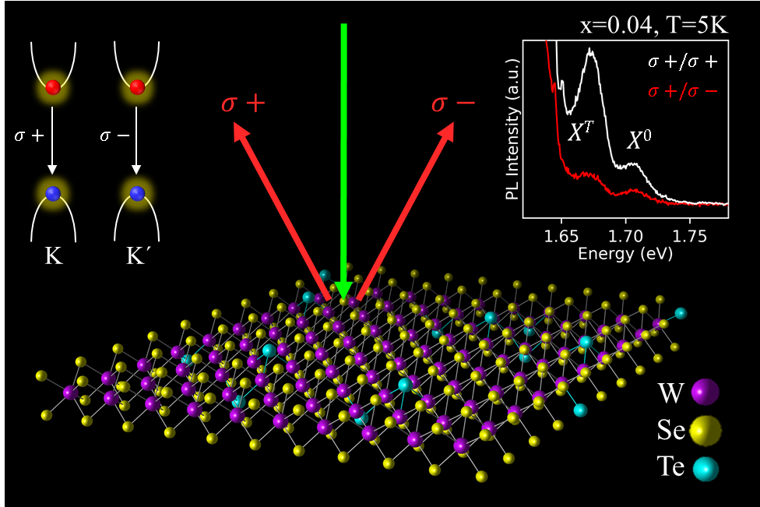
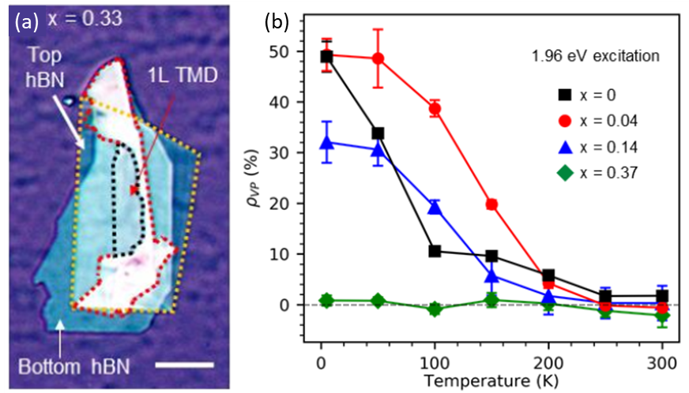
In this work,our team explored the possibility of achieving a single material where both valleytronic and neuromorphic functionality can be combined. Two-dimensional (2D) transition metal dichalcogenide alloys are ideal for this application due to their inherent structural polymorphism. By alloying a TMD in a semiconducting hexagonal phase (WSe2) with one that naturally occurs in a semimetallic phase (WTe2), we can lower the energy barrier between these two structural phases. However, while valleytronic behaviors are known to be robust in WSe2, it is an open question whether they would survive in a TMD alloy where the parent compounds are in different structural phases. We performed a systematic characterization of the optical and vibrational properties of monolayer WSe2(1-x)Te2x alloys, which are potential candidates for phase change memory, to understand how valley polarization is altered with the incorporation of Te. The principle result of our work is that both valley polarization and valley coherence remain large in WSe2(1-x)Te2x alloys up to x = 14%, which is comparable to the behavior of the parent compound WSe2. Alloys also appear to host valley-polarized excitons that are more resistant to phonon-induced depolarization mechanisms. This implies that at elevated temperatures alloys may outperform pure WSe2 in valleytronic applications. These results are the first systematic examination of valley properties in 2D phase change materials and point to a new class of devices where valleytronics can be utilized in concert with phase change elements in hybrid next-generation computing architectures.
For more information please see our recent publication in Communications Physics Valley phenomena in the candidate phase change material WSe2(1-x)Te2x doi:10.1038/s42005-019-0277-7, or email pvora@gmu.edu.

Follow the Topic
-
Communications Physics
An open access journal from Nature Portfolio publishing high-quality research, reviews and commentary in all areas of the physical sciences.

Related Collections
With Collections, you can get published faster and increase your visibility.
Nonlinear dynamics of living systems
Publishing Model: Open Access
Deadline: Nov 09, 2026
High-Energy Light Sources - From Tabletop to Large Facilities
Publishing Model: Open Access
Deadline: Sep 30, 2026