Violet Arsenic Phosphorus: Switching p-Type into High Performance n-Type Semiconductor by Arsenic Substitution
Published in Materials
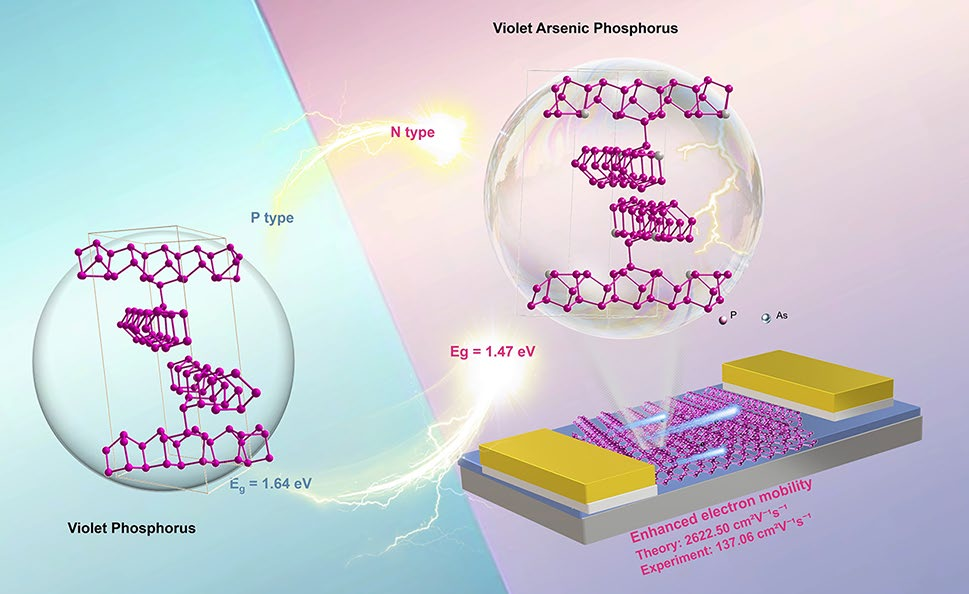
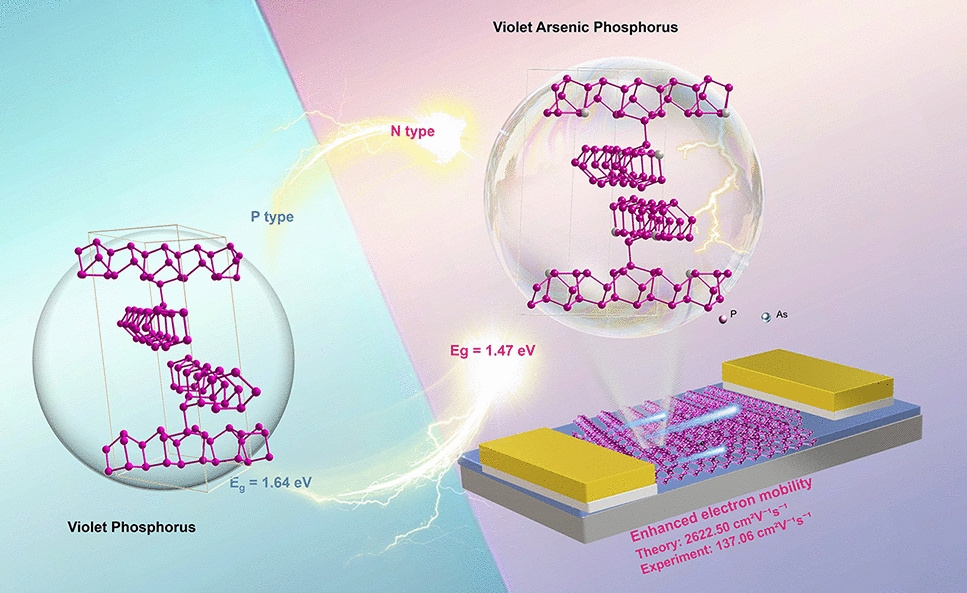

Violet phosphorus, a recently explored layered elemental semiconductor, has attracted much attention due to its unique photoelectric, mechanical properties, and high hole mobility. Herein, violet arsenic phosphorus has for the first time been synthesized by a molten lead method. The crystal structure of violet arsenic phosphorus (P83.4As0.6, CSD-2408761) was determined by single crystal X-ray diffraction to have similar structure as that of violet phosphorus, where P12 is occupied by arsenic/phosphorus (As/P) atoms as mixed occupancy sites As1/P12. The arsenic substitution has been demonstrated to tune the band structure of violet phosphorus, switching p-type of violet phosphorus to high-performance n-type violet arsenic phosphorus. The effective electron mass along the < 010 > direction is significantly reduced from 1.792 to 0.515 m0 by arsenic substitution, resulting in an extremely high electron mobility of 2622.503 cm2 V⁻1 s⁻1. The field effect transistor built with P83.4As0.6 nanosheets was measured to have a high electron mobility (137.06 cm2 V⁻1 s⁻1, 61.2 nm), even under ambient conditions for 5 h, much higher than the hole mobility of violet phosphorene nanosheets (4.07 cm2 V⁻1 s⁻1, 73.3 nm). This work provides a new idea for designing phosphorus-based materials for field effect transistors, giving significant potential in complementary metal–oxide–semiconductor applications.

Editor of Nano-Micro Letters, which is an Open-Access, peer-reviewed journal reported papers that have at least one dimension ranging from a few sub-nanometers to a few hundreds of micrometers. The journal is published by Springer Nature and indexed by SCI, EI, SCOPUS, Pubmed, etc. The 2025 JCR Impact Factor is 38.5. The 2025 CiteScore is 58.9.
Follow the Topic
-
Nano-Micro Letters
Nano-Micro Letters is a peer-reviewed, international, interdisciplinary and open-access journal that focus on science, experiments, engineering, technologies and applications of nano- or microscale structure and system in physics, chemistry, biology, material science, and pharmacy.

Please sign in or register for FREE
If you are a registered user on Research Communities by Springer Nature, please sign in