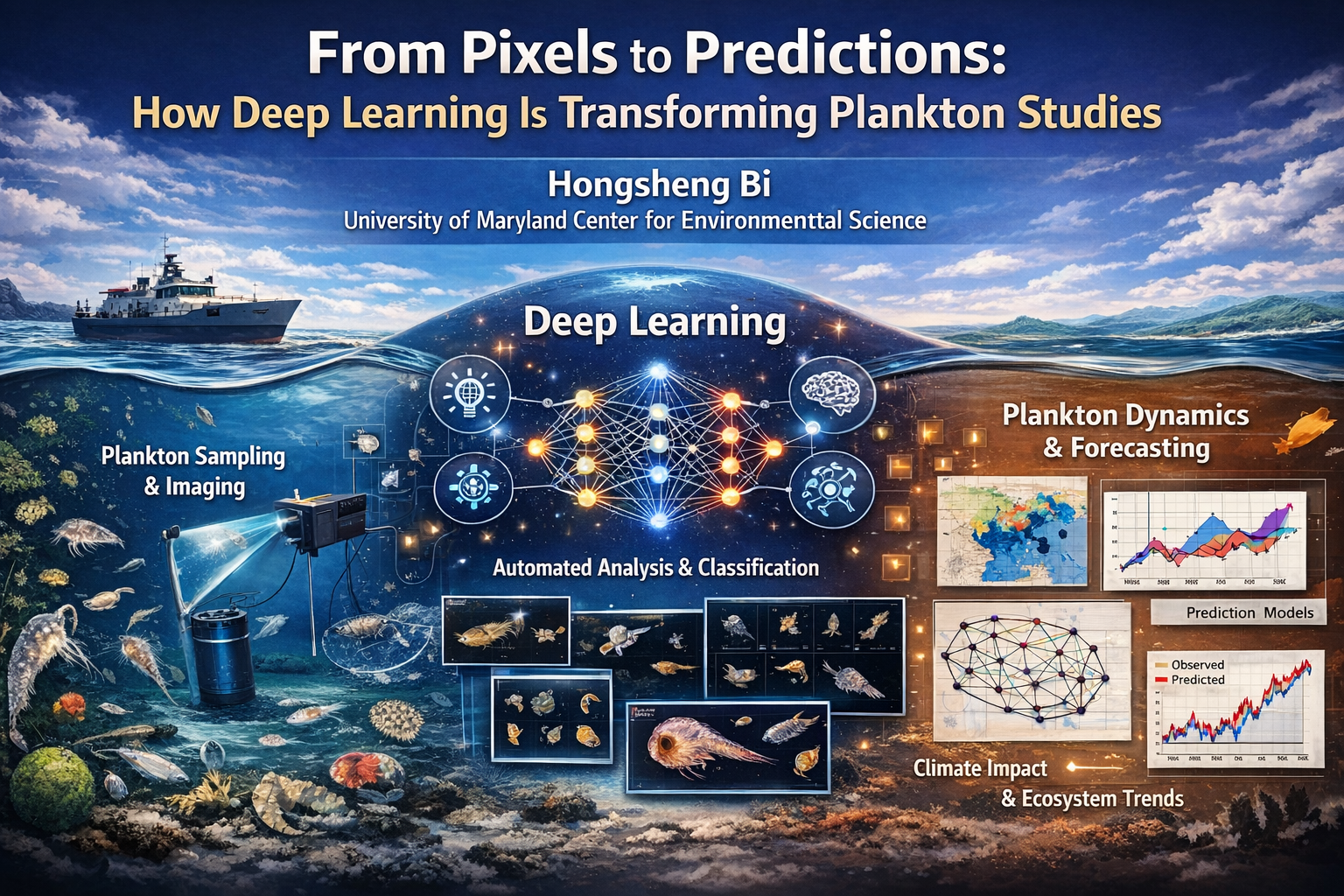
Virtual Event 20th January - From Pixels to Predictions: How Deep Learning Is Transforming Plankton Studies
Published in Earth & Environment and Ecology & Evolution
Date: 📅 Tuesday 20th January 2026
Time: ⏰ 15:00 PM CET | 9:00 AM EST | 14:00 GMT
Sign up: https://cassyni.com/events/S1igwfE9VkmU1gLietDT8H?88t85
The event will be recorded, so if you cannot follow it live, you'll still be able to watch the recording which will be circulated to those who have signed up.
Speaker: Prof Hongsheng Bi is a Fisheries Oceanographer with a specialised focus on the fine-scale spatial distributions of pelagic organisms and their trophic interactions. He is a Professor at University of Maryland Center for Environmental Science, USA. Hongsheng's expertise centers on developing advanced underwater plankton imaging systems, notably the PlanktonScope, integrated with leading-edge deep learning techniques. These technological advancements are crucial in elevating our capacity to assess zooplankton in coastal waters, either rapidly or in real-time. This enhanced capability plays a vital role in delivering essential data for effective and timely ecosystem management.
Abstract: Plankton are the foundation of marine ecosystems and critical regulators of the ocean’s carbon cycle, yet their small size and large variability make them difficult to study. This talk presents an integrated AI-driven framework for observing and predicting plankton dynamics. Hongshen will introduce PlanktonScope for high-resolution, in situ observation of plankton communities, and its accompanying image-processing pipeline, which applies deep-learning models for automated detection, classification, and enumeration. Building on these advances, Hongshen will highlight Plankton-Chronos, a time-series prediction model that uses long-term image datasets and large language models to forecast plankton abundance and community shifts. Together, these developments demonstrate how artificial intelligence can transform marine ecosystem monitoring, from capturing microscopic images to predicting large-scale ecological change.
Q&A: The presentation will be followed by a Q&A session chaired by SDG14 working group chairs, Éva Loerinczi and Greta Hedley-Miller, with the opportunity for you to ask questions.
We look forward to welcoming you on 20 January.