Warming, carbon balance, and the future of young forests
Published in Ecology & Evolution and Plant Science

Forests depend on successful recruitment of seedlings and saplings. These young plants are responsible for replacing older trees and sustaining forest diversity over time, yet they are often more vulnerable to environmental change than mature individuals. As global temperatures continue to rise, understanding how warming affects the physiology of young woody plants has become an important question for ecologists, forest managers, and restoration practitioners.
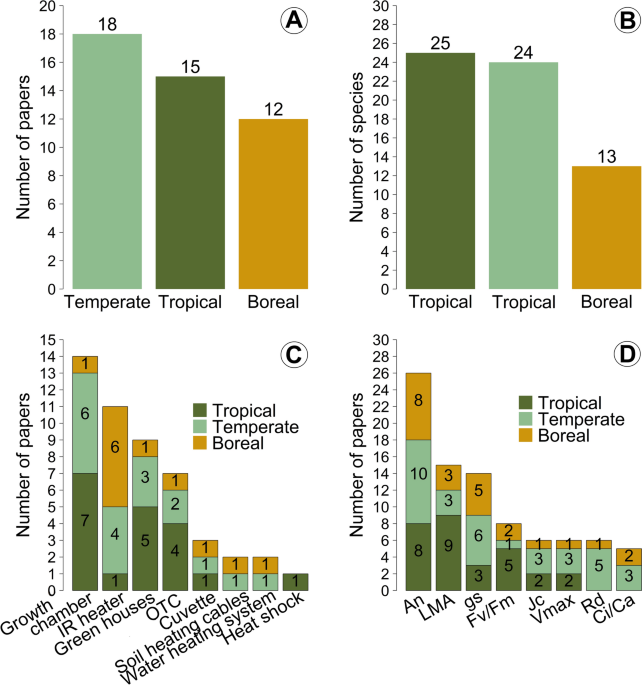
In a recent, open access paper published in Theoretical and Experimental Plant Physiology, the authors addressed this question through a systematic review and meta-analysis of experimental studies on warming. Drawing on data from 39 studies and 62 woody species, the authors examined how temperature increases influence a range of leaf traits linked to carbon balance, including photosynthesis, respiration, stomatal conductance, and leaf structure.
One of the most interesting findings is that photosynthesis itself often showed signs of acclimation to warmer conditions. In other words, young plants were frequently able to adjust and maintain rates of carbon assimilation despite higher temperatures. This suggests that warming does not automatically translate into reduced photosynthetic performance, at least within the temperature ranges investigated in the analyzed studies.
Higher respiratory costs
At the same time, the picture becomes more complex when carbon losses are considered. The review found evidence that warming tends to increase respiratory costs and may also favor photorespiration, a process that consumes energy and reduces the efficiency of carbon gain. The authors suggest that these changes could shift the overall carbon balance of young plants, leaving fewer resources available for growth, survival, and establishment.
The study also challenges a common expectation that tropical species are consistently more vulnerable to warming than species from temperate or boreal regions. Based on the available evidence, the authors did not find clear support for this pattern. However, they emphasize that tropical forests remain underrepresented in the literature. Despite their global importance, relatively few tropical species have been studied experimentally, highlighting a substantial gap in current knowledge.
Beyond its ecological implications, the work underscores the value of looking beyond photosynthesis alone when assessing plant responses to climate change. Forest regeneration depends on a balance between carbon gains and carbon costs, and warming can influence both sides of that equation. By identifying broad patterns as well as important data gaps, this study provides a useful foundation for future research on how forests may regenerate in an increasingly warmer world.
Author's note: I used Microsoft Copilot to assist in creating this post, including the image.

Follow the Topic
-
Theoretical and Experimental Plant Physiology
Dedicated to publishing original research in various domains of plant physiology, including primary and secondary metabolism and biochemistry, photobiology, photosynthesis processes, plant signaling and response, crop physiology, stress physiology, plant-microbe and plant-insect interactions.