What a debate over a building's name taught me about how universities are really run
Published in Social Sciences, Education, and Business & Management


When a university decides whether to keep or change the name on one of its buildings, it can look, from the outside, like a small administrative matter. A committee meets. A vote is taken. A line is added to the minutes.
Anyone who has lived through such a moment knows it is never small. A name carries memory. For some it honours a founder, a benefactor, a family; for others it is a daily reminder of who the institution was once built to exclude. The disagreement is rarely about procedure. It is about belonging – whose history is celebrated, whose is unsettled, and whose is quietly asked to step aside.
I have watched these moments from both sides. As a student in South Africa. I was part of a generation that filled courtyards and corridors demanding that our universities change. Years later, I found myself on the other side of the table – serving on a university Council and chairing an Institutional Forum, one of the bodies meant to carry the voices of staff and students into the heart of decision-making. From that seat I learned something that has shaped everything I now research: the formal machinery of governance – the committees, codes, and statutes – often struggles to hold the very human realities it exists to serve.
This paper, written with my doctoral supervisor André du Plessis, grew out of that puzzle.
Governance is not just paperwork
When we talk about how a university is "governed," we usually mean its official structures: the Council that holds legal responsibility, the Senate that guards academic matters, the forums and committees meant to keep everyone accountable. In South Africa, these were carefully designed after apartheid to make universities more democratic and inclusive.
Yet, three decades on, many of these structures have quietly become box-ticking exercises. Meetings happen, reports are filed, the right boxes are marked – and very little actually changes. Diversity is often measured by counting who sits in the room, while the harder question of whose voice genuinely shapes a decision goes unasked.
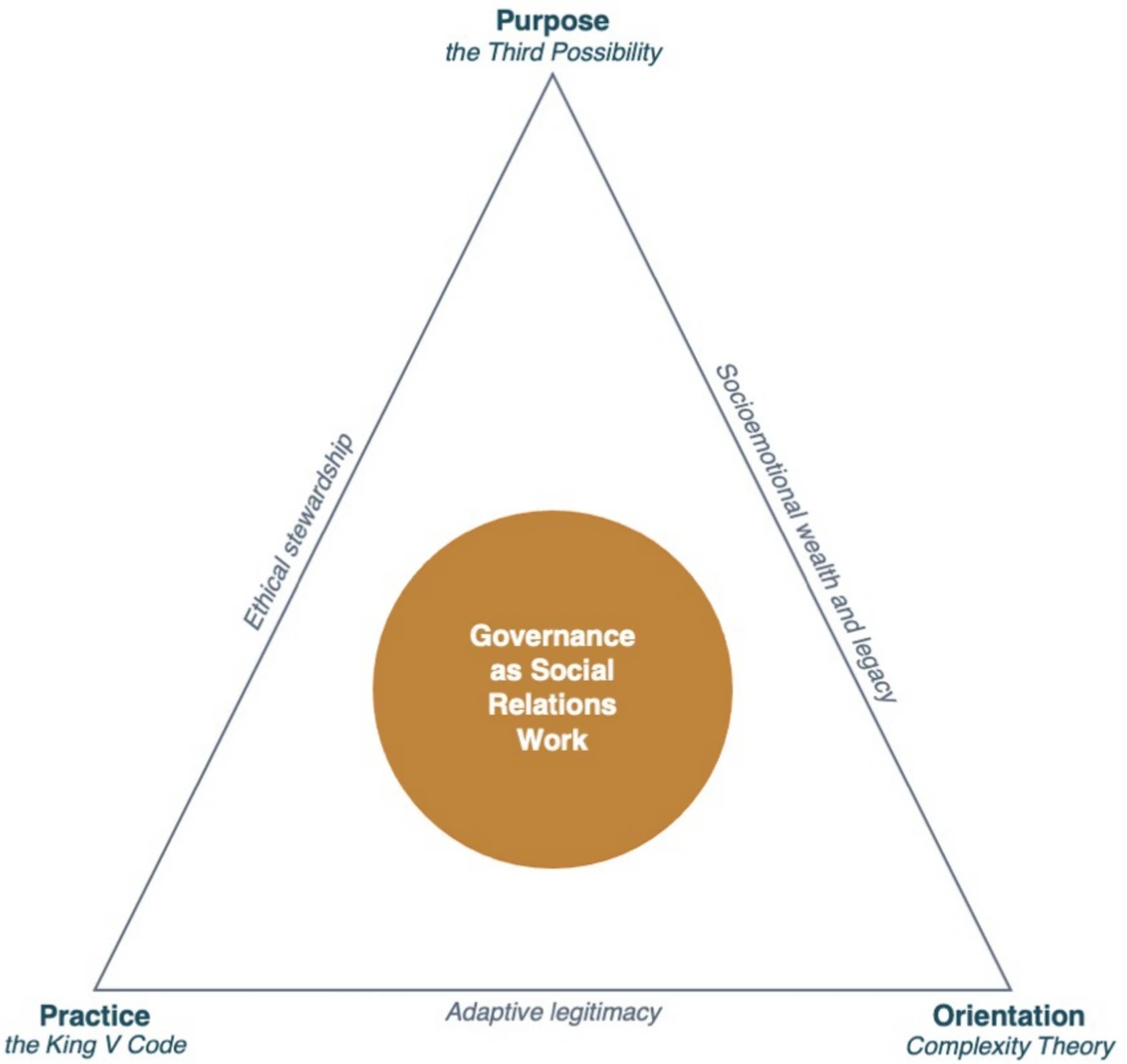
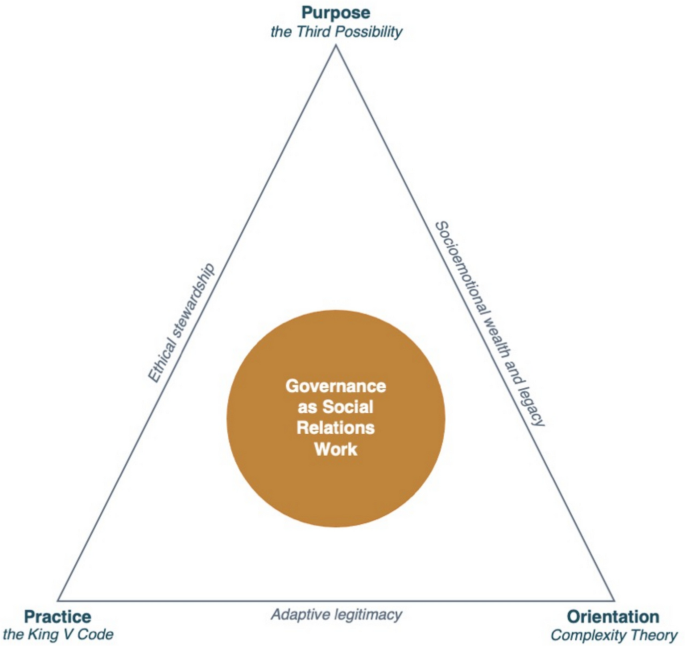
Our argument is simple to state and, we hope, harder to ignore: governance is not really about structures at all. It is about relationships. We call this governance as social relations work – the everyday, often invisible business of how authority, participation and trust are negotiated between real people. A code of conduct does not run an institution. People do, in thousands of small encounters where they decide whether to listen, to share power, or to close ranks.
Three ideas, held together
To make sense of this, we brought together three bodies of thinking that are rarely placed in the same conversation. Each answers a different question.
The first asks what governance is for. Drawing on an idea called the "Third Possibility," we argue that a university should be governed not as an asset to be managed for a few, nor merely balanced between competing interests, but as a legacy held in trust for society. Its leaders are stewards, accountable to the generations who came before and those still to come.
The second asks how governance actually works. Here we lean on complexity science, which treats a university as a living, adaptive system rather than a machine. You cannot simply pull a lever and predict the outcome; decisions ripple unpredictably through alumni, students and the public. Good governance therefore has to learn and adapt, not merely command and control.
The third asks how governance should be practised. For this we turned to South Africa's King Code, a respected approach to governance built on a refreshingly honest principle: "apply and explain". Rather than hiding behind compliance, leaders must openly justify their decisions against their stated values – and be willing to be challenged on them.
Held together, these three ideas describe governance that is morally grounded, alert to complexity, and answerable in public.
What this looks like in practice
Ideas are only as good as what they let you do differently. So we offer concrete suggestions.
One is what we call socioemotional wealth mapping. Before making a charged decision – renaming a building, changing a language policy, reforming a curriculum – a governing body would first surface, openly and on the record, the identities, histories and attachments at stake. Whose memory does this affirm? Whose does it injure? The decision might still be difficult and contested, but it would be reasoned through honestly rather than steamrolled or quietly avoided.
Another is to change what we measure. Instead of only counting who is present in governance, we ask whether their presence makes any difference. Do the recommendations of staff and student bodies actually shape what Council decides? When leaders overrule them, can they explain why in a way that holds up to scrutiny? Presence is not the same as influence – and only influence changes an institution.
Why South Africa, and why everyone else should care
We anchored the paper in South Africa because its universities sit at a remarkable crossroads: monuments to post-apartheid hope and, at the same time, inheritors of a painful past still being reckoned with. That makes the country an unusually clear window onto a struggle now playing out worldwide.
Universities everywhere are under pressure – from populist movements attacking diversity and inclusion, from shrinking budgets, from a loss of public trust. The temptation, in such moments, is to retreat into control and compliance. Our argument is that this is exactly the wrong move. What institutions need under pressure is not tighter box-ticking, but a richer, more human understanding of how they are actually held together.
Ultimately, this work is about a single question: what are universities for? Governance is the quiet mechanism through which that question is answered every day – through which inclusion is either advanced or obstructed, trust either built or eroded. I came to this research from the protest line and the boardroom alike. Both taught me the same lesson: the rules matter, but it is the relationships that decide whether an institution becomes the place it claims to be.

Bryan Jason Bergsteedt is a doctoral candidate, studying a Doctor of Education (DEd) in Educational Leadership and Management, at the University of Pretoria. His research draws on Complexity Theory, ethical leadership, and socioemotional dynamics, to explore how systems of governance can advance equity, social cohesion, and nation-building. He holds a Postgraduate Diploma in Leadership Development (cum laude), from Stellenbosch Business School, graduating top of his cohort. He received undergraduate and postgraduate qualifications at faculties of Science, Medicine and Health Sciences, and Economic and Management sciences, at Stellenbosch University.
Bryan has held multiple executive governance roles, including Chairperson of the Institutional Forum, and Council Member, at Stellenbosch University, contributing to policy reform, transformation oversight, and strategy. His interdisciplinary background spans governance, education, and multilateralism, with over a decade of experience in teaching and academic leadership in the higher education sector.
He recently attended the 63rd United Nations Graduate Study Programme, in Geneva, as the sole South African representative, and represents South Africa on the Global Youth AI Advisory Body – a global network of emerging leaders examining the intersection of artificial intelligence and its impact on humanity. His lived experiences continue to shape his advocacy for inclusive, ethically grounded approaches to governance and policy.
Follow the Topic

Introducing: Social Science Matters
Social Science Matters is a campaign from the team at Palgrave Macmillan that aims to increase the visibility and impact of the social sciences
Continue reading announcement

Please sign in or register for FREE
If you are a registered user on Research Communities by Springer Nature, please sign in