What Brazilian hospitals taught me about resilience under pressure
Published in Public Health, Education, and Business & Management

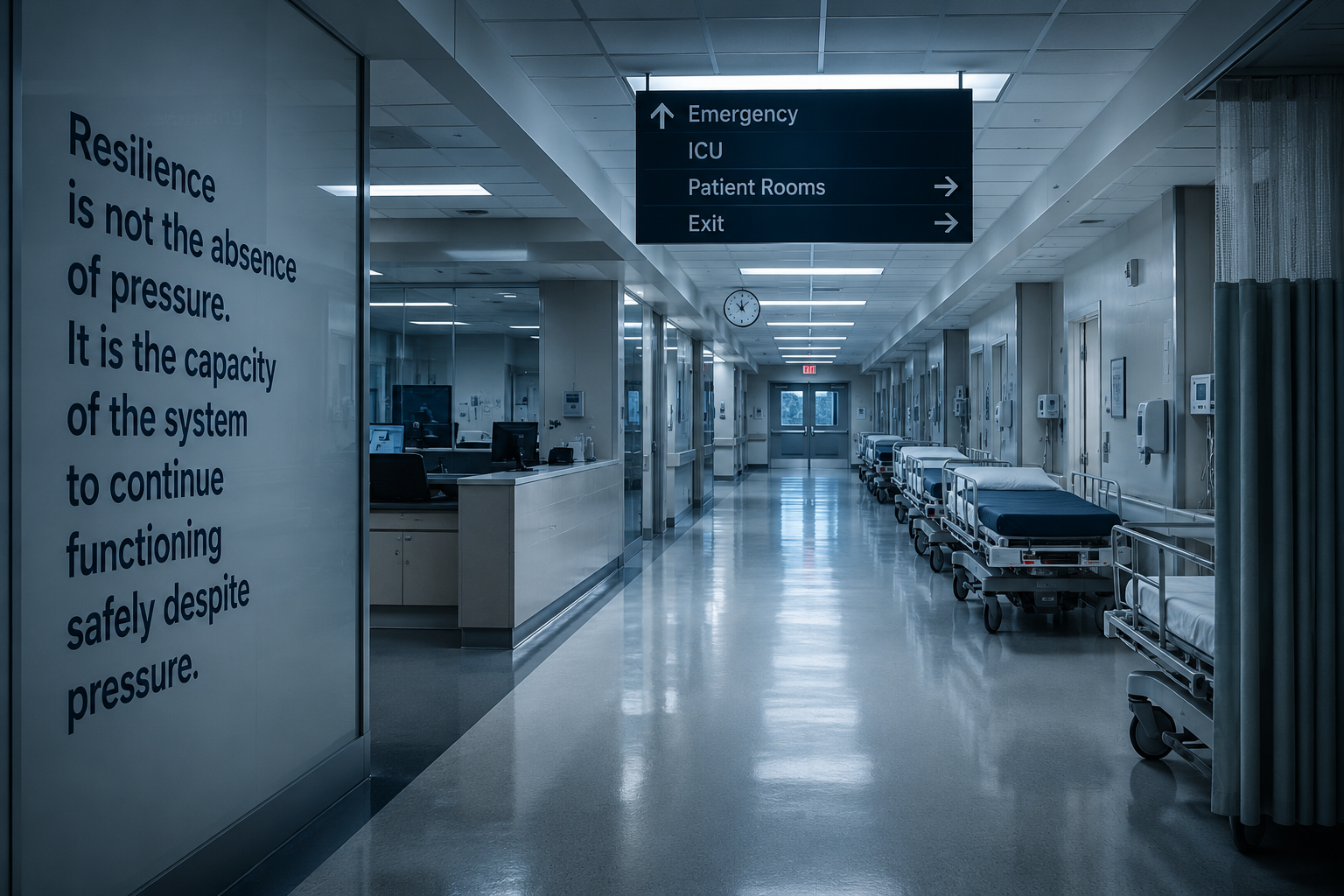






Several studies have associated emergency department overcrowding, operational fragmentation, and staff overload with patient safety risks, delayed care, communication failures, and burnout in healthcare systems worldwide. Discussions in quality improvement, resilience engineering, and healthcare operations research have increasingly reinforced the importance of governance structures, operational coordination, and organizational resilience in highly pressured environments.
Over the last few years, I have participated in projects involving Lean Healthcare, organizational maturity assessment, clinical governance, and emergency department overcrowding analysis in Brazilian hospitals.
These experiences — combined with operational work in intensive care units, emergency departments, and healthcare leadership — reinforced an important perception:
Resilience in healthcare systems is often misunderstood.
In many organizations, resilience becomes associated with the ability of professionals to continue operating despite chronic overload. However, operational experience and quality improvement initiatives increasingly demonstrate that sustainable healthcare systems cannot depend indefinitely on extraordinary individual effort alone.
Eventually, even highly committed teams become vulnerable when governance structures, operational visibility, communication flows, and decision-making processes become fragile.
In projects related to operational flow and organizational maturity, it became clear that resilient systems are characterized not only by technical competence, but by their ability to maintain coordination under pressure.
This includes:
- reliable operational data;
- governance structures capable of supporting decision-making;
- communication alignment between teams;
- organizational trust;
- and operational models capable of functioning even during periods of saturation.
Many healthcare crises are not necessarily generated by lack of technical knowledge.
They emerge from fragmentation.
Fragmented communication.
Fragmented accountability.
Fragmented operational visibility.
Fragmented priorities.
Under pressure, fragmented systems collapse faster.
At the same time, I have also witnessed remarkable operational recoveries in hospitals capable of reorganizing flow, rebuilding governance mechanisms, and restoring alignment between teams even in highly constrained environments.
These experiences significantly changed the way I understand healthcare leadership and operational resilience.
Resilience is not the absence of pressure.
It is the capacity of the system to continue functioning safely, coherently, and predictably despite pressure.
And perhaps that is one of the most important lessons Brazilian hospitals have taught me.
References
- To Err Is Human: Building a Safer Health System
- Resilient Health Care
- The association between emergency department crowding and adverse patient outcomes: a systematic review
- Burnout in healthcare professionals: a call for organizational action
- Goodhart’s Law and healthcare performance measurement
Follow the Topic
-
BMC Global and Public Health
An open access, transparent peer review journal publishing outstanding and influential research and opinion of broad interest to all professional communities involved in global and public health research, policy-making, implementation and delivery worldwide.

Related Collections
With Collections, you can get published faster and increase your visibility.
Environmental exposure, maternal health and child health
BMC Global and Public Health is pleased to announce a call for papers for our upcoming collection entitled Environmental exposure, maternal health and child health, guest edited by Dr. Nuria Güil from the Barcelona Institute for Global Health, Spain, Dr. Pengfei Guo from University of South Carolina, USA and Dr. Wei Li from Yale University, USA. The aim of the collection is to capture global efforts and novel approaches in this multi-disciplinary area. Maternal and child health is a substantial domain of global public health, with outcomes that shape individual well-being and societal development. Pregnancy and early life are periods of heightened biological sensitivity, during which exposures exert lasting effects. Complications such as hypertensive disorders, gestational diabetes, and perinatal mental health challenges, as well as birth and child outcomes including preterm birth, growth restriction, and neurodevelopmental impairment, highlight the need for continued research and intervention to reduce risks and promote health equity.
Environmental exposures are increasingly recognized as critical and modifiable determinants of maternal and child health. Adverse exposures such as ambient air pollution, environmental tobacco or cannabis smoke, contaminated water, pesticides, endocrine disruptors, heavy metals, noise, light pollution, natural disasters, and other emerging pollutants contribute to reproductive and developmental risks, often acting in mixtures and interacting with social or neighborhood determinants. At the same time, positive environmental influences such as access to clean air and water, green space, safe housing, and supportive community environments, have been shown to promote healthier pregnancies, enhance child neurodevelopment, and reduce stress for families. Advancing knowledge of both harmful and protective pathways is essential for developing effective interventions, guiding policy, and addressing environmental challenges that threaten maternal and child health.
We are now inviting the submission of manuscripts of outstanding interest covering the breadth of multi-disciplinary studies, ranging from observational to interventional that are focused on the effect of environmental exposure on maternal and child health. We envision this work to inform future research, conceptual frameworks, intervention development, and policy advancement.
Sample foci of papers include:
- Epidemiological studies on environmental exposures (e.g., air pollutants, per- and polyfluoroalkyl substances, pesticides, heavy metals, plastics, greenspace, noise, climate-related hazards) and maternal, fetal, and child health outcomes
- Environmental tobacco or cannabis secondhand smoke exposure and postpartum physical and mental health on maternal and child health (e.g., postpartum depression and anxiety, maternal sleep and recovery, breastfeeding outcomes, infant respiratory illness and neurodevelopment)
- Population-level insights into contextual pathways and disparities (e.g., social determinants, neighborhood environment, climate vulnerability) that influence reproductive, perinatal, and developmental health outcomes
- Policy, intervention, and prevention strategies to reduce environmental risks and improve maternal and child health globally
- Interactions between environmental exposures and social determinants of health
- Novel data collection/assessment tools (e.g., mixture, exposome, or omics approaches)
This Collection supports and amplifies research related to SDG 3: Good Health and Well-being.
We encourage work from local, regional and global partnerships and collaboration among scientists from multi-disciplinary fields and using multiple methodologies. We ask that authors be attentive to the use of non-stigmatizing/preferred language in their manuscripts as outlined in relevant language guidelines for their respective fields.
All manuscripts submitted to this journal, including those submitted to collections and special issues, are assessed in line with our editorial policies and the journal’s peer-review process. Reviewers and editors are required to declare competing interests and can be excluded from the peer review process if a competing interest exists.
Publishing Model: Open Access
Deadline: Oct 30, 2026
Strategies for reducing cross-border health challenges
BMC Global and Public Health is calling for submissions to our Collection on strategies for reducing cross-border health challenges. This Collection aims to address the pressing need for innovative, collaborative solutions to health issues that transcend national boundaries, such as infectious disease outbreaks, migration-related health disparities, and the global impact of climate change on health systems.
The aim of this Collection is to explore the multifaceted nature of cross-border health challenges and to identify actionable strategies that promote health equity and resilience. Potential topics include the role of international partnerships, data sharing, and policy harmonization in managing health crises. Submissions addressing technological innovations, public health interventions, or socio-political frameworks to tackle these global issues are highly encouraged.
Our goal is to foster a deeper understanding of how interconnected health systems and collaborative actions can reduce the burden of cross-border health challenges. We invite submissions on the following subtopics:
Strengthening health system resilience in response to transnational disease outbreaks.
Addressing health disparities among migrant and refugee populations.
The impact of climate change on cross-border health challenges.
Leveraging technology and big data to enhance global health surveillance and response.
Policy frameworks for improving international health collaboration.
Case studies of successful cross-border public health initiatives.
By focusing on scalable and sustainable solutions, this Collection seeks to advance knowledge and inform practice in tackling health challenges that require coordinated global action.
We encourage work from local, regional, national, and global partnerships and collaboration among multidisciplinary scientists using multiple methodologies. We ask that authors be careful to use non-stigmatizing/preferred language in their manuscripts as outlined in relevant language guidelines for their respective fields.
This Collection supports and amplifies research related to SDG 3: Good Health and Well-being, SDG 5: Gender Equality, and SDG 10: Reduced Inequalities.
All manuscripts submitted to this journal, including those submitted to collections and special issues, are assessed in line with our editorial policies and the journal’s peer-review process. Reviewers and editors are required to declare competing interests and can be excluded from the peer review process if a competing interest exists.
Publishing Model: Open Access
Deadline: Sep 29, 2026
Please sign in or register for FREE
If you are a registered user on Research Communities by Springer Nature, please sign in