What can we image?
Published in Cancer, Genetics & Genomics, and General & Internal Medicine

For most of my career, molecular imaging was synonymous with tracers.
Every tracer had its own story. FDG reflected glucose metabolism. DOTATATE targeted somatostatin receptors. PSMA visualized prostate cancer. We became experts in individual imaging agents, each designed to answer a specific clinical question.
But one day I started wondering whether we had been asking the wrong question all along.
Instead of asking What does this tracer image?, what if we asked:
What can we image?
It sounds like a simple question. Yet when I looked for the answer, I could not find one.
So I started making lists.
One tracer after another. One molecular target after another. One publication after another.
At first, it felt like the preparation for a review article. But the more I collected, the more I realized that this was becoming something entirely different. The list kept growing. New tracers appeared almost every month. Some targets could be visualized with multiple imaging agents, others only indirectly. Entire biological pathways were gradually emerging from what had previously seemed like isolated discoveries.
This was no longer a collection of tracers.
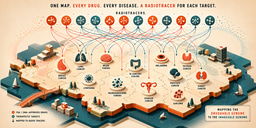
It was becoming a map.
Then another question emerged.
The human genome contains around 20,000 protein-coding genes. Surely only a small fraction could be visualized with molecular imaging.
Or could they?
Nobody seemed to know.
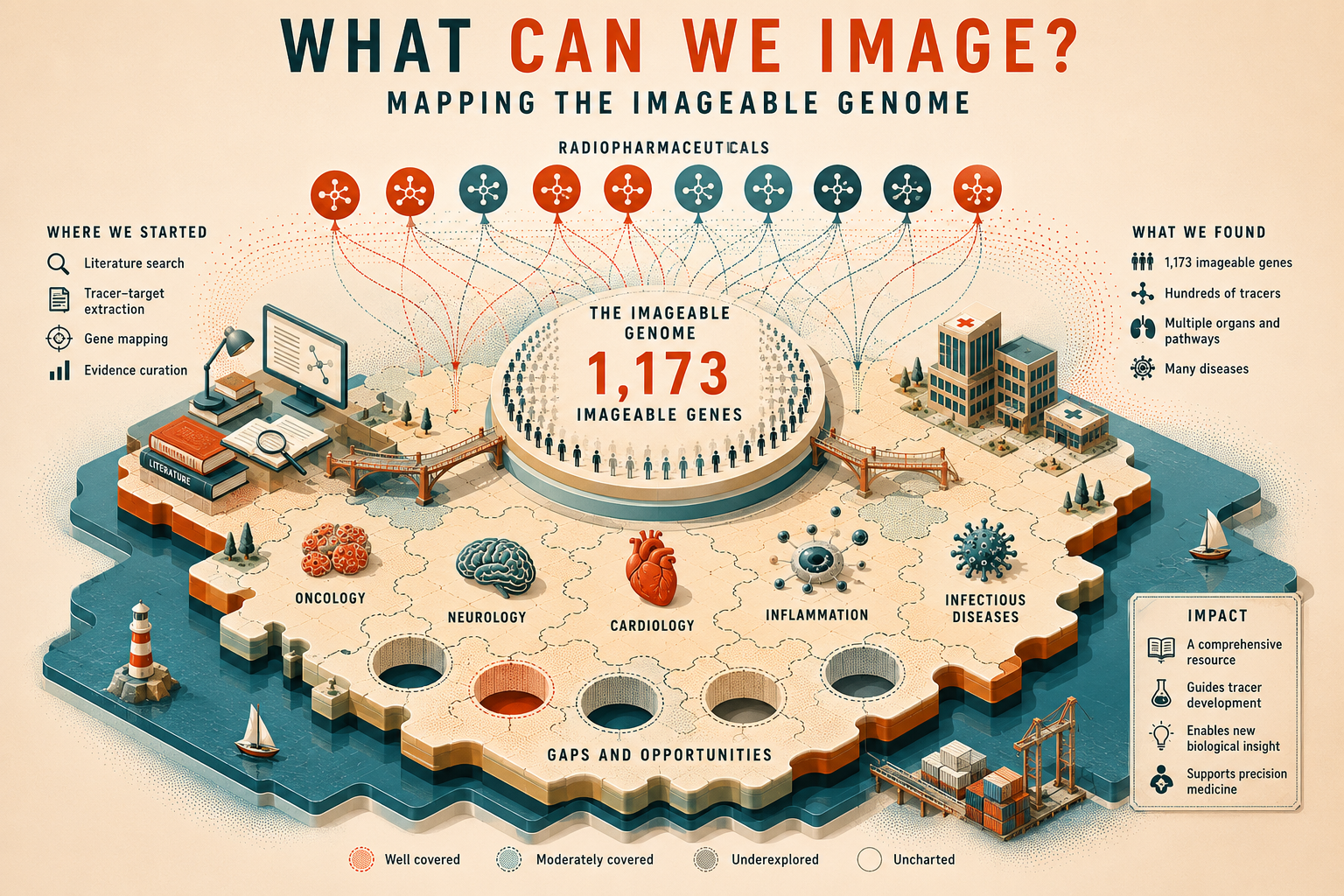
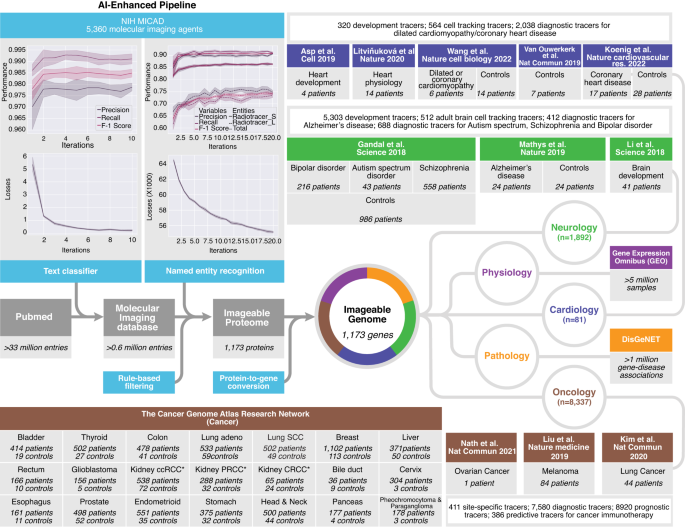
So together with my colleagues, we systematically searched the literature, curated imaging targets and linked them to the human genome. The project became increasingly ambitious, but the guiding question remained remarkably simple:
Which human genes are imageable today?
The answer surprised us.
Not dozens.
Not hundreds.
More than one thousand genes already had an imaging strategy.
For the first time, we could look at molecular imaging from a genome-wide perspective. Instead of seeing individual tracers, we saw an entire landscape. Some gene families were densely covered by imaging probes, while others remained almost unexplored. Gaps in imaging became just as informative as the successes.
Publishing The Imageable Genome changed the way I thought about molecular imaging.
The paper was never just about cataloguing genes. It provided a framework for understanding where molecular imaging already exists, where opportunities remain, and how future tracers might be developed more systematically.
But finishing the project immediately raised another question.
If more than one thousand genes can already be imaged, how many of them are actually relevant for precision medicine? Which ones can not only be visualized, but also guide or monitor targeted therapies?
That question led us to develop the Theranostic Genome.
And once we had connected imaging with therapy, the next question seemed inevitable: how much of the entire druggable genome could already be visualized using existing molecular imaging approaches?
That became the Druggable Genome.
Looking back, these three projects now feel like chapters of the same story.
It all began with a deceptively simple question that nobody had really asked before:
What can we image?
Today, when I hear about a newly discovered therapeutic target, my first thought is no longer whether somebody has developed a tracer for it.
Instead, I wonder where it belongs on the map.
Because perhaps the most important contribution of The Imageable Genome was not identifying more than a thousand imageable genes.
It was changing the way we think about molecular imaging.

I am a physician-scientist and Professor of Nuclear Medicine at the University of Lucerne, Switzerland, with a clinical and research focus on molecular imaging, precision oncology, and translational medicine. My work explores how medical imaging can reveal disease biology, guide targeted therapies, and accelerate drug development.
My research combines clinical imaging, genomics, systems biology, and data science to understand which molecular targets can be visualized in vivo and how imaging can serve as a companion diagnostic beyond radiopharmaceutical therapies. This work has led to the concepts of the Imageable Genome, the Theranostic Genome, and more recently the repurposing of molecular imaging to map drug targets in vivo.
I am also co-founder of Coral Analytics, where we are developing ex vivo molecular imaging technologies to help personalize cancer treatment. I enjoy collaborating across medicine, biology, engineering, and artificial intelligence to translate innovative ideas into tools that improve patient care.
I look forward to sharing our research, discussing new ideas, and connecting with scientists interested in molecular imaging, precision medicine, cancer biology, and translational research.
Follow the Topic
-
Nature Communications
An open access, multidisciplinary journal dedicated to publishing high-quality research in all areas of the biological, health, physical, chemical and Earth sciences.
Related Collections
With Collections, you can get published faster and increase your visibility.
Women's Health
Publishing Model: Hybrid
Deadline: Ongoing
Tumor Microenvironment Crosstalk and Therapeutic Implications
Publishing Model: Hybrid
Deadline: Nov 02, 2026
Please sign in or register for FREE
If you are a registered user on Research Communities by Springer Nature, please sign in