When a Polymer Becomes a Quantum Regulator: How Asymmetric Matrices Control Dynamic Phosphorescence
Published in Materials

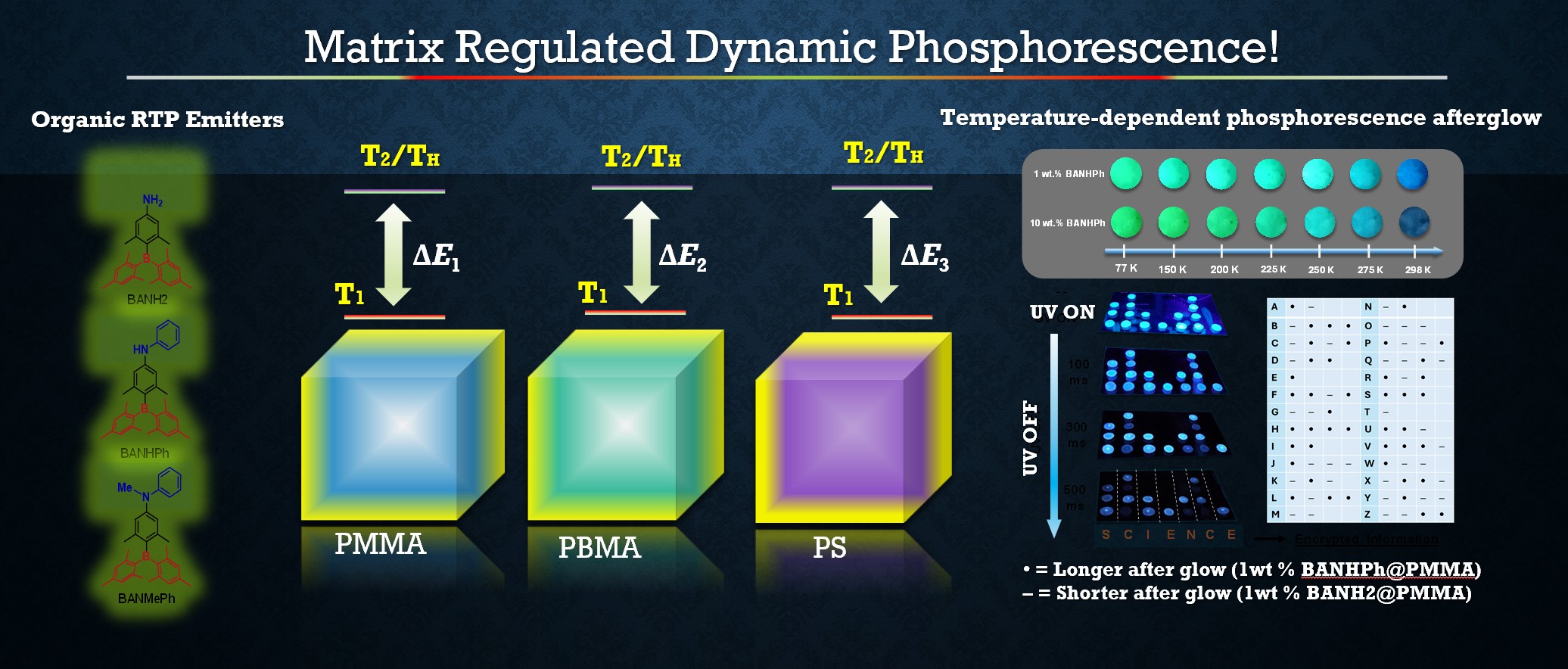
Organic room-temperature phosphorescence (RTP) has emerged as a powerful platform for next-generation optoelectronics, encryption, and sensing. Traditionally, polymer matrices are treated as inert hosts that simply rigidify chromophores to suppress non-radiative decay. Our work challenges this assumption by showing that polymer environments can actively control the excited-state landscape of molecular emitters.
We demonstrate that asymmetric polymer matrices regulate the energetic alignment of closely spaced triplet excited states, enabling thermally stimulated dynamic phosphorescence with near-unity photoluminescence efficiency at room temperature. By embedding borylaniline chromophores in PMMA, PBMA, and polystyrene, we uncover how subtle differences in steric confinement and electronic polarity shift triplet energy gaps and govern thermal up-conversion and down-conversion between emissive states.
Remarkably, the polymer environment can lift the degeneracy of excited-state conformers, creating new radiative pathways that do not exist in solution or crystalline solids. This matrix-induced control results in temperature-dependent color switching, long afterglow lifetimes, and efficient exciton recycling.
Beyond fundamental insights, these materials demonstrate practical utility in multilevel information encryption and afterglow displays, where emission color and lifetime encode data. Our findings reveal polymer matrices as dynamic regulators of photophysics rather than passive scaffolds—opening new design strategies for smart luminescent materials.
Follow the Topic
-
Nature Communications
An open access, multidisciplinary journal dedicated to publishing high-quality research in all areas of the biological, health, physical, chemical and Earth sciences.

Related Collections
With Collections, you can get published faster and increase your visibility.
Women's Health
Publishing Model: Hybrid
Deadline: Ongoing
Tumor Microenvironment Crosstalk and Therapeutic Implications
Publishing Model: Hybrid
Deadline: Nov 02, 2026