When Interstellar Chemistry Becomes More Than Chemistry
Published in Chemistry
Explore the Research
s42004-026-02159-4?utm_campaign=related_content&utm_source=HEALTH&utm_medium=communities
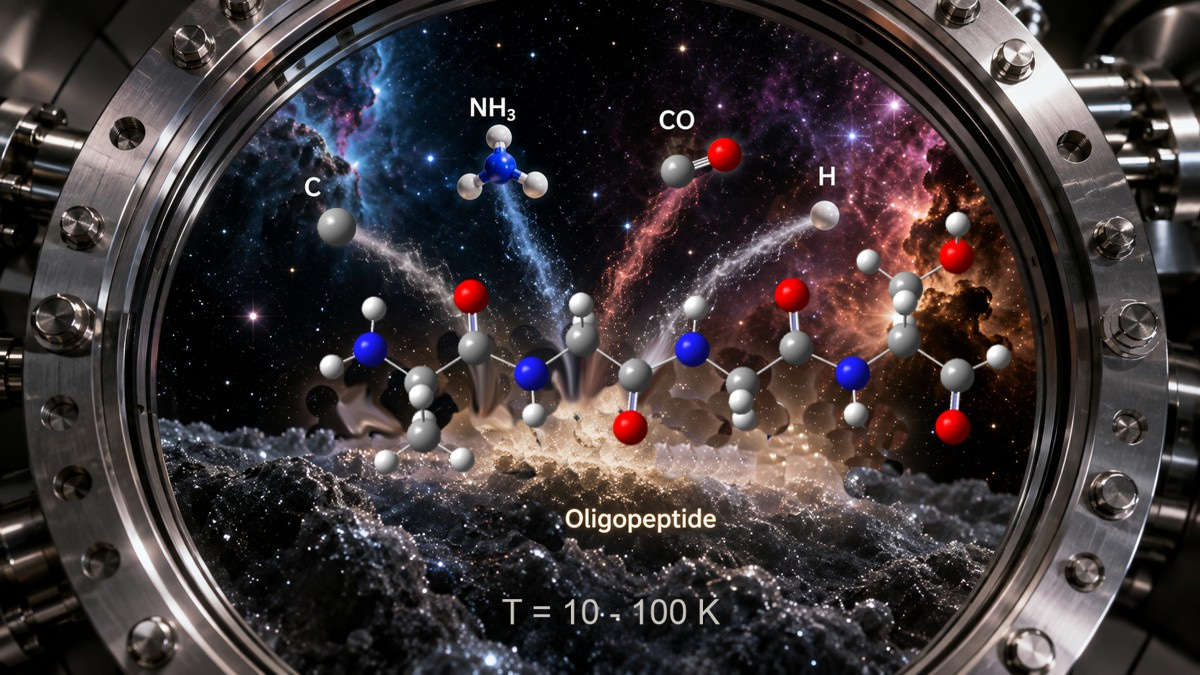
In our previous studies, we first demonstrated that peptides can form under the extreme conditions of interstellar space through the spontaneous low-temperature condensation of its most abundant species (C, NH3, and CO) onto cold dust particles. This finding suggested that some of the molecular building blocks associated with life may have existed long before the Earth formed. Once we had established that peptide formation in space was possible, a more fundamental question emerged: Could this chemistry become self-sustaining and evolve towards greater complexity? This question motivated our new study.
Autocatalysis and the origin of life
Life is not defined simply by the presence of organic molecules. What makes living systems remarkable is their ability to grow in complexity, adapt, and ultimately evolve. In chemistry, one of the most promising routes towards evolution is autocatalysis, a process in which reaction products promote their own formation. If peptides formed in space can catalyse the production of additional peptides, they would become much more than passive products of interstellar chemistry. They would be active participants in a process resembling the earliest stages of chemical evolution.
In order to investigate this possibility, we studied the action of the formed refractory organics found in our experiments on the further growth of peptides. The result was striking. Peptide formation in the presence of the products of the initial C+NH3+CO reaction became significantly more efficient, and longer peptide chains appeared in larger quantities than before.
Since peptides are among the most versatile catalysts known in modern biochemistry, it is tempting to view them as the driving force behind this enhancement. At the same time, the residue is a complex mixture of organic compounds, many of which have yet to be specified. One of the challenges ahead will be identifying exactly which molecules in the mixture are responsible for the catalytic effect and determining whether peptides themselves are indeed the key catalysts.
Increased peptide diversity
While the catalytic enhancement of peptide formation was a source of great excitement, another surprising revelation from the present study emerged from a different direction: atomic hydrogen. Hydrogen is the most abundant element in the universe, and as such, it is an unavoidable component of realistic interstellar chemistry. One of our main goals was to establish conditions that most closely resemble those present in interstellar space. For this reason, we decided to incorporate atomic hydrogen into the studied reaction. However, we initially had concerns that including hydrogen atoms might suppress peptide formation. In the extremely cold conditions of space, hydrogenation often stabilises reactive species through hydrogen saturation, which can terminate chemical pathways by converting reactive intermediates into inert molecules.
The experiments revealed the opposite. Instead of inhibiting peptide formation, atomic hydrogen significantly enhanced it. Furthermore, it increased the diversity of the peptide population. In our earlier experiments, relatively short glycine peptides typically dominated the product distribution. The presence of hydrogen made longer peptides much more prominent and substantially increased the overall variety of peptides with different amino acid residues in their compositions.
This observation has provided us with a new perspective on the role of hydrogen in interstellar chemistry. Instead of merely acting as a terminating agent, hydrogen participates in reactions with carbonaceous species, generating new radicals incorporated into growing peptide chains. In summary, hydrogen not only increases the amount of peptide material formed but also contributes to the emergence of molecular diversity and complexity.
Outlooks
The catalytic properties of the product of the studied reaction, coupled with the increased diversity of the peptides formed during this reaction, naturally raise questions about the role of such reactions in the origin of life. For us, the most exciting aspect of this work is that it shifts the discussion from molecular formation to molecular evolution. The question is no longer whether peptides can form in space, we already know that they can. The challenge is to understand whether these molecules can participate in self-amplifying chemical networks capable of increasing complexity over time. If they can, then some of the earliest steps on the path toward life as we know it may have begun not on planets, but in the universe itself. Therefore, it would be very interesting to conduct a targeted search for the peptides found in our experiments within extraterrestrial samples.

Dr. habil.; Principal Investigator specializing in Astrochemistry, Atomic, Molecular, and Optical Physics, Low Temperature Physics and Chemistry, Experimental Physics, Biophysics, and Nanotechnology
Follow the Topic
-
Communications Chemistry
An open access journal from Nature Portfolio publishing high-quality research, reviews and commentary in all areas of the chemical sciences.

Related Collections
With Collections, you can get published faster and increase your visibility.
Peptide drug design
Publishing Model: Hybrid
Deadline: Jan 28, 2027
Synthetic approaches to carbon nanomaterials
Publishing Model: Open Access
Deadline: Nov 30, 2026


