When offshore wind becomes more than a climate story
Published in Earth & Environment
When people talk about China’s clean energy transition, the image that comes to mind is usually one of scale: vast solar bases in the northwest, enormous onshore wind fleets across northern China, and ultra high voltage transmission lines carrying electricity eastward to the country’s population centers. For us, one of the most important questions lay elsewhere, along China’s eastern coast. This is where the motivation for our paper began.
Over the past several years, offshore wind has expanded rapidly around the world, and China has been at the center of that growth, accounting for roughly 75% of newly installed global capacity in 2023 and nearly half of cumulative global offshore wind capacity by the end of 2024 [1][2]. And yet, despite this leadership, offshore wind still feels like a niche technology in China. There is no national target, provincial plans remain modest, and almost every conversation circles back to the same concern: it is expensive.
But the more we dug into the data, the more we realized that the “offshore wind is expensive” framing misses something important. Its benefits are not limited to climate goals; they also align closely with the economic and energy self-sufficiency ambitions coastal communities.
A coastal decarbonization dilemma
China’s eastern coastal provinces face a particular challenge. They are densely populated, economically dynamic, and home to the country’s largest electricity demand centers, yet they lack the abundant land based renewable resources found in inland provinces. This creates a structural mismatch: demand is concentrated along the coast, while the best onshore wind and solar resources sit thousands of kilometers away.
That mismatch is not just a modeling problem. Between 2021 and 2023, several coastal provinces experienced electricity shortages and power rationing. In conversations with local stakeholders, we heard the same tension repeatedly. Many were interested in offshore wind, but they also worried: Could it scale fast enough? What would it cost to connect to the grid? What would it mean for local investment and jobs? When reliability feels urgent, building new thermal power looks like the quicker option, and China has approved over 150 GW of new coal plants since early 2022 [4]. But that path locks in emissions and delays the structural change the power system needs. We wanted to explore whether offshore wind could offer a different approach, one that addresses not only carbon reduction but also local priorities such as energy self-sufficiency and employment.
Looking beyond carbon reduction
Our study does not treat offshore wind as just another clean electricity source. Instead, we examined how expanding China’s offshore wind resources could affect coastal provinces’ energy self sufficiency, investment, employment, grid stability, and the future shape of the national transmission network. Using GridPath, an open-source capacity expansion and dispatch model, we compared multiple scenarios, including an accelerated pathway in which installed offshore wind capacity reaches 1,000 GW by 2050.
Because the future of offshore wind depends on many uncertain factors at once, including technology learning rates, capital costs, carbon constraints, transmission expansion, and demand growth, we could not rely on a single best guess scenario. We carried out extensive sensitivity analysis across all these dimensions. We also collected grid connection cost evidence from China, the United States, and Europe, since public data for China alone remains limited.
What surprised us most
Offshore wind could do much more than add low carbon electricity to the grid. Under accelerated deployment, offshore wind substantially improves energy self sufficiency in coastal provinces. By 2050, economic powerhouses such as Zhejiang, Jiangsu, Shandong, and Guangdong could dramatically reduce their reliance on imported electricity, and some could even shift from major importers to exporters. Collectively, coastal provinces flip from importing 813 TWh in the baseline to exporting 88 TWh in the accelerated scenario [3]. That is striking because these provinces are usually thought of as demand centers, not supply centers.
Large scale offshore wind development could also reshape China’s transmission system. Rather than adding pressure to the grid, higher offshore wind levels reduce the need for transmission expansion. Total transmission capacity in 2050 is 13% lower under the accelerated scenario than in the baseline [3], while East and South China shift toward becoming exporting regions and the traditional exporting role of the northwest diminishes. Accelerated offshore wind deployment does not just change the generation mix, it changes the spatial layout of the power system.
Perhaps most surprising, we expected the accelerated scenario to cost significantly more than the baseline. Instead, total system costs increased by only about 1.9%, even after accounting for the high empirical cost of offshore wind grid connection infrastructure, which can range from 8% to 24% of total project capital expenditure [3]. Aligning national climate goals with local provincial interests does not require a difficult tradeoff, especially considering the multiple benefits to energy security and local economy.
Why this matters
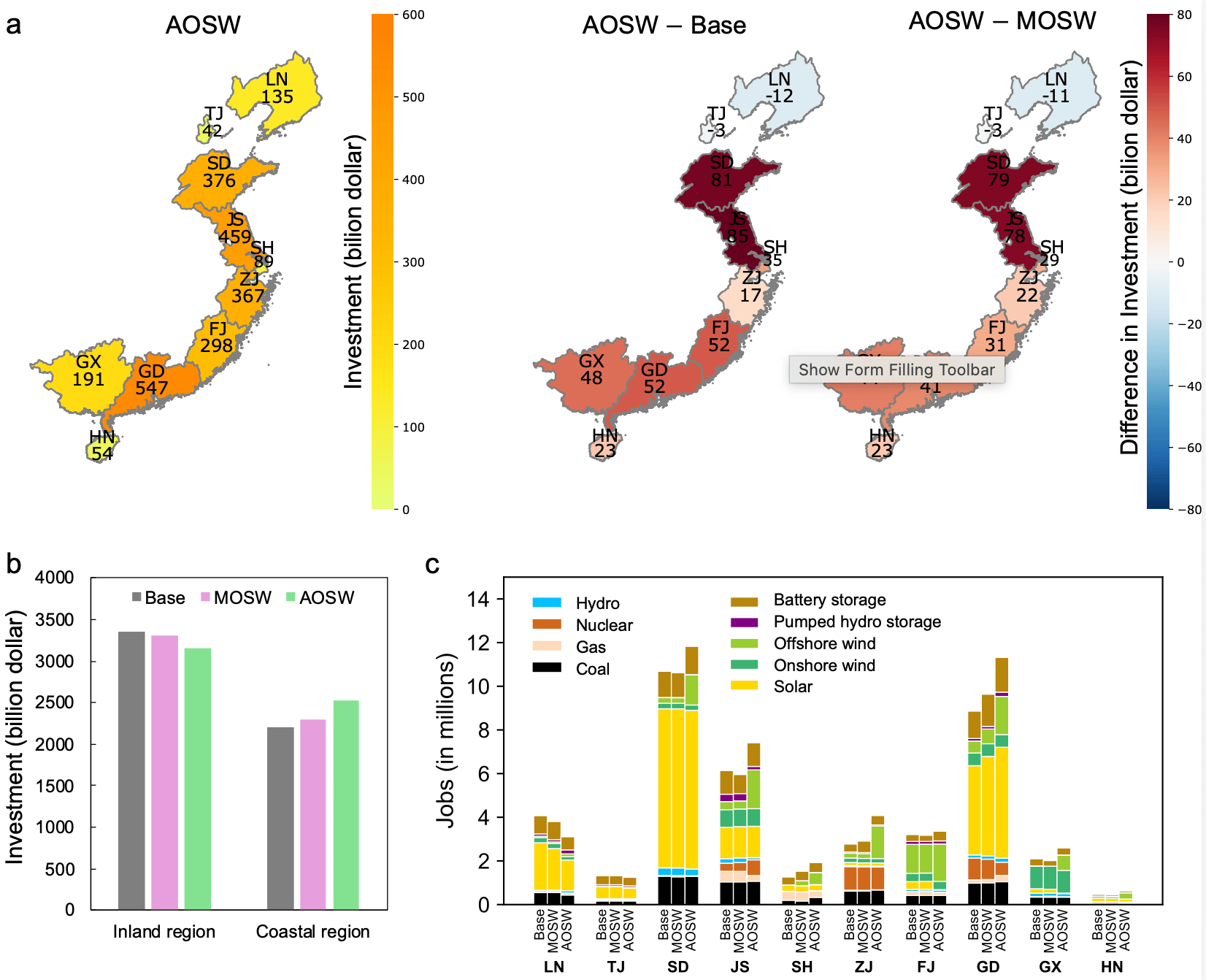
The local economic implications are substantial. In our accelerated scenario, coastal provinces see cumulative investments of about $2.6 trillion in power generation technologies between 2025 and 2050, supporting 48 million jobs over 25 years [3]. Offshore wind stimulates activity in manufacturing, construction, installation, operations, and maintenance. For coastal regions trying to reconcile decarbonization with economic development, that combination matters.
Offshore wind also supports power system reliability in ways that are not always fully appreciated. In our modeling, it makes an important contribution during peak load periods, reduces reliance on storage discharge, and eases pressure on long distance electricity imports. Its system value is broader than commonly assumed.
Honestly, the hardest part of this project was not the modeling. It was learning to communicate the results to audiences who think in very different frameworks: engineers who want precise numbers, economists who want marginal cost curves, policy analysts who want clear recommendations, and provincial officials who want to know what it means for their province specifically. That is why we led with energy self sufficiency rather than carbon emissions and showed provincial results rather than national averages. Offshore wind is not just “the right thing to do.” It is the aligned thing to do, aligned with what local stakeholders are already trying to achieve.
Looking ahead
For us, the clearest message from this work is that offshore wind should not be treated as a marginal option in decarbonizing China’s coastal provinces. It deserves explicit consideration in long term planning for transmission, power sector investment, and regional development, rather than assuming coastal demand will continue to be met through imported electricity or new thermal capacity.
More broadly, this work speaks to a challenge beyond China. Energy transitions are not only about building clean energy, but also about where it is built, who benefits, and whether the transition addresses local concerns. How do we balance speed, cost, and social acceptance in the next phase of the energy transition?
Offshore wind sits at the intersection of technology, geography, planning, and local development. For China’s coastal provinces, it offers a way to decarbonize faster while strengthening energy security and creating new economic opportunities. What began as a practical puzzle about coastal demand and limited local renewables led us to a bigger insight: under the right conditions, offshore wind can help rewrite the future map of the power system.
Acknowledgements
This work would not have been possible without our co-authors Gang He, Nikit Abhyankar, Haozhe Yang, and Umed Paliwal, and the support of the Global Energy Initiative at Climateworks Foundation. We also thank the GridPath development team at Blue Marble Analytics for making such a powerful modeling tool freely available to the research community.
References
[1] Global Wind Energy Council (GWEC). Global Offshore Wind Report 2024. GWEC, 2024. https://www.gwec.net/reports/globaloffshorewindreport
[2] Global Wind Energy Council (GWEC). Global Wind Report 2025. GWEC, 2025. https://www.gwec.net/reports/globalwindreport
[3] Peng, L., He, G., Abhyankar, N., Yang, H., Paliwal, U. & Lin, J. Aligning offshore wind deployment with local priorities to accelerate power system decarbonization. Communications Earth & Environment (2026).
[4] Champenois, F., Myllyvirta, L., Qin, Q. & Zhang, X. China’s New Coal Power Spree Continues as More Provinces Jump on the Bandwagon. Centre for Research on Energy and Clean Air (CREA), 2023. https://energyandcleanair.org/publication/chinas-new-coal-power-spree-continues-as-more-provinces-jump-on-the-bandwagon/

Hi, I am an Assistant Research Scientist at UC Berkeley. My research centers on energy system decarbonization and low-carbon technology deployment, using optimization and data-driven models to evaluate clean energy transitions.



Please sign in or register for FREE
If you are a registered user on Research Communities by Springer Nature, please sign in