When Phylogeny Becomes Taxonomy: Why Morphology—and Taxonomists—Still Matter
Published in Ecology & Evolution, Protocols & Methods, and Plant Science


For much of my academic career, I have worked with organisms in the field, museum specimens, morphological characters and quantitative approaches to classification. During that time, molecular biology has transformed systematics. DNA sequencing, phylogenetics and genomics have given us extraordinary tools for understanding evolutionary history.
I value these developments greatly.
But I have also become increasingly concerned about a different trend: the assumption that molecular evidence is not simply useful, but almost mandatory before a taxonomic study can be considered convincing.
For researchers working with morphology, a familiar question often appears during peer review:
“Where are the molecular data?”
Sometimes this is exactly the right question.
Sometimes it is not.
The distinction matters—not only for individual manuscripts, but for the future of taxonomy itself.
When “molecular” becomes synonymous with “modern”
Traditional taxonomy is sometimes treated as though it were an older form of science waiting to be replaced by molecular methods.
That view seriously underestimates what taxonomists actually do.
A skilled taxonomist does much more than look for visible differences between specimens. Expertise develops through years of examining variation among individuals, populations and related taxa; comparing historical collections and type material; recognizing environmentally induced variation; evaluating which characters are reproducible; and deciding which differences are genuinely useful for diagnosis.
Much of this knowledge cannot be generated automatically from a sequence alignment.
Yet today, a study may contain extensive specimen sampling, carefully documented morphological characters, quantitative morphometrics and rigorous statistical analysis—and still be regarded as incomplete simply because DNA sequences were not included.
If the absence of molecular data itself becomes a reason for rejection, a powerful scientific method has quietly become a methodological gatekeeper.
That deserves discussion.
Phylogeny and taxonomy are related—but they are not the same question
Part of the problem may come from treating phylogenetic inference and taxonomic classification as though they were interchangeable.
They are closely related, but they do not necessarily ask the same question.
Molecular phylogenetics is extremely powerful for investigating historical relationships among lineages. Its conclusions depend on the genes or genomic regions sampled, the organisms included, and the evolutionary models used.
Taxonomy has a somewhat different practical responsibility. It must delimit, diagnose, describe, name and communicate biological units that other researchers can recognize and use.
Morphology contributes directly to that task because it describes the phenotype expressed by organisms—the characters that can often be observed in living individuals, preserved material, historical collections and type specimens.
Neither type of evidence is inherently superior.
More importantly, neither should automatically be expected to provide the same answer.
When two trees disagree
Anyone who has worked in systematics has encountered disagreement between molecular phylogenies and morphology-based groupings.
This is sometimes framed as a problem that must be resolved by deciding which dataset is “correct.”
But disagreement can itself be biologically informative.
Convergent evolution may cause distantly related organisms to resemble one another. Rapid phenotypic differentiation may make close relatives look unexpectedly different. Hybridization, introgression and incomplete lineage sorting can complicate molecular histories. Recently diverged taxa may remain morphologically very similar.
There is another, simpler reason why two trees may disagree:
They may not be describing the same thing.
A morphology-based phenogram or clustering analysis may summarize similarity, differentiation or diagnosability within measured phenotypic space.
A molecular phylogeny attempts to infer historical relationships.
Why should their topologies always be identical?
Perhaps the more useful question is not:
“Which tree is right?”
but:
“What biological information is each tree actually representing?”
Not every tree tells the same story
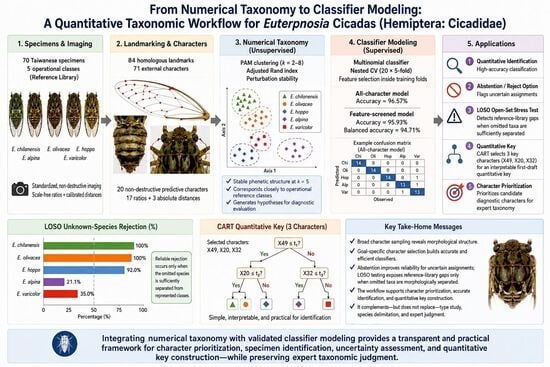
This distinction became particularly clear in our recently published work on Euterpnosia cicadas.
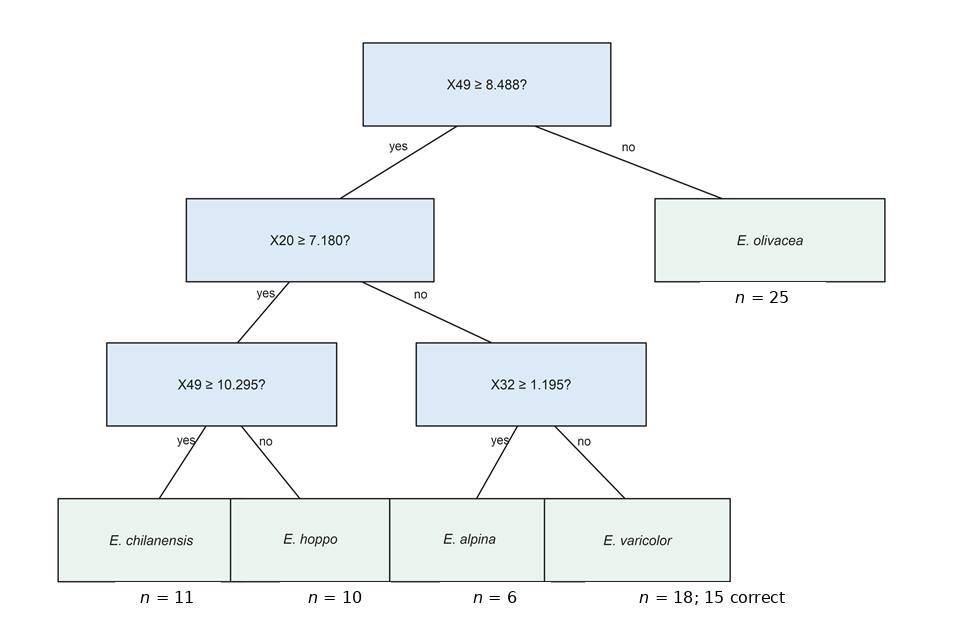
Not every tree is a phylogenetic tree. In our recently published study, this quantitative screening tree uses measurable morphological characters and thresholds to assist identification. Its branches represent diagnostic decision rules—not ancestral relationships.
In that study, my co-author and I deliberately separated several different scientific tasks.
Numerical taxonomy was used to explore morphological structure.
Classifier modelling was used to test whether named reference groups could be identified reliably from quantitative external characters.
A classification tree was used to generate an interpretable first draft of a quantitative identification key.
But none of these outputs was treated as an automatic solution to species delimitation, nomenclature or evolutionary history.
That distinction was intentional.
A classifier can tell us whether reference groups are predictively distinguishable.
A clustering analysis can tell us whether measured morphological structure is stable.
A molecular phylogeny may tell us something about historical relationships.
None of these outputs, by itself, should automatically become “the taxonomy.”
Taxonomic judgment remains an integrative scientific task.
The expertise behind morphology is easy to underestimate
One reason I worry about the declining status of morphology-based taxonomy is that taxonomic expertise is unusually slow to build.
It can take many years to understand the variation within a difficult group.
A specialist may remember hundreds of specimens, historical descriptions, unusual populations, poorly preserved types, local variants and characters that initially appeared diagnostic but later proved unreliable.
That knowledge rarely appears in a spreadsheet.
It is accumulated by repeatedly encountering organisms—in collections and in the field.
For me, taxonomy still begins there: with organisms themselves.
And this is also where the current situation becomes worrying.
If young researchers repeatedly receive the message that morphology-based taxonomy is inherently incomplete unless accompanied by molecular data, why would they invest years developing expertise in morphology, nomenclature, museum collections and organismal variation?
We may eventually face a paradox:
increasingly sophisticated molecular datasets, but fewer people capable of interpreting the organisms from which those sequences were obtained.
Sequences can often be generated again.
A generation of accumulated taxonomic expertise is much harder to replace.
Integrative taxonomy should mean integration—not replacement
None of this is an argument against molecular systematics.
It is an argument against methodological hierarchy.
Integrative taxonomy should not mean:
molecular evidence first, everything else in support.
Instead, it should mean asking what each source of evidence contributes to the biological problem.
Molecular data may be exceptionally powerful for investigating lineage history, population processes and evolutionary relationships.
Morphology remains essential for diagnosis, description, identification, phenotypic differentiation and comparison with historical collections and type material.
Ecology, geography, behaviour, acoustics, cytology and other evidence may contribute still other dimensions.
The strongest taxonomic study is therefore not necessarily the one containing the largest number of methods.
It is the one in which the evidence is appropriate to the question—and the connection between evidence and conclusion is explicit.
Sometimes several independent lines of evidence will converge.
Sometimes they will not.
Both outcomes can be scientifically interesting.
What should reviewers and editors ask instead?
As a reviewer, I think we can improve the discussion by replacing one automatic question:
“Why are there no molecular data?”
with several more informative ones:
Is the sampling adequate for the taxonomic claim?
Are the proposed diagnostic characters reproducible?
Has within-species variation been sufficiently considered?
Can the proposed taxa be independently recognized?
Where quantitative morphology is appropriate, has variation been analysed rigorously?
Are type material and nomenclatural evidence handled appropriately?
And perhaps most importantly:
Would molecular evidence resolve a specific uncertainty that cannot reasonably be resolved using the evidence already available?
If the answer is yes, asking for molecular evidence may be entirely justified.
If the answer is simply that “modern taxonomy should contain DNA,” then perhaps we should reconsider what scientific problem we are actually asking the authors to solve.
A request for additional evidence should arise from a specific weakness in the taxonomic argument—not from a methodological checklist.
We need both histories and organisms
The future of taxonomy should not require a choice between traditional morphology and molecular systematics.
We need both.
We need molecular systematists who can reconstruct evolutionary histories.
We need taxonomists who know organisms, specimens, characters and nomenclature.
And increasingly, we need researchers who understand both traditions well enough to recognize when their results should converge—and when disagreement between them may itself reveal something biologically important.
Perhaps the real goal should therefore not be to make every taxonomic study molecular.
It should be to make every taxonomic conclusion explicit about what evidence supports it, what question that evidence addresses, and what that evidence can—and cannot—tell us.
For fellow taxonomists, molecular systematists, reviewers and editors, I would be very interested to hear your views:
When reviewing a taxonomic manuscript, how do you decide whether molecular evidence is genuinely necessary for a defensible taxonomic conclusion—and when it would simply be valuable additional evidence?

Professor at Fujian Polytechnic Normal University and Reviewing Editor in the Springer Nature Reviewer Programme. My research focuses on plant systematics and taxonomy, biodiversity, seed ecology, and climate change ecology, with particular interests in machine learning and quantitative approaches to biological classification. I use morphometrics, multivariate analysis, species distribution modelling, and statistical modelling to investigate species delimitation, ecological responses, and adaptation. I am particularly interested in rigorous, reproducible and interdisciplinary approaches that connect taxonomy, ecology and quantitative biology.