When Seconds Matter: How Artificial Intelligence is Transforming Orthopaedic Emergencies
Published in Biomedical Research

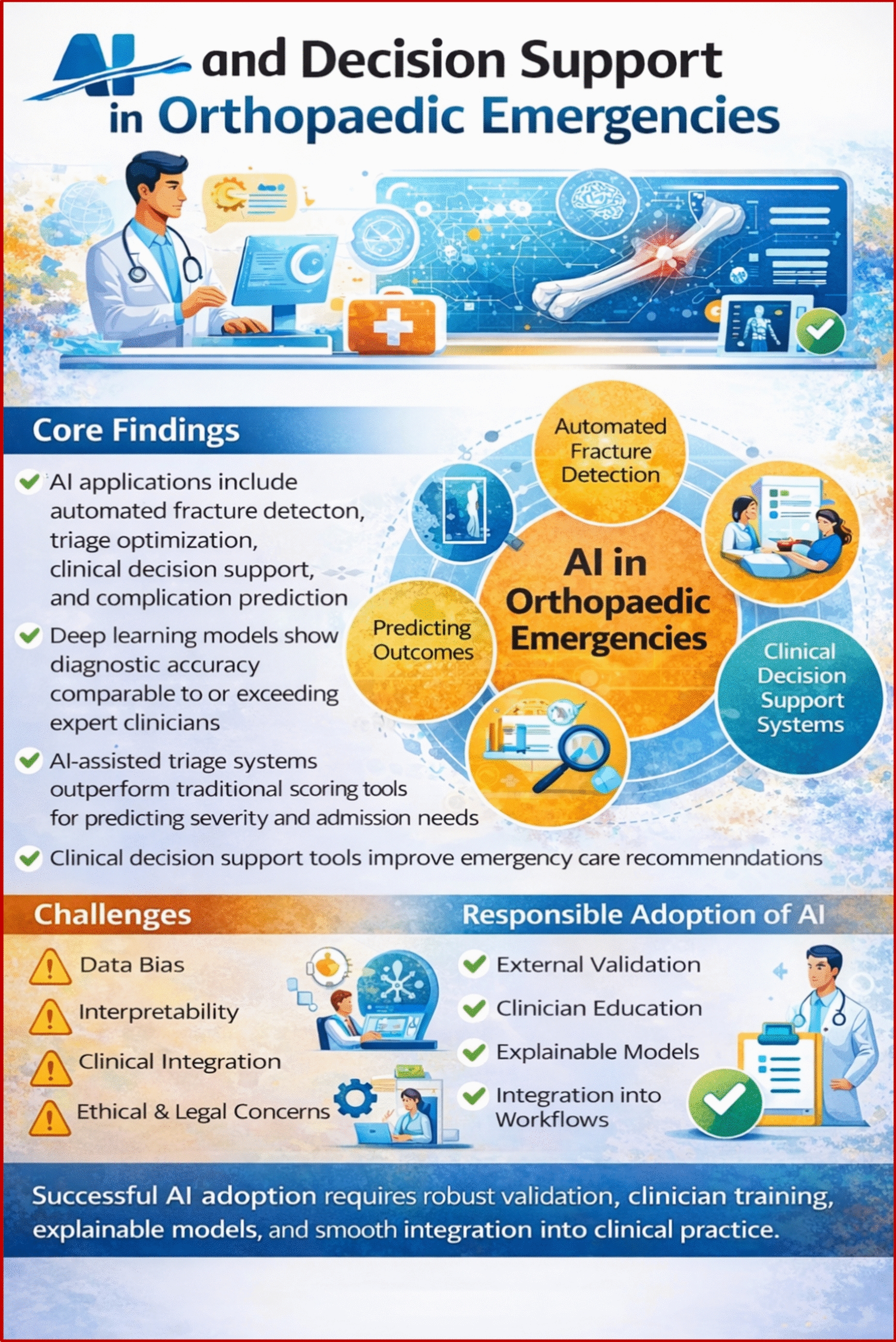

It is late at night in a busy emergency department. A young man arrives after a road traffic accident. He is in pain, frightened, and surrounded by a flurry of activity. Doctors must make quick decisions—Is there a fracture? How severe is it? Does he need surgery immediately?
In such moments, time is not just important—it is everything.
This reality was the starting point for our recent work, “Artificial Intelligence and Decision Support in Orthopaedic Emergencies: A Review”. As orthopaedic surgeons and researchers, we have witnessed firsthand the pressures, uncertainties, and occasional errors that occur in emergency care. We began asking a simple but powerful question:
Can artificial intelligence (AI) help doctors make faster and better decisions when lives and limbs are at stake?
The Problem: Human Limits in High-Pressure Situations
Emergency orthopaedic care is often delivered under challenging conditions—overcrowded hospitals, limited specialists, incomplete patient histories, and the constant pressure to act quickly.
Even experienced clinicians are not immune to error. Studies show that fractures can be missed in up to one in four cases, especially during late-night shifts when fatigue sets in . These missed diagnoses can lead to complications, prolonged suffering, and even legal consequences.
We realized that this is not a problem of competence—it is a problem of human limitation.
And that is where AI enters the story.
What Is AI Doing in Orthopaedic Emergencies?
Artificial intelligence, particularly machine learning and deep learning, excels at recognizing patterns in large datasets. In medicine, this means analyzing images, predicting outcomes, and assisting in decision-making.
Our review explored how AI is already being applied in orthopaedic emergencies:
1. Detecting Fractures Faster and More Accurately
AI systems can analyze X-rays, CT scans, and MRIs to identify fractures—sometimes with accuracy equal to or even better than experienced clinicians .
Think of AI as a second pair of eyes—one that never gets tired, never rushes, and reviews every image with the same level of attention.
2. Helping Decide Who Needs Urgent Care
Not all injuries are equal. Some patients need immediate surgery, while others can wait safely.
AI can analyze patient data—age, injury mechanism, vital signs—and predict:
-
Who needs admission
-
Who may require surgery
-
Who is at risk of complications
This improves triage, ensuring that the most critical patients are treated first .
3. Supporting Doctors in Decision-Making
One of the most exciting roles of AI is as a clinical decision-support tool.
Imagine a junior doctor in a rural hospital faced with a complex fracture. AI can:
-
Suggest treatment options
-
Highlight red flags
-
Recommend whether surgery is needed
Rather than replacing doctors, AI acts as a trusted assistant, helping ensure consistency and adherence to best practices .
4. Predicting the Future of a Patient’s Recovery
AI can also look beyond the present moment. By analyzing large datasets, it can predict:
-
Risk of infection
-
Chances of bone non-union
-
Likelihood of readmission or complications
This allows doctors to intervene early and personalize care .
Why This Matters—Especially in Countries Like India
While AI is advancing globally, its impact could be transformational in resource-limited settings.
In many parts of India:
-
Specialist doctors are not always available
-
Radiology support may be limited
-
Emergency departments are overcrowded
AI can bridge these gaps by providing real-time support, even in smaller hospitals.
For example:
-
A rural doctor could use AI to detect a fracture that might otherwise be missed
-
A busy emergency department could prioritize patients more efficiently
-
Treatment decisions could become more standardized, reducing variability
In essence, AI has the potential to make high-quality care more accessible and equitable.
The Challenges: Why We Must Proceed Carefully
Despite its promise, AI is not without limitations.
⚠️ Data Bias
AI systems are only as good as the data they are trained on. If the data does not represent diverse populations, the results may be inaccurate.
⚠️ “Black Box” Problem
Many AI models do not clearly explain how they arrive at decisions, making clinicians hesitant to trust them.
⚠️ Ethical and Legal Concerns
Who is responsible if an AI system makes an incorrect recommendation? How do we protect patient data?
These questions are critical, and our review emphasizes the need for:
-
Transparent algorithms
-
Strong regulatory frameworks
-
Continued human oversight
A Key Insight: AI Should Not Replace Doctors
One of the most important messages from our work is this:
AI is not here to replace clinicians—it is here to support them.
The best outcomes occur when human expertise and artificial intelligence work together.
Doctors bring:
-
Clinical judgment
-
Experience
-
Empathy
AI brings:
-
Speed
-
consistency
-
data-driven insights
Together, they form a powerful partnership.
The Future: Where Are We Heading?
Looking ahead, the possibilities are exciting.
We envision a future where:
-
AI integrates imaging, patient records, and lab results in real time
-
Emergency decisions are supported instantly by intelligent systems
-
Telemedicine and AI bring expert care to remote areas
-
Wearable devices help detect injuries early
This is not science fiction—it is already beginning to happen.
The Story Behind the Research
This review was born out of years of clinical experience—moments in emergency rooms where decisions had to be made quickly, sometimes with incomplete information.
We have seen:
-
Missed fractures that could have been avoided
-
Delays that affected outcomes
-
Young doctors struggling under pressure
At the same time, we have also witnessed the rapid rise of AI in medicine.
Bringing these two realities together, we felt compelled to explore how AI could meaningfully improve orthopaedic emergency care, particularly in settings like India where the need is greatest.
Final Thoughts
Orthopaedic emergencies are about urgency, precision, and responsibility. Every decision matters.
Artificial intelligence offers an opportunity to:
-
Reduce errors
-
Improve efficiency
-
Support clinicians
-
Enhance patient outcomes
But its success depends on how thoughtfully we implement it.
If we get it right, AI could become one of the most important tools in modern emergency medicine—not as a replacement for doctors, but as a partner in saving lives and limbs.
Reference:
Vaishya R, Saiyed A, Vaish A, et al. Artificial Intelligence and Decision Support in Orthopaedic Emergencies: A Review. Indian Journal of Orthopaedics (2026)
Follow the Topic
-
Indian Journal of Orthopaedics
This is the official publication of the Indian Orthopaedic Association, focusing on clinical orthopaedics and basic research.