When six spare hours changed everything






An unexpected opportunity
All of us have had that moment when we stop and think, "Wait... this doesn't look right." That was me, in 2022.
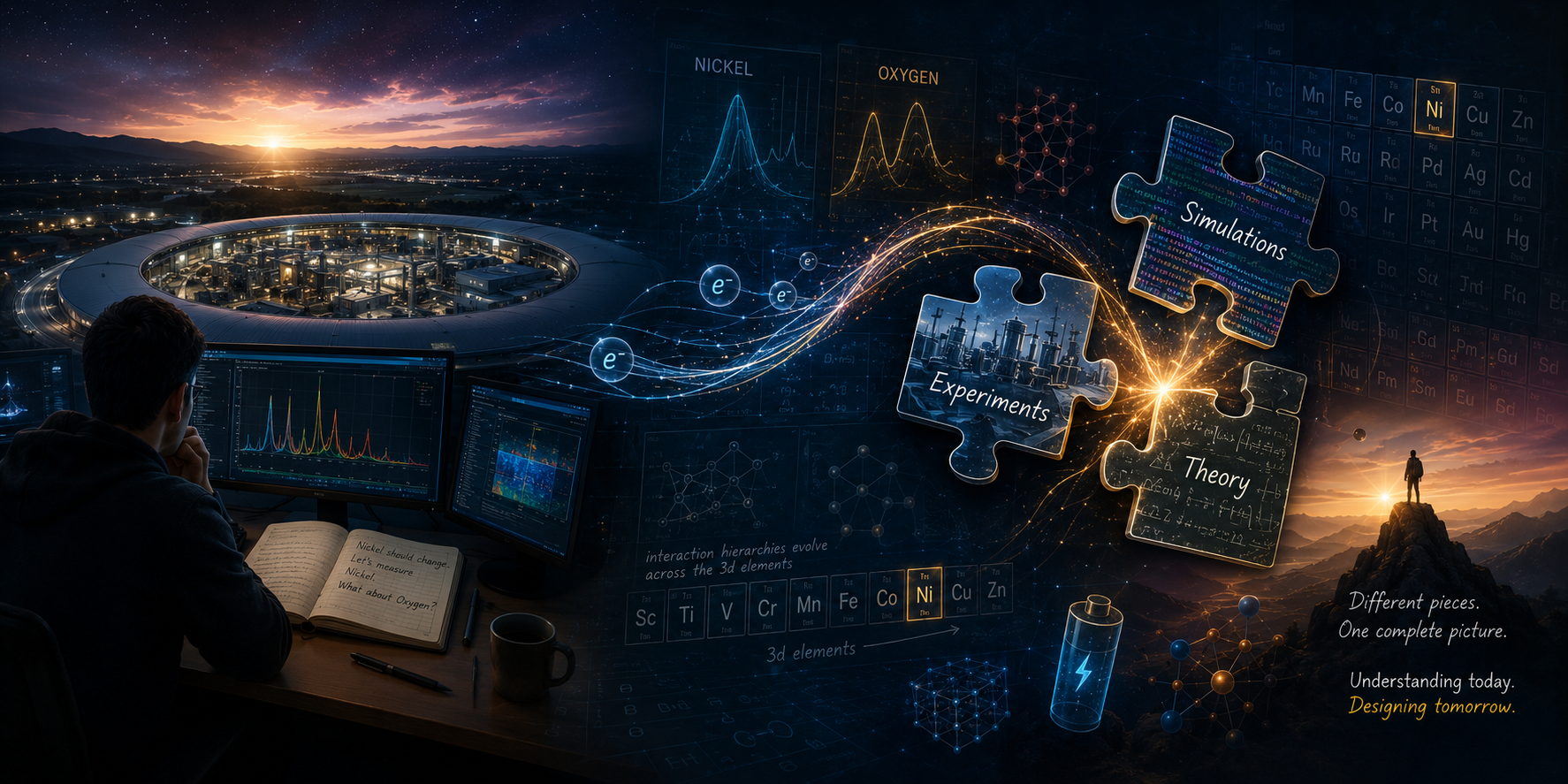
During a night shift at Diamond Light Source, the UK's national synchrotron facility, I was measuring battery materials using an instrument capable of revealing what electrons are doing inside atoms. The experiment was supposed to last all night. Instead, it finished six hours early.
Beamtime at Diamond is precious. Scientists from around the world compete for access because every hour can lead to new discoveries. Letting six hours go unused felt like a waste. So I started thinking about a question that had been sitting in the back of my mind for years.
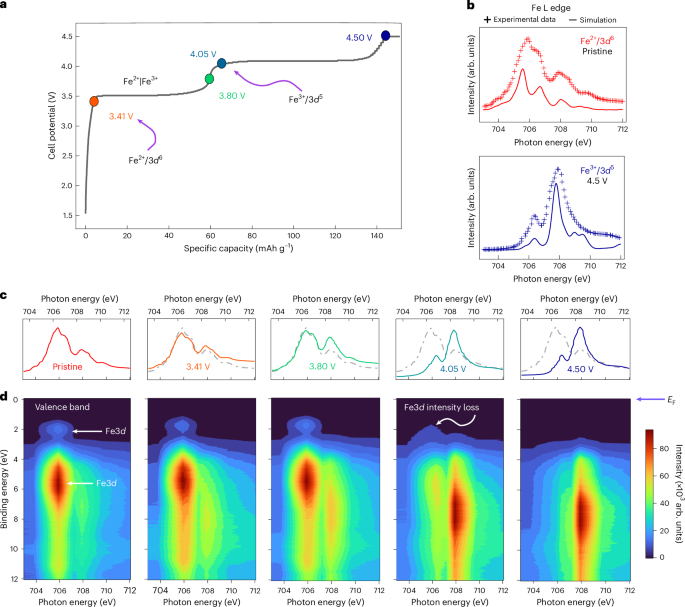
The material I was studying was lithium nickel oxide. According to the simplest picture many of us learn first—the ionic model—nickel should be primarily responsible for the electronic changes that occur when a battery charges and discharges.
So I thought: "Let's directly measure what nickel is doing." The answer seemed obvious before I even started.
Then another thought appeared. "What if the charge of nickel doesn't change during cell charge/discharge? I still have time. Why not measure oxygen as well?"
I collected the data and went back to Warwick. Presentations. Meetings. Other projects. The data sat quietly on my computer for months.
The result that made no sense
When I finally analysed the measurements, I expected to see large electronic changes in nickel. Instead, nickel barely changed at all.
Oxygen, however, was changing everywhere.
I checked the data again. Same result.
I repeated the analysis. Same result.
I left it alone and came back several months later. Still the same result.
At that point, I remember thinking: "This is odd." Then came a more uncomfortable thought. "If this is right, the simplified picture many of us learn first is missing part of the story."
That is not something a scientist says lightly.
At first, I thought I had made a mistake. The observations seemed to contradict the simple picture I had learned from textbooks. Yet the data stubbornly refused to change.
What started as curiosity was rapidly becoming a mystery.
Looking for answers in an unexpected place
The surprising result sent me deep into the literature. I started reading everything I could find. Not only battery research, but also condensed–matter physics, a field dedicated to understanding how electrons and atoms behave inside materials to describe macroscopic and microscopic properties of them.
There I encountered the work of Jan Zaanen, George Sawatzky, and James W. Allen. They have spent decades developing a conceptual framework describing how different electronic and atomic interactions compete to determine the behaviour of electrons inside materials, building on ideas that trace back to the pioneering work of the British physicist Neville Mott. In essence, several types of electronic and atomic interactions could coexist between the 3d elements and ligand atoms that make up a material, and their relative balance could fundamentally change how that material behaves.
Then came the moment when the pieces suddenly clicked together.
As I worked through more literature, I found myself slowly developing a suspicion. The balance between these interactions might itself evolve as the elements forming the materials change.
Then I came across a recent development of the framework proposing exactly that: the balance between these interactions evolves across the 3d family of elements in the periodic table.
I remember feeling a mix of excitement and relief. It was as if someone had put into words what I was beginning to suspect from the data. More importantly, it felt like a signal that I was looking in the right direction.
I remember sitting there thinking: "What if battery scientists were never really disagreeing?" "What if these are simply different expressions of the same underlying physics?"
Maybe the apparently competing explanations for how battery materials store and release energy were not competing at all.
Putting the idea to the test
Ideas are exciting.
Evidence is what matters.
As the project grew, many collaborators contributed experiments, analysis, simulations, and critical discussions that helped refine the emerging picture.
To test the hypothesis, I teamed up with my colleague Daniela. Together we designed a new set of experiments and returned to Diamond in 2024. Daniela led the experimental campaign, expanding it to a broader range of materials and measurements.
The idea was simple. If the framework was correct, different battery materials should display distinct electronic behaviours that follow the evolution of interaction hierarchies across the periodic table.
As the data arrived, something remarkable happened. Daniela and I discussed the results with our colleague Hrishit, who found them fascinating and consistent with ideas he had been developing from a theoretical perspective. He carried out additional simulations to explore the emerging picture. These simulations went beyond the standard one-electron descriptions commonly used in battery research and explicitly considered electron-electron interactions.
His simulations were shaking hands with our experiments. Different simulation approaches I was also running independently were agreeing with each other.
For the first time, everything seemed to be telling the same story. Piece by piece, the puzzle came together.
What initially looked like unrelated behaviour was all following a hidden pattern.
A bigger picture emerges
By the end of 2024, I realised this was much bigger than the question that had started it. We were no longer looking at a single battery phenomenon. We were looking at a framework capable of connecting ideas that had been treated separately for years.
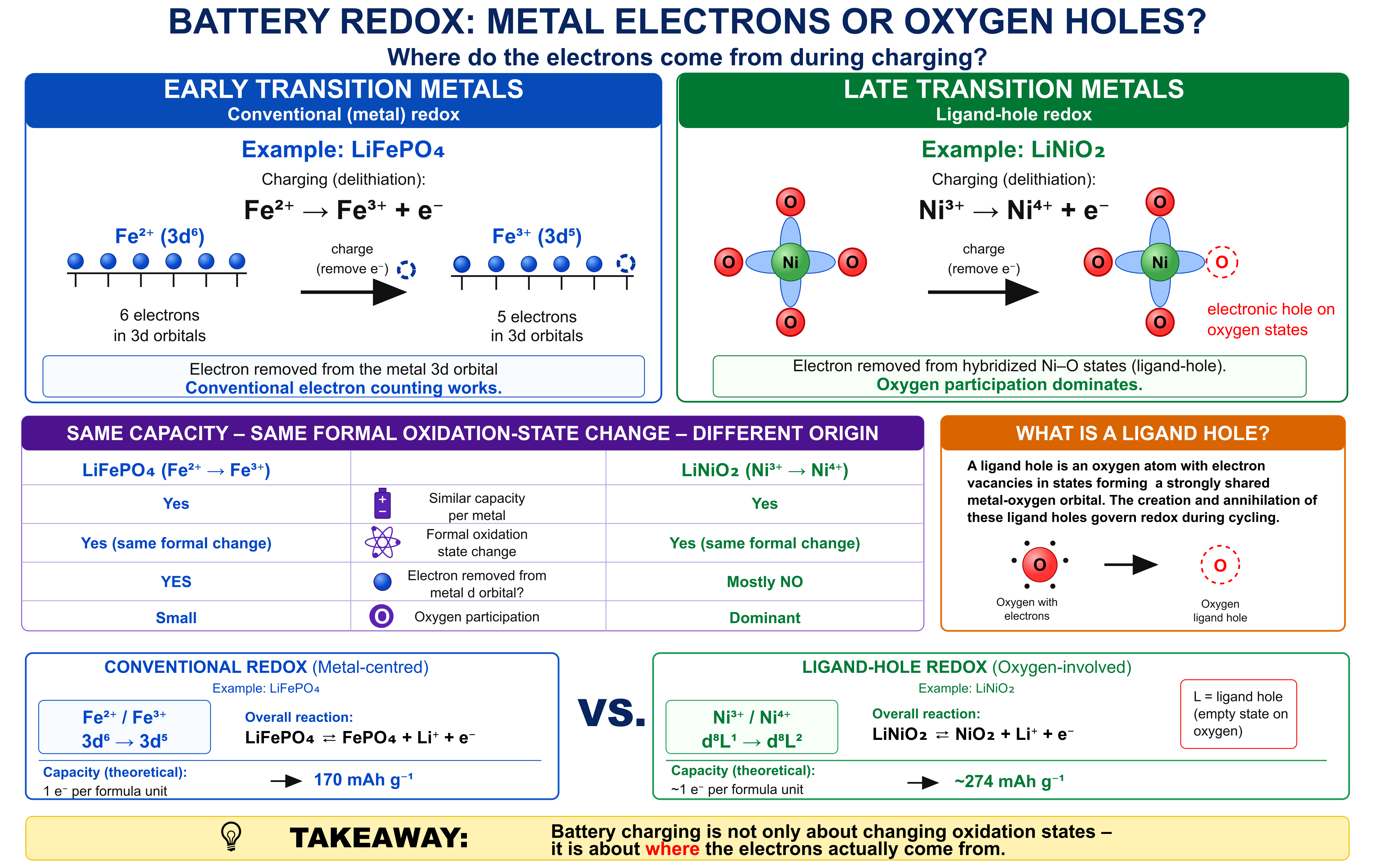
their influence on battery performance.
The electronic mechanisms that scientists had debated for years could be understood within a simple and intuitive framework. The behaviour of different materials was being governed by the evolving balance of fundamental electronic interactions across elements in the periodic table.
What began as a couple of spare hours of beamtime had revealed a deeper set of rules connecting electronic behaviour across an entire family of elements and the materials built from them.
That was the moment I realised this work was much bigger than the question that started it.
The journey was far from over. We submitted the manuscript in May 2025 and, after four rounds of review, it was finally accepted in February 2026. At times the process felt ardous, but every round challenged us to strengthen the evidence, sharpen the arguments, and communicate the ideas more clearly.
Science often moves more slowly than people imagine. Yet that is also one of its strengths. Knowledge grows through questioning, testing, and sharing ideas with others. Unlike many resources, knowledge never runs out. The more we create and share it, the more there is for everyone.
Looking ahead
This doesn’t stop here. For me, the most exciting aspect of this work is not what it explains about today's battery materials, but what it may enable tomorrow.
For decades, materials discovery has often relied on trial and error. Scientists make a material, test it, learn from the result, and try again.
But what if we could do better?
What if understanding how interaction hierarchies evolve across different elements allowed us to anticipate how adding a new element will change a material before we even make it?
If we can predict how elemental substitutions modify the fundamental interactions governing electronic behaviour, we can begin to predict how materials themselves will behave.
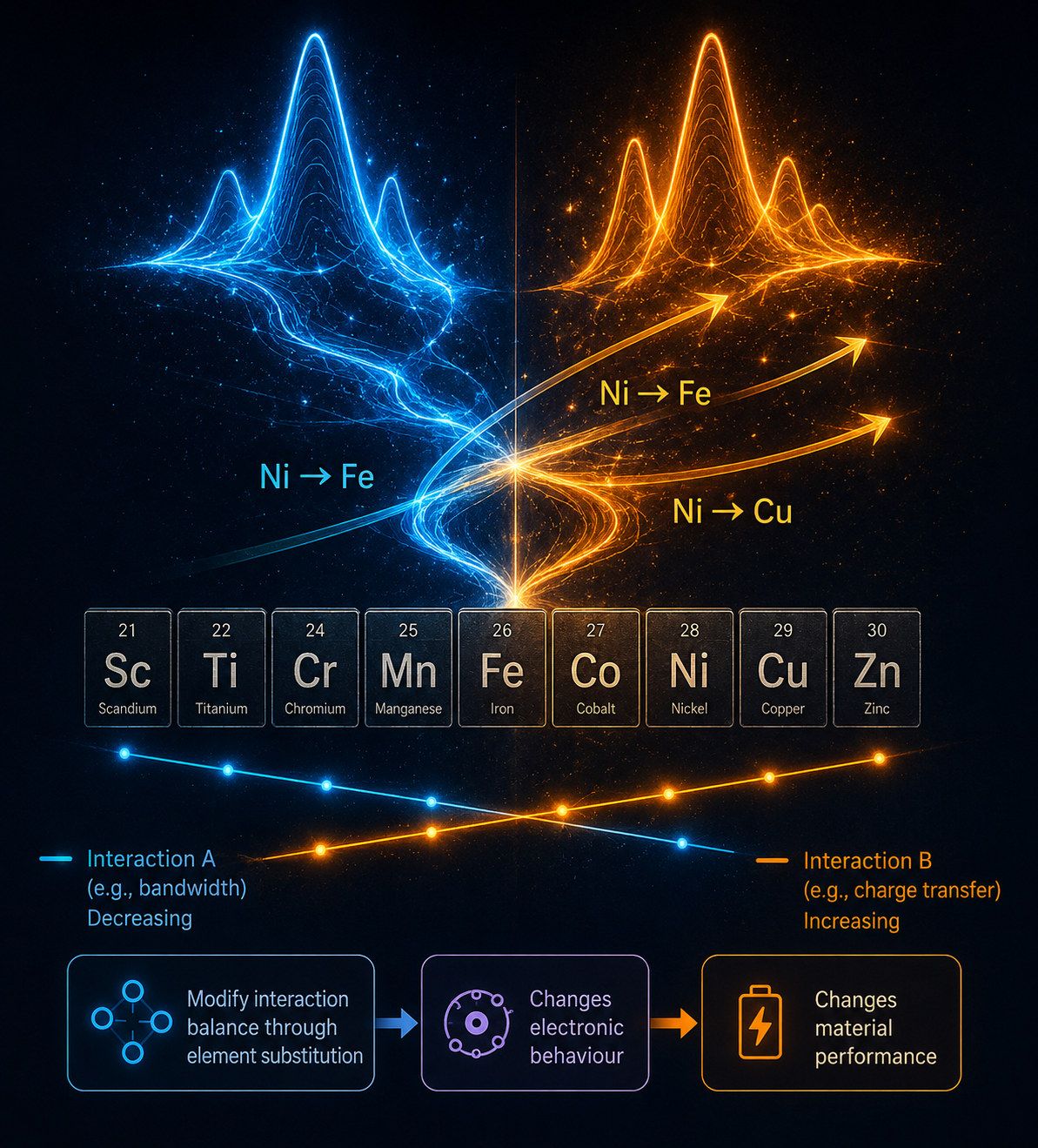
3d elements and, in principle can be modified by elemental substitution
A more rigorous and profound approach based on these new ideas could help us understand how the electronic rules governing materials evolve across the 3d family of elements well enough to deliberately engineer their properties from the start, rather than discover them through trial and error.
That possibility is what excites me most.
Because the future of science is not only about understanding the world. It is about learning how to design it.
Follow the Topic
-
Nature Nanotechnology
An interdisciplinary journal that publishes papers of the highest quality and significance in all areas of nanoscience and nanotechnology.